


| Weight | N/A |
|---|---|
| size | 1L, 2L, 3L, 4L, 5L, 6L, 8L, 10L, 20L, 45L |
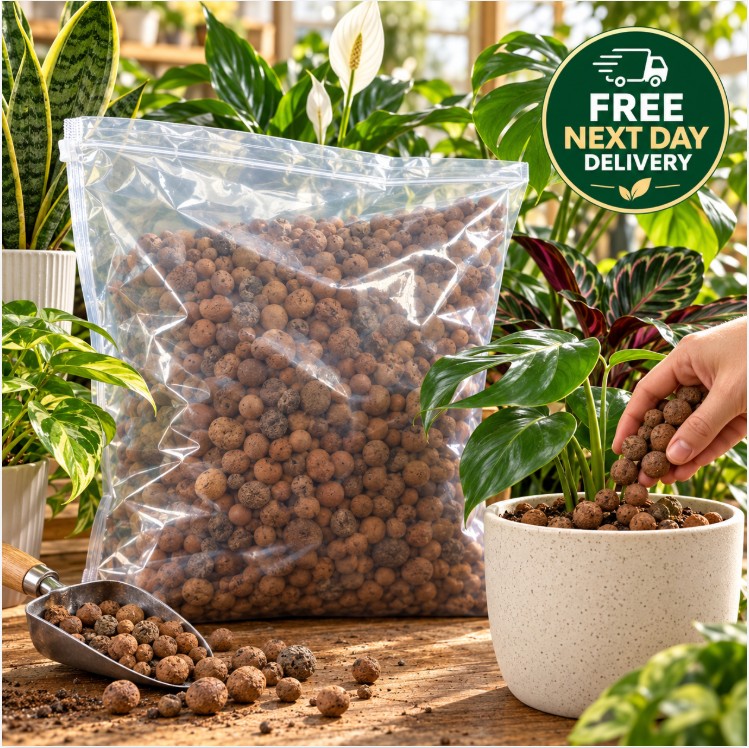
Clay Pebbles 8–16 mm – LECA Expanded Clay Growing Media for Houseplants, Hydroponics, Orchids and Terrariums
Price range: £7.00 through £40.00
Shop clay pebbles 8–16 mm (LECA) for houseplants, hydroponics, orchids and terrariums. Porous expanded clay for root support and potting mixes.
Delivery within 1-3 working days
Delivery In Plain Packaging
Lots in Stock
Description
Grow with a versatile, porous substrate for houseplants, hydroponic vegetables, herbs and carefully managed orchid collections. These 8–16 mm expanded clay pebbles provide physical support around plant roots and an open structure for use in suitable hydroponic and semi-hydroponic growing systems.
Also known as LECA, lightweight expanded clay aggregate, clay balls, clay pellets and hydroponic clay granules, expanded clay is a baked mineral growing medium. It can be used as the main substrate in an appropriate soil-free system, incorporated into selected potting mixes, or used beneath the planting substrate in a terrarium.
The pebbles support the plant while water and nutrients are supplied through the chosen growing system. Their porous structure and the spaces between individual granules help create a root environment with access to moisture and air. The product’s low soluble salt content also makes it suitable for correctly managed recirculating hydroponic systems.
LECA for soil-free growing
In hydroponics, plants receive their essential nutrients from a prepared nutrient solution. Clay pebbles provide the growing structure around the roots; the feeding programme supplies the nutrition.
This gives growers control over watering and feeding, whether maintaining a single indoor plant or operating a larger growing system. Successful growing still depends on suitable light, temperature, oxygen, water quality and nutrient management.
Expanded clay can be used in aggregate-based systems where nutrient solution is delivered by hand or irrigation equipment. Depending on the system, excess solution may drain away or return to a reservoir for reuse.
Clay pebbles for popular houseplants
Many familiar houseplants are grown commercially in hydroculture. LECA can therefore be a useful option when creating an indoor plant collection with suitable plants, containers and watering arrangements.
Examples of plants used in hydroculture include:
Common houseplant name – Botanical name or plant group
Swiss cheese plant – Monstera deliciosa
Monkey Mask / Swiss cheese vine – Monstera adansonii
Heartleaf philodendron – Philodendron hederaceum, also sold as Philodendron scandens
Pothos / devil’s ivy – Epipremnum aureum
Peace lily – Spathiphyllum
Flamingo flower – Anthurium
Chinese evergreen – Aglaonema
Rubber plant – Ficus elastica
Fiddle-leaf fig – Ficus lyrata
Spider plant – Chlorophytum comosum
Snake plant / mother-in-law’s tongue – Dracaena trifasciata, formerly Sansevieria trifasciata
Dragon tree and related foliage plants – Dracaena
Umbrella plant – Plants commonly sold as Schefflera
Kentia palm – Howea forsteriana
Areca palm – Chrysalidocarpus lutescens
Bird of paradise – Strelitzia
These examples are represented in established hydroculture ranges, including plants grown in baked clay granules. The list describes growing possibilities; individual species, cultivars and established root systems still need appropriate care.
Other examples include Alocasia in specialist hydroculture collections and Pachira aquatica, commonly called the money tree, in prepared expanded-clay growing systems. Their inclusion does not mean that every soil-grown specimen can be transferred without an adjustment period.
Plants already established in hydroculture have adapted to that growing environment. A plant transferred from compost needs closer observation while it adjusts. Switching growing media can be difficult, and clay pebbles alone do not prevent root rot. Choose the watering method for the particular plant and container.
Semi-hydroponics and self-watering houseplant displays
Semi-hydroponic growing commonly combines a mineral substrate with a controlled water reservoir. Depending on the design, the system may use an inner growing pot, an outer container and a water-level indicator.
Clay granules provide a stable structure around the roots and can absorb moisture from the reservoir. A water-level indicator helps the grower manage the supply without repeatedly lifting the plant out of its container.
This approach can suit individual houseplants and larger interior planting displays. Follow the specific system’s reservoir levels and replenishment instructions, because the correct water level depends on the container and the plant. Filling every pot to the same depth or watering every plant on the same calendar can give very different results.
Clay pebbles for orchids
Expanded clay is also used in orchid cultivation, either as a growing-medium component or within a suitable specialist growing method. Orchid media need to match the plant’s roots, moisture requirements and growing conditions.
Phalaenopsis, or moth orchids, are one example: some growers successfully cultivate them in LECA using a semi-hydroponic container with a small reservoir. This requires a suitable setup and careful moisture management.
Orchid roots still need oxygen, and prolonged wet conditions can cause problems. When changing an established orchid’s growing medium, consider its existing root condition, the container and the watering routine together. LECA should be selected as part of an orchid-growing method rather than treated as a direct replacement with identical care requirements.
Hydroponic vegetables, salad crops and herbs
Clay pebbles can support a wide range of food-growing projects when used in a suitable hydroponic system. They are particularly useful where the growing method calls for a coarse aggregate around the roots.
Examples of crops grown in media-based hydroponic systems include:
Fruiting vegetables: tomatoes, cucumbers and peppers.
Kitchen herbs: basil, mint and coriander.
Leafy crops: spinach, Swiss chard and rocket.
These plants have different growing habits and feeding requirements. Large fruiting crops need sufficient growing space and support, while herb and salad systems can be designed around smaller plants and more frequent harvesting. Select the growing system and nutrient programme for the crop being cultivated.
Expanded clay is also used in systems such as Dutch buckets, where an aggregate supports plants receiving nutrient solution through irrigation. For young plants, an appropriate propagation plug can support the early root system before transfer into the larger growing container.
Flowering plants and seasonal growing
Hydroponic growing is also used for ornamental flowers. In suitable ebb-and-flow systems, examples include marigolds, petunias, zinnias and pansies.
Expanded clay pellets are among the media used in this type of system. Nutrient solution periodically enters the growing area and then drains back, allowing air to return around the roots between cycles. Irrigation timing must suit the plants and conditions.
Suitable growing-system applications
The role of clay pebbles changes with the equipment being used:
Growing method – Role of the clay pebbles
Flood-and-drain / ebb-and-flow – Support roots while nutrient solution periodically floods and drains from the growing area.
Drip irrigation – Provide a root-supporting aggregate while nutrient solution is delivered from above.
Hand-watered hydroponic pots – Hold the plant in a porous substrate supplied with an appropriate nutrient solution.
Recirculating hydroponics – Form part of a system in which drained nutrient solution returns to a reservoir.
Run-to-waste hydroponics – Support roots where drainage leaves the growing container instead of returning to the feed reservoir.
Choose containers and irrigation equipment designed for an aggregate substrate. Watering frequency depends on the crop, container size, growth stage and environment.
Aquaponic grow beds
Expanded clay balls are also used in aquaponic plant grow beds. Aquaponics combines plant production with an aquatic system, using biological processes to make nutrients available to the plants.
In this application, the clay provides a growing structure within a properly designed bed. Successful operation depends on the balance between plants, aquatic life, filtration, circulation and oxygen supply.
Choose the bed design and water-management method for the complete aquaponic system. This use concerns the planted growing area; it should not be confused with a claim that the product has been tested for every aquarium or aquatic animal application.
Potting mixes, compost structure and aeration
Clay pebbles can be incorporated into selected houseplant growing mixes to introduce a coarse component and help loosen the structure.
The finished mix must still provide an appropriate balance of moisture retention, aeration and root support. The amount of expanded clay to use depends on the other ingredients and the plant’s requirements.
The 8–16 mm grade is relatively coarse, so consider the size of the container and root system when choosing how to use it. Small pots and delicate roots may need a different combination of ingredients from a large established plant.
Terrariums, bottle gardens and miniature plant displays
Clay pebbles can form a basal layer beneath the planting substrate in a terrarium or bottle garden.
In this arrangement, plants generally grow in a suitable compost or terrarium substrate above the clay layer. Examples of plants used in humid terrarium displays include:
Fittonia, commonly called nerve plants.
Peperomia.
Hypoestes, or polka dot plants.
Suitable Pilea species.
Small ferns.
Selaginella.
Mosses suited to the display conditions.
Match the plants to the enclosure’s humidity, light and available space. A closed terrarium and an open display have different moisture requirements, and both need careful watering.
A consistent finish for hydroculture planters
Clay granules can also be used around an established hydroculture growing pot and across the visible surface of the planting.
This helps create a consistent appearance within a decorative container while keeping the growing arrangement accessible for maintenance. Position any water-level indicator so that it remains easy to read, and follow the planting system’s instructions when filling around the inner pot.
Contains
Expanded clay pebbles / LECA growing medium, nominal grade 8–16 mm.
Please refer to the selected listing option for the supplied volume or pack size. (1L, 2L, 3L, 4L, 5L, 6L, 8L, 10L, 20L, 45L)
The stated size describes the particle grade. Expanded clay is supplied as individual granules with variation in shape and dimensions.
How to use
1. Choose the application before planting
Decide whether the pebbles will be used as the main growing medium, as part of a potting mix, or as a layer beneath a terrarium substrate.
Select a container and watering arrangement suited to that application. A reservoir-based houseplant pot, a drip-fed hydroponic container and a terrarium each manage water differently.
For houseplants, establish whether the plant has already been grown in hydroculture or will be moved from compost. That difference affects the preparation and level of monitoring needed during establishment.
2. Rinse before use
Rinse the pebbles thoroughly to remove loose dust and small particles.
This is particularly useful before filling a hydroponic system, where loose material could enter irrigation equipment. The supplied product label advises rinsing with clean water adjusted to pH 5.5.
That figure relates to the product’s preparation instructions. Set the operating nutrient solution according to the plant, feed and growing system being used.
3. Plant in a suitable container
For an established hydroculture plant, use the appropriate growing pot and reservoir arrangement. Position the plant and add prepared clay granules according to the container manufacturer’s instructions.
Where a water-level indicator is part of the system, keep it correctly positioned and visible. Fill to the level specified for that system and follow its guidance for allowing the reservoir to fall before replenishing.
Avoid burying the display’s indicator beneath a decorative surface layer. Easy access to the reservoir and indicator makes routine care simpler.
4. Manage transfers from compost carefully
Moving a soil-grown plant into LECA changes the conditions around its roots. Check guidance for the particular plant and conversion method before beginning.
Observe the plant during establishment and adjust care to its response. A plant that has just been transferred should not automatically be given the same routine as a mature specimen already established in hydroculture.
LECA growing requires attention to watering, nutrition and root health. Coarse-rooted plants can be easier to accommodate in a coarse aggregate than plants with very fine root systems.
5. Supply appropriate plant nutrients
For plants growing directly in clay pebbles, use a nutrient product suitable for the chosen hydroponic or hydroculture method.
Follow its instructions for dilution, crop type and growth stage. Adjust feeding as the plant develops and as growing conditions change.
In managed hydroponic systems, monitor pH, which affects nutrient availability, and electrical conductivity, or EC, which indicates the concentration of dissolved salts. Different crops need different nutrient conditions, so use crop-specific guidance rather than one setting for every plant.
6. Set watering to suit the plants
Adjust watering to the size of the plant, growing container, light, temperature and growth stage.
For active hydroponic systems, follow the equipment instructions for irrigation and drainage. Ensure that the intended water flow reaches the growing area and that drainage can leave the container as designed.
For semi-hydroponic houseplants, manage the reservoir according to the container and plant requirements. For orchids, use guidance appropriate to both the orchid and the chosen growing method.
7. Use suitable support for young plants
Young seedlings often begin in a propagation medium or plug that supports their small root systems. They can then be transferred into a suitable larger system as they develop.
Expanded clay has relatively limited water-holding capacity compared with some other hydroponic substrates, so pay attention to moisture delivery during establishment. Keep the irrigation arrangement appropriate for the young roots.
8. Incorporate into potting mixes thoughtfully
When using clay pebbles as a growing-mix ingredient, select the other components and proportions for the plant.
Check how the resulting mix behaves after watering and adjust the care routine accordingly. Changing the proportion of coarse material changes the growing environment, so a previous watering schedule may need revision.
9. Build terrariums with separate functional layers
For a terrarium, arrange the clay layer beneath a suitable planting substrate and establish the plants in the upper growing layer.
Water sparingly and observe how moisture behaves inside the enclosure. Position the finished display in lighting appropriate to its plants, and avoid allowing excess water to accumulate around the planting substrate.
10. Maintain the growing system
Inspect plants, reservoirs and irrigation equipment regularly. Remove loose debris and follow the system’s maintenance guidance.
Refresh nutrient solution and manage salt accumulation according to the feeding programme and growing method. Repeatedly topping up a reservoir without appropriate maintenance can change its nutrient balance.
Expanded clay can be reused when its condition and cleanliness allow. Prepare used media appropriately before another planting cycle, paying attention to remaining roots and debris.
Store unused pebbles in a dry place, keep the packaging closed where practical, and wash hands after handling.
Add a review
You must be logged in to post a review
Log In
Q & A
Ask a question
There are no questions yet


Reviews
There are no reviews yet