
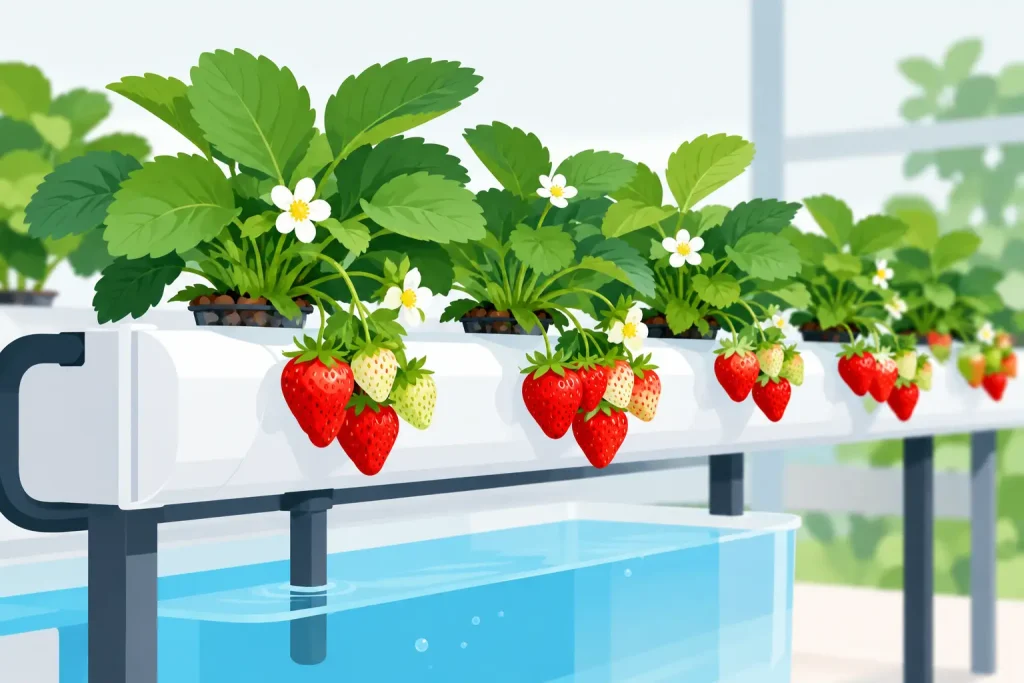
Strawberries are less forgiving than leafy greens, but that is exactly why a well-managed system pays off. Hydroponics for strawberries gives you cleaner fruit, fewer soil-borne problems and far better control over water, feed and harvest timing. It also exposes weak irrigation design, poor climate control and missed pollination very quickly.
The aim is not simply to keep plants alive. A productive indoor crop needs a healthy root zone, enough light to support flowering, even moisture around the crown and reliable pollination. Get those areas right and strawberries can produce consistently from a compact growing area.
Choosing a hydroponic system for strawberries
Strawberries have relatively shallow roots, but their crowns must remain dry. The crown is the point where leaves, runners and flower stems emerge. If it sits in constantly wet media or nutrient solution, crown rot becomes a real risk.
For most indoor growers, drip-fed coco coir in pots, slabs or troughs is the most practical starting point. It gives each plant a generous root zone, allows accurate feed control and makes it easier to replace individual plants if one develops disease. Run-to-waste also avoids recirculating pathogens through the whole crop, although it uses more nutrient solution and requires sensible runoff management.
NFT channels and gullies can work well where the plant crown is held above the channel and roots receive a shallow, moving film of solution. They make efficient use of space and keep fruit off the floor, but roots can dry out quickly if a pump fails. Channel gradients, flow rate and filtration need to be right from day one.
Deep water culture is possible, but it is rarely the easiest choice for strawberries. Plants need excellent aeration, stable water temperatures and carefully supported crowns. A single root disease issue can spread across a shared reservoir. For a small fruiting crop, a drip system is usually easier to monitor and troubleshoot.
Vertical towers look productive on paper but need a realistic lighting plan. The upper sites often shade the lower plants, and irrigation can become uneven. Use vertical systems only where you can provide uniform light and reach every plant for pruning, pollination and picking.
Start with the right plant material
Day-neutral or everbearing varieties are generally the most useful option indoors because they are less dependent on seasonal day length. They can flower and fruit repeatedly under a controlled photoperiod. June-bearing varieties can produce excellent fruit, but their cropping pattern is more seasonal and their establishment requirements are less convenient for a continuous indoor harvest.
Bare-root or frigo plants are a common choice. Rehydrate roots before planting, spread them naturally through the media and keep the crown level with, or just above, the surface. Do not bury it. Freshly planted crowns should be given time to establish roots before being pushed hard with high light and a strong feed.
Light levels that support fruit, not just foliage
A strawberry plant can look healthy under modest lighting while still failing to set enough flowers or fill fruit properly. Fruiting requires more energy than leaf production, so lighting should be designed around the crop rather than the available fitting.
For most indoor setups, a canopy PPFD of roughly 250-400 µmol/m²/s is a workable target, depending on cultivar, temperature and CO2 level. Run lights for 14-16 hours a day. Lower intensity can work, but harvests will be lighter and plants may stretch. Excessive intensity without matching temperature, nutrition and irrigation can lead to leaf stress and uneven fruit development.
LED fixtures are usually the sensible choice for strawberry tents, racks and small rooms because they offer good efficiency and manageable heat output. Even coverage matters more than a very high reading directly beneath the centre of the fixture. Check the edges of the crop as well as the centre, then adjust hanging height, fixture spacing or plant layout accordingly.
Keep the canopy open. Remove old, damaged leaves and unnecessary runners so light reaches developing flowers and airflow can move through the plants. Do not strip plants aggressively. Each healthy leaf is contributing energy to the next flush of fruit.
Nutrient management and irrigation
Strawberries prefer a mildly acidic root zone. A pH of around 5.5-6.2 is a sound working range for hydroponic production. Letting pH drift slightly within that range can help maintain nutrient availability, but sharp swings usually point to a reservoir, water-quality or feeding issue that needs attention.
A starting EC of around 1.2-1.5 is often suitable while plants establish. Once flowering and fruiting are underway, many growers operate closer to 1.5-1.8 EC. The correct level depends on cultivar, water hardness, climate, light intensity and how often plants are irrigated. More feed is not automatically more fruit. Excess EC can restrict water uptake, burn leaf margins and reduce fruit quality.
Use a complete hydroponic base nutrient formulated for fruiting plants, then make changes only when there is a reason. Calcium, potassium and magnesium demand rises as the crop matures, but adding separate bottles without checking the overall EC can unbalance the feed. Measure pH and EC regularly, and keep notes on reservoir changes, runoff and plant response.
In coco, use short, frequent irrigation events once plants are actively growing. The aim is to maintain an evenly moist root zone with enough air exchange, not to leave pots saturated all day. Frequency should increase as light, temperature and root mass increase. Early in the crop, fewer events are required. During a warm, bright fruiting period, plants may need several smaller feeds across the light cycle.
Water temperature matters in recirculating systems. Warm nutrient solution holds less dissolved oxygen and encourages root pathogens. Keep reservoirs clean, covered from light and suitably aerated. Fit a filter ahead of fine drippers, especially when using organic additives or products that can leave residue in irrigation lines.
Climate control and pollination are not optional
The best feed programme will not compensate for stagnant, humid air. Strawberries generally perform well with daytime temperatures around 18-24°C and cooler nights. Prolonged high temperatures can reduce pollen viability, soften fruit and increase pest pressure. Very low temperatures slow development and delay cropping.
Aim for steady humidity rather than chasing a single number. Around 60-75% relative humidity is often workable during growth and flowering, provided air movement is good. When dense foliage and ripening fruit raise the risk of botrytis, reduce humidity and improve extraction. A properly sized extraction fan, circulation fans and a dehumidifier are often more valuable than another nutrient additive.
Flowers must be pollinated to form evenly shaped berries. In a small indoor grow, gentle daily vibration is normally enough. Tap flower trusses lightly, use an electric pollinator or direct a soft airflow across open blooms. Do this when flowers are fully open, preferably during the light period when conditions are dry. Poor pollination produces small, misshapen fruit with undeveloped sections.
Do not blast plants with a powerful fan. You want flower movement, not wind damage. Position circulation fans so they move air around and beneath the canopy while avoiding a constant direct stream at the same leaves.
Crop maintenance and common problems
Remove runners unless you are deliberately propagating new plants. Runners consume energy that would otherwise support flowers and fruit. Remove old leaves that touch the media or restrict airflow, and pick ripe berries promptly. Overripe fruit left in the canopy is an easy starting point for mould.
Watch for two-spotted spider mite, thrips, aphids and fungus gnats. Inspect leaf undersides and growing points each week, not only when damage is visible. Sticky traps help monitor flying pests, while clean floors, covered reservoirs and prompt removal of dead plant material reduce the places pests and disease can establish.
If leaves are dark, lush and the crop is producing few flowers, the plants may be receiving too much nitrogen, not enough light, or temperatures may be too high. If fruit is small despite plenty of flowers, check pollination first, then light intensity, root-zone EC and irrigation consistency. If crowns soften or leaves suddenly wilt while media remains wet, inspect roots and reduce saturation immediately.
When to renew the crop
Strawberry plants do not maintain peak production forever. After repeated fruiting cycles, plants can become woody, less vigorous and more vulnerable to pests and disease. For a dependable indoor setup, stagger new plants into the system rather than waiting for every established plant to decline at once. This keeps harvests moving while giving you a clean point to inspect, sanitise and reset part of the growing area.
A strawberry crop rewards routine more than constant intervention. Build the system so you can check roots, emitters, reservoir readings, flowers and airflow quickly each day. When those checks become part of the workflow, the crop is far easier to keep productive.






