
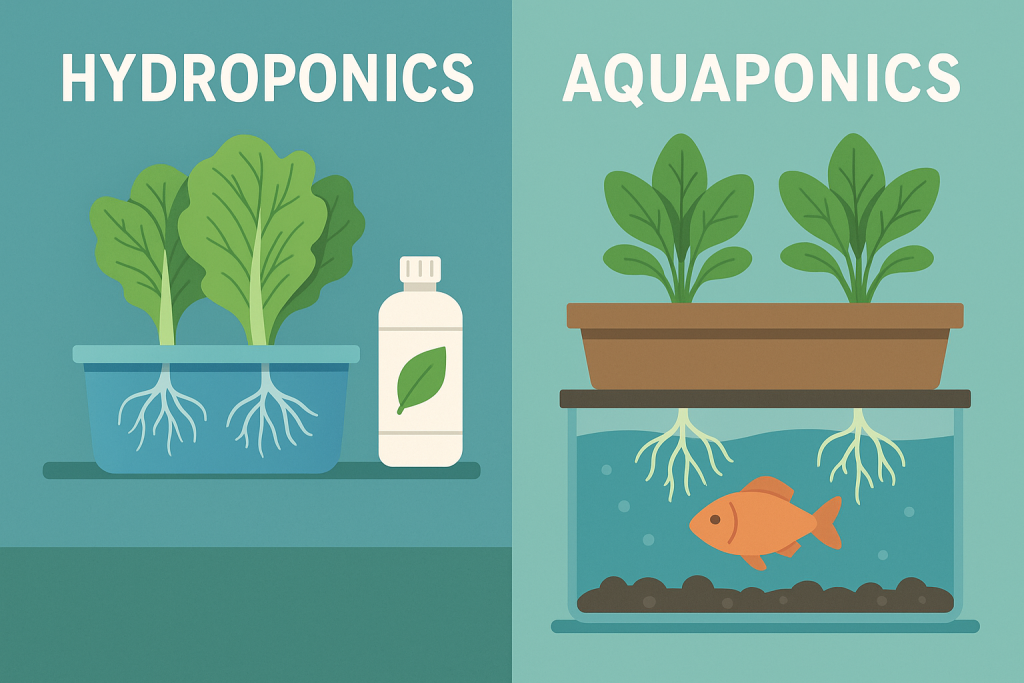
Introduction
In recent years, the demand for sustainable, high-yield farming methods has surged among both home gardeners and commercial farmers. Two of the most popular soil-free systems—hydroponics and aquaponics—have been making waves for their efficiency, versatility, and eco-friendly potential.
While both systems grow plants without soil, they differ significantly in how they deliver nutrients, manage water, and fit into a grower’s goals. This guide will explain each system in detail, compare their strengths and weaknesses, and help you decide which one is the right choice for your situation.
What Is Hydroponics?
Hydroponics is the science of growing plants in a nutrient-rich water solution without soil. Instead of relying on natural soil to deliver nutrients, growers use specially formulated nutrient solutions to feed plants directly through their roots.
Key features of hydroponics:
- Uses inert growing media like rockwool, clay pebbles, or coco coir
- Nutrients are delivered through water in precise amounts
- Systems can be indoor or outdoor
- Ideal for growing leafy greens, herbs, tomatoes, strawberries, and more
What Is Aquaponics?
Aquaponics is a hybrid farming method that combines hydroponics with aquaculture (raising fish). The fish produce waste, which is converted by beneficial bacteria into nutrients for the plants. In turn, the plants help filter and clean the water before it returns to the fish tank.
Key features of aquaponics:
- Uses live fish as the nutrient source
- Creates a self-sustaining ecosystem
- Can be highly sustainable with minimal waste
- Produces both plants and fish as food
Key Differences Between Hydroponics and Aquaponics
| Feature | Hydroponics | Aquaponics |
|---|---|---|
| Nutrient Source | Artificial nutrient solution | Fish waste converted by bacteria |
| Maintenance | Monitor pH, EC, nutrient mix | Monitor fish health, bacteria balance, pH, temperature |
| Yield Speed | Often faster growth | Slightly slower due to biological processes |
| Sustainability | Conserves water but relies on purchased nutrients | Highly sustainable, recycles nutrients naturally |
| Setup Cost | Can be lower for small systems | Usually higher due to fish tanks & filtration |
| Produce Types | Leafy greens, fruits, herbs | Leafy greens, herbs, plus edible fish |
Pros and Cons of Hydroponics
Pros:
- Faster plant growth due to controlled nutrient delivery
- Can be set up in small spaces, indoors or outdoors
- Easier for beginners compared to aquaponics
- Predictable results and easier scalability
Cons:
- Requires ongoing purchase of nutrient solutions
- Less “organic” appeal compared to aquaponics
- No secondary yield (e.g., fish)
Pros and Cons of Aquaponics
Pros:
- Produces both plants and fish
- Very eco-friendly with minimal waste
- Nutrients are natural and organic
- Creates a balanced ecosystem
Cons:
- More complex to manage (fish care, bacteria health)
- Higher initial setup cost
- Learning curve is steeper for beginners
Cost, Maintenance & Learning Curve
Cost:
- Hydroponics can be more affordable for small projects.
- Aquaponics has higher upfront costs but can be cheaper long-term if you produce your own fish food and manage the system well.
Maintenance:
- Hydroponics focuses on nutrient and water monitoring.
- Aquaponics requires attention to plant needs, fish health, and water quality.
Learning Curve:
- Hydroponics is straightforward for beginners.
- Aquaponics demands a deeper understanding of biology and ecosystem balance.
Which Is Better for Home Gardeners?
If your goal is fresh vegetables, herbs, and small fruits with minimal fuss, hydroponics is often the better starting point. It’s easier to manage, takes up less space, and provides quick results.
However, if you love the idea of sustainable food production and don’t mind caring for fish, aquaponics can be a rewarding long-term hobby that produces both plants and protein.
Which Is Better for Commercial Farmers?
For large-scale, high-yield operations that need predictability, hydroponics offers more control and scalability. You can fine-tune nutrient delivery for consistent results, making it easier to meet market demands.
Aquaponics can work well for niche markets focused on sustainability and local organic food, especially in areas where “farm-to-table” branding is valuable. It may also offer higher profit margins when selling both vegetables and fish.
How to Choose Between Hydroponics and Aquaponics
Ask yourself:
- Do I want to produce only plants, or plants and fish?
- Am I comfortable managing a living ecosystem with fish?
- Is my main goal speed and simplicity, or sustainability and diversity?
- How much space and budget do I have?
Your answers will help guide you toward the right choice.
10-Year-Old-Friendly Summary
Imagine you have two magic gardens that don’t need dirt:
- In hydroponics, you give the plants a yummy drink full of vitamins (nutrients), and they grow super fast.
- In aquaponics, you keep fish as pets, and their poop becomes plant food (thanks to helpful bacteria). The plants clean the water, and the fish stay happy.
Hydroponics is like feeding your plants from a bottle.
Aquaponics is like having plants and fish help each other out.
Conclusion
Both hydroponics and aquaponics are powerful ways to grow fresh, healthy food without soil. Hydroponics offers speed, control, and ease—perfect for beginners or those aiming for maximum yield. Aquaponics creates a sustainable, eco-friendly loop that can produce both plants and fish but requires more care and patience.
Whether you’re a home gardener looking for a fun new project or a commercial farmer planning your next investment, there’s a system that can fit your needs and goals.
Recommended Products from Hydroponic Centre
- Bluelab pH Controller Wifi — A smart device that automatically monitors and maintains optimal pH levels in your nutrient or aquaponic system via Wi‑Fi. Great for keeping your plants healthy with minimal manual intervention.
- Bluelab Combo Meter — An all-in-one handheld meter to monitor pH, conductivity (nutrient strength), and temperature. Excellent for precise, real-time readings.
- Hailea Nutrient Chiller HC‑100A / HC‑1000A — These chillers help maintain ideal nutrient solution temperatures, which is especially important for both hydroponic and aquaponic systems to prevent root stress and encourage stable growth.
- FishPlant Production Unit — A specialized grow bed designed for aquaponic setups, enabling optimal plant cultivation while the system supports healthy fish growth. Great for integrating crops and aquaculture seamlessly.
- Silent Mammoth Kits — High-performance, whisper-quiet ventilation kits designed to maintain airflow in grow rooms without disruptive noise — ideal for both indoor hydroponics and aquaponics.
- Origin Dripper Kits — Drip-irrigation modules that deliver nutrient solutions with precision — perfect for efficient hydroponic systems.
- LightHouse WHITE LED Tent Bundle — A lightproof growing tent with LED lighting, engineered to maintain consistent light cycles crucial for plant development. Ideal for indoor growers wanting a controlled environment.



