
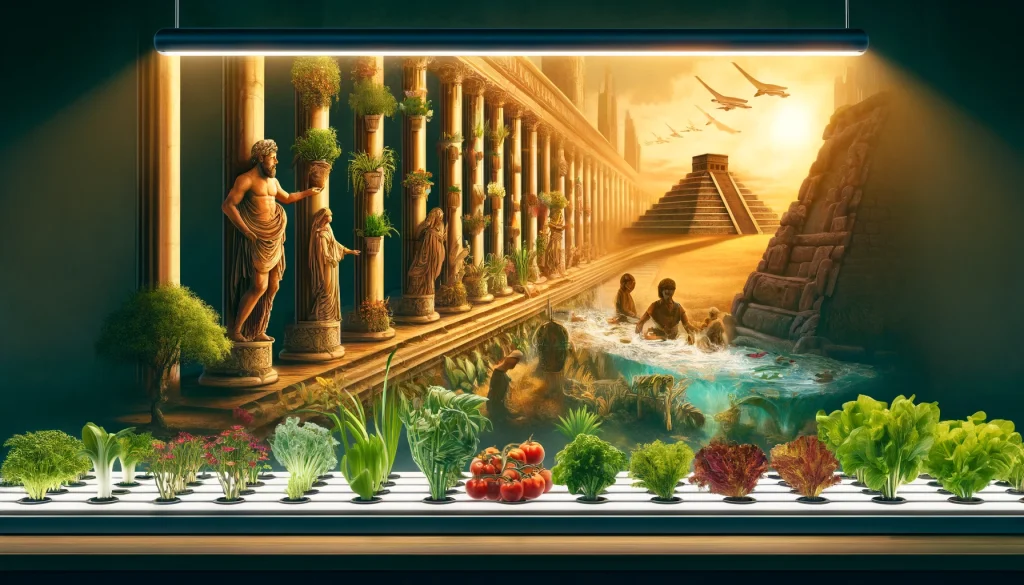
Hydroponic gardening, a method that allows plants to grow without soil, has ancient origins dating back thousands of years. While it’s challenging to pinpoint one specific inventor, various cultures contributed to its development. Let’s explore the rich history of hydroponics and how it evolved into the sophisticated system we know today.
The Roots of Hydroponics: Ancient Civilizations
The idea of growing plants in water with dissolved nutrients has been practiced for millennia. Ancient civilizations like the Babylonians and Aztecs used forms of hydroponics to cultivate crops. The famous Hanging Gardens of Babylon, one of the Seven Wonders of the Ancient World, is believed to have used hydroponic principles. Meanwhile, the Aztecs employed floating gardens, or chinampas, which allowed crops to thrive in shallow lake beds.
Modern Foundations: William Frederick Gericke
While ancient techniques laid the groundwork, the modern form of hydroponics is attributed to William Frederick Gericke in the 1930s. Gericke, a professor at the University of California, was the first to demonstrate that plants could be grown solely using water and nutrient solutions on a large scale. His work transitioned hydroponics from a laboratory concept to a practical farming method. The term “hydroponics” comes from the Greek words hydro (water) and ponos (labor), meaning “working water.”
Gericke’s initial experiments involved growing tomatoes without soil, which astounded the public. His methods showed how hydroponics could solve problems related to poor soil quality, leading to greater interest from both scientists and commercial farmers.
NASA and Beyond: Hydroponics in Space
Hydroponics gained significant attention from the National Aeronautics and Space Administration (NASA) in the 20th century. As humans explored the possibility of long-term space travel, hydroponic gardening emerged as a promising solution for growing food in space. Since soil isn’t available in space environments, hydroponics offers a way to produce fresh crops with minimal resources.
NASA’s research further propelled the development of hydroponic systems, integrating advanced technologies like aeroponics (growing plants with misted nutrients) and aquaponics (combining fish farming with hydroponics). These innovations have influenced how we grow plants today, not only in space but also in urban environments where traditional farming space is limited.
Why Choose Hydroponics Today?
Hydroponics is now seen as an efficient, sustainable, and high-yield gardening method that appeals to home gardeners and commercial farmers alike. Here are some key reasons why hydroponics is so popular:
- Water Efficiency: Hydroponic systems use up to 90% less water than traditional farming, making them ideal for regions with limited water resources.
- Faster Growth: Plants grow faster in hydroponic systems due to controlled nutrient intake and environmental conditions.
- Space-Efficient: Hydroponics allows vertical farming, enabling more plants to grow in smaller areas—perfect for urban settings.
- Fewer Pests and Diseases: Without soil, plants are less susceptible to soil-borne pests and diseases.
Recommended Hydroponic Products
If you’re looking to get started with hydroponics, some products from Hydroponic Centre can help set up your system:
- Advanced Nutrients – This line offers a range of boosters and nutrient solutions for optimal plant growth.
- LED Grow Lights – Perfect for indoor hydroponics, these lights provide the necessary spectrum for photosynthesis.
- ONA Odour Control – Keeps your grow room fresh and free from unwanted smells.
- DWC Systems – Deep Water Culture systems are ideal for beginners looking for simple setups.
Understanding Hydroponics for Kids
To make hydroponics easy to understand for kids, think of it like this: plants don’t need dirt to grow. They need water, sunlight, air, and food (nutrients). Hydroponics is a way to give plants all the food and water they need, without planting them in the ground. Imagine a plant sitting in water with vitamins mixed in—it grows just as healthy, or even healthier, than if it were in soil! You can grow all sorts of plants this way, even in small spaces like your kitchen or bedroom.
Conclusion
From ancient civilizations to modern-day innovations, hydroponic gardening has a rich history that shows its adaptability and potential for the future. Whether you’re a home gardener looking to grow herbs in your kitchen or a commercial farmer aiming to increase crop yields, hydroponics offers a sustainable, efficient solution. With technology continuing to evolve, the future of farming might just be in water, not soil.



