
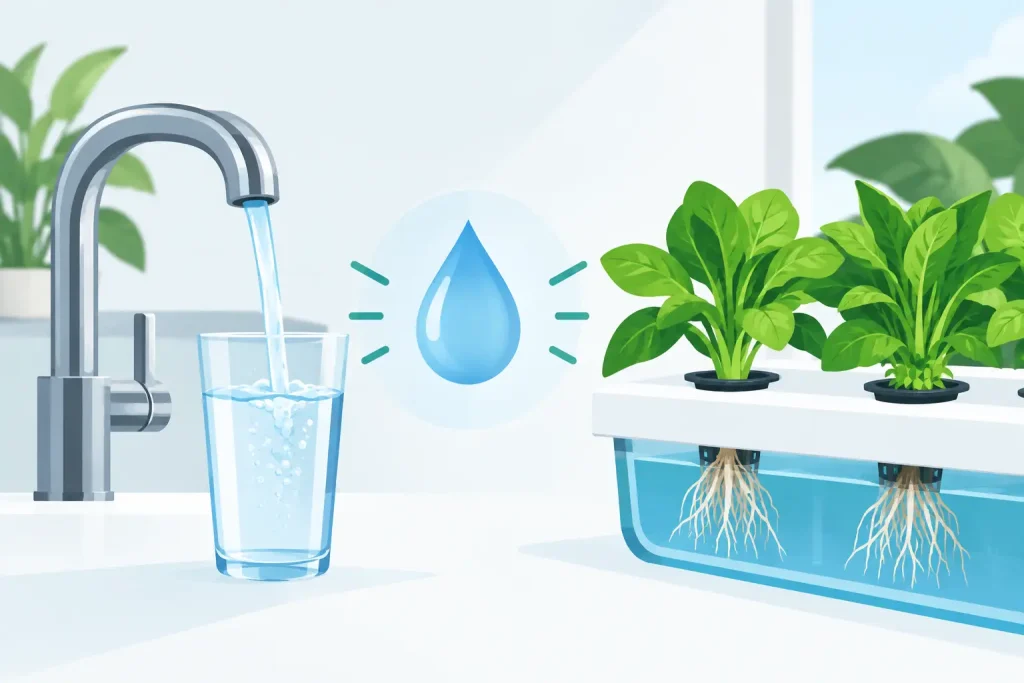
A nutrient tank can look perfectly mixed and still cause problems before the feed has touched a root. In many UK areas, tap water for hydroponics carries enough dissolved mineral content to alter the nutrient profile, push EC higher than expected, or leave pH drifting between reservoir changes. That does not automatically make it unsuitable. It means the water needs measuring before you build a feeding programme around it.
For a small hand-watered run-to-waste setup, ordinary mains water may be entirely workable. In a recirculating DWC, NFT or aeroponic system, the same water can become more challenging because minerals, sodium and pH imbalance recirculate with the feed. The correct approach is not to assume all tap water is bad, or that reverse osmosis is always necessary. Start with the numbers, then match your treatment to the crop, system and nutrient range.
What tap water contains before nutrients
Mains water is not blank water. It commonly contains calcium, magnesium, bicarbonates, chlorine or chloramine, and varying levels of sodium. The exact balance differs by region and can change with source water, treatment work and seasonal supply demands.
Hard-water areas often begin with higher calcium carbonate and bicarbonate levels. Calcium and magnesium are useful plant nutrients, but they are only useful when they fit the rest of the feed. If your starting water already contains substantial calcium, adding a standard hard-water nutrient plus Cal-Mag can create excesses. That can interfere with potassium uptake and make deficiencies harder to diagnose.
Bicarbonates matter because they raise alkalinity. This is different from pH. A sample can be adjusted to the correct pH and still resist that adjustment, causing the reservoir to climb again over time. High alkalinity usually means more acid is needed to bring a nutrient solution into range, particularly with soft-water nutrient formulations.
Sodium is the mineral worth watching most closely. Plants do not use much of it, and it accumulates in recirculating systems. A water supply with elevated sodium may be manageable for occasional run-to-waste irrigation, but it gives less room for error in a reservoir that is topped up repeatedly.
Testing tap water for hydroponics
A basic EC meter and pH meter should be standard kit for any active hydro system. Test a fresh sample of cold mains water after letting it run briefly, rather than using water that has stood in plumbing overnight. Record the EC, pH and temperature, then repeat the check occasionally. Consistency is as valuable as the initial reading.
EC shows the total concentration of electrically conductive dissolved salts. It does not identify what those salts are. Water at 0.3 EC could be mostly useful calcium and magnesium, or it could contain a less helpful balance of sodium and bicarbonates. Still, it is the fastest operational check and tells you how much of your total EC budget has already been used before nutrients go in.
As a working guide, starting water below around 0.2 EC is generally easy to build a feed with. At 0.2 to 0.4 EC, many growers achieve good results using an appropriate nutrient line and a disciplined mixing routine. Above 0.4 EC, obtain a water report or consider treatment, especially for sensitive plants, young stock and recirculating systems. These are not hard cut-offs. A stable 0.35 EC supply with low sodium can perform better than a lower-EC supply with an awkward mineral profile.
Your local water supplier’s analysis can provide useful detail on hardness, calcium, magnesium, sodium, chloride and alkalinity. Treat it as a reference point, not a replacement for your own meter readings. The report is usually an average, while your grow room works with the water arriving at your property today.
Test after mixing, not just before
The reservoir is what the plant receives, so test again once nutrients and additives are fully mixed. Add base nutrients to the water first, mix thoroughly, then check EC. Only after the full nutrient blend is in solution should you adjust pH.
For most hydroponic crops, a pH range of roughly 5.5 to 6.2 gives reliable access to the main nutrients. Allowing a controlled drift within that range is often preferable to forcing exactly the same figure every day. Do not chase pH immediately after mixing either. Give the solution time to settle, particularly where hard water or silica products are involved.
Chlorine, chloramine and beneficial microbes
Chlorine is added to protect drinking water, but it can be unhelpful where you rely on beneficial microbes, biological inoculants or living organic inputs. In a conventional mineral feed system with good hygiene, low levels of chlorine are rarely the main cause of poor plant performance.
Leaving water in an open vessel with circulation or aeration can reduce free chlorine, but it does not reliably remove chloramine. Chloramine is more stable and is used by some water providers. If you are using microbial products or want a more predictable input, use a suitable carbon filter or a water conditioner designed for horticultural use. Check what your local supplier uses before assuming that overnight standing will solve the issue.
Avoid treating every reservoir by default if there is no clear need. Unnecessary conditioners add cost and can complicate a feed schedule. In a sterile system, clean equipment, correct solution temperature and regular reservoir management matter more than trying to remove every trace of disinfectant.
When filtration or RO makes sense
Carbon filtration is useful where chlorine or chloramine is the concern. It improves the starting water without stripping the minerals that may be helping your nutrient balance. A sediment pre-filter is sensible where plumbing carries visible particulates that could block drippers, pumps or irrigation manifolds.
Reverse osmosis removes most dissolved minerals and provides a low-EC base water. It is particularly useful when tap water has high EC, excessive hardness, problematic sodium, or unpredictable composition. It also makes nutrient recipes more repeatable, which is valuable for high-density systems and growers working to tight crop schedules.
RO water has trade-offs. The unit needs maintenance, produces reject water, and the final feed must be built from scratch. Many nutrient ranges offer separate soft-water and hard-water formulations for this reason. With RO or very soft water, a calcium and magnesium supplement may be required, but only at the rate justified by the nutrient programme and crop response. More Cal-Mag is not an automatic fix for every leaf issue.
For larger installations, blending RO water with tap water can be more efficient than running fully purified water. A controlled blend can lower the starting EC while retaining some calcium and magnesium. Measure the blended water every time until the ratio is proven stable.
Match the water to the system
Run-to-waste coco gives you more tolerance because each irrigation introduces fresh solution and runoff carries away excess salts. Even so, high starting EC reduces the margin available for feed strength and can make runoff rise quickly. Check input and runoff EC regularly rather than increasing nutrients based on leaf colour alone.
Recirculating systems demand closer water management. DWC, NFT and aeroponic roots sit directly in the solution, so a mineral imbalance or rising sodium level stays in contact with the plant. Use clean reservoirs, monitor daily, top up with appropriately adjusted water, and replace the solution on a schedule that suits reservoir volume, plant size and uptake.
Seedlings, cuttings and freshly rooted plants need the gentlest starting point. Their low feed strength leaves little room for mineral-heavy water. If your mains supply begins at a high EC, filtered or RO water can make propagation far easier to control.
A practical mixing routine
Keep the process repeatable. Fill the tank with measured source water, record its EC, add your base nutrient components one at a time and mix between each addition. Add supplements only where the water analysis, nutrient schedule or observed plant need supports them. Measure final EC, allow the mix to settle, then adjust pH.
Do not mix concentrated nutrient bottles together before dilution. This can cause precipitation, particularly with calcium-containing products. Keep pH up and pH down separate from nutrients, store meters properly, and calibrate them regularly. An inaccurate pH pen can create more confusion than hard water ever will.
If a crop is underperforming, do not blame mains water first. Check root-zone temperature, dissolved oxygen, irrigation frequency, reservoir hygiene, light intensity and environmental control. Tap water is one variable in a system, not the whole diagnosis.
The most productive water source is the one you can measure, repeat and balance without constant correction. Build a short record of source EC, mixed EC, pH movement and plant response across a few reservoir changes. That record will tell you whether your tap water needs treatment far more clearly than a label or a forum recommendation.






