
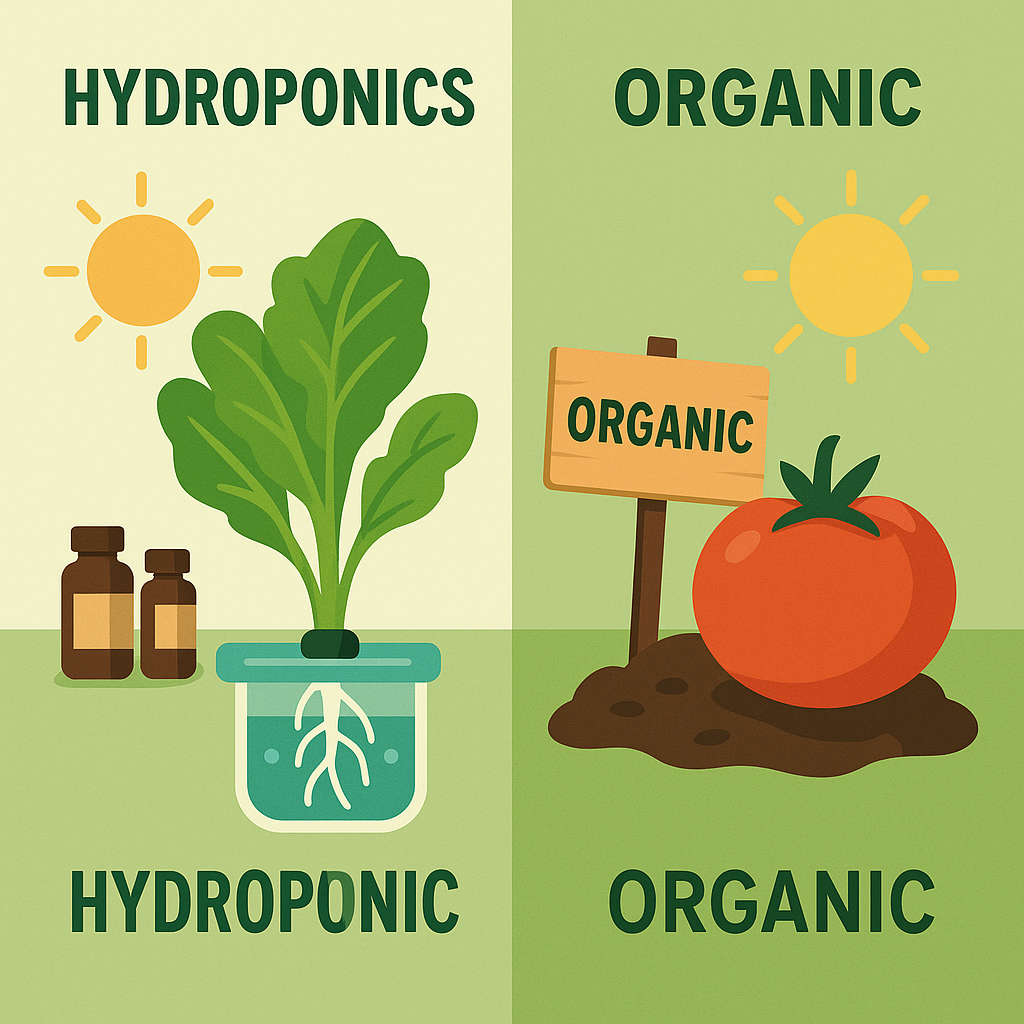
Introduction
The demand for organic food has soared in recent years. Shoppers want fresh produce that’s healthy, chemical-free, and environmentally friendly. At the same time, hydroponics—growing plants without soil using nutrient-rich water—has gained popularity with both home gardeners and commercial farmers.
But here’s the big question: Is hydroponic farming the same as organic farming? Let’s break it down and explore whether hydroponics fits into the world of organic agriculture, what the differences are, and which method might work best for you.
What Does “Organic” Really Mean?
Organic farming is about more than just avoiding chemicals. It follows a set of principles:
- Using natural fertilizers (like compost and manure) instead of synthetic ones
- Avoiding pesticides and herbicides whenever possible
- Supporting biodiversity and soil health
- Maintaining sustainable practices that minimize harm to the environment
In short, organic farming relies heavily on soil health—a factor that hydroponics completely bypasses.
What Is Hydroponics?
Hydroponics is a soilless farming method where plants grow in a nutrient-rich water solution. The nutrients are carefully measured and delivered directly to the roots, which often sit in inert mediums like rockwool, clay pebbles, or coco coir.
Why people love hydroponics:
- Plants grow faster than in soil
- Uses up to 90% less water than traditional farming
- Works in small spaces, indoors or outdoors
- Reduces reliance on pesticides due to controlled environments
Useful Hydroponic Tools
- Origin Dripper Kits – deliver nutrients efficiently to plant roots
- Bluelab Combo Meter – check pH, EC, and temperature at once
- Hailea Nutrient Chiller – keeps nutrient solution at the ideal temperature
Is Hydroponics Organic?
Here’s where the debate begins. Hydroponics doesn’t use soil, so it cannot technically meet traditional organic definitions that rely on soil health.
However, many hydroponic growers argue their crops are as clean—or even cleaner—than organic ones because:
- No pesticides are needed in most systems
- Nutrient solutions are precisely controlled and free from contaminants
- Systems are water-efficient and environmentally friendly
In some countries, hydroponic produce can be certified organic, while in others it cannot. For example:
- USA: Some hydroponic produce is certified organic
- UK & EU: Hydroponics generally cannot be certified organic because soil is a key requirement
Hydroponics vs. Organic Farming: Key Differences
| Feature | Hydroponics | Organic Farming |
|---|---|---|
| Growing Medium | Nutrient water, inert media | Soil enriched with compost, manure, organic matter |
| Nutrients | Precise, often synthetic solutions | Natural sources only |
| Pest Management | Controlled environments, minimal pesticides | Natural pesticides, crop rotation, biodiversity |
| Certification | Sometimes allowed (varies by country) | Universally recognized |
| Sustainability | Saves water, space, and reduces transport | Enhances soil and biodiversity |
Benefits of Hydroponics Compared to Organic Farming
Hydroponics advantages:
- Faster crop cycles = higher yields
- Year-round growing indoors
- Lower water use
- Ability to grow in urban spaces or areas with poor soil
Organic advantages:
- Strong consumer trust in certification
- Builds long-term soil health
- Less reliance on synthetic inputs
Which Is Better for Home Gardeners?
If you’re a home grower, hydroponics offers:
- Convenience (no soil mess)
- Space-saving designs like indoor kits
- The joy of year-round herbs and veggies
On the other hand, organic gardening appeals if you have access to healthy soil and prefer to grow naturally outdoors.
Recommended Home Hydroponic Products:
Which Is Better for Commercial Farmers?
Commercially, hydroponics wins on speed, scalability, and predictability. It’s ideal for urban farms, vertical farming, and year-round production.
Organic farming still dominates in consumer recognition. Many buyers specifically look for the “organic” label, which hydroponics may not qualify for depending on regulations.
Recommended Commercial Products:
- Bluelab pH Controller WiFi – automates pH balance in large systems
- Hailea Nutrient Chillers – keeps large reservoirs stable
FAQs
Q: Can hydroponic food be organic?
A: Sometimes yes, sometimes no—it depends on local certification rules.
Q: Is hydroponic food safe?
A: Yes. In fact, it often avoids pesticides altogether.
Q: Does hydroponics taste the same as organic?
A: Many growers report that hydroponic produce is just as flavourful—sometimes more so due to precise nutrient delivery.
10-Year-Old-Friendly Summary
Think of it like this:
- Organic farming is like feeding your plants with homemade compost and taking care of the soil.
- Hydroponics is like giving plants a special vitamin drink in water so they grow faster, without any dirt at all.
Both can grow healthy food—but hydroponics doesn’t use soil, so it’s not the same as organic.
Conclusion
Hydroponics and organic farming share the same goal: healthy, sustainable food. But they take different paths. Hydroponics is about efficiency, technology, and speed, while organic farming focuses on soil health and natural methods.
For home gardeners, hydroponics provides a clean, convenient, and exciting way to grow food indoors. For commercial farmers, it delivers reliable, high-volume harvests year-round.
Whether you prefer the traditional soil-based approach of organic farming or the futuristic water-based world of hydroponics, both have an important role in feeding the future.



