
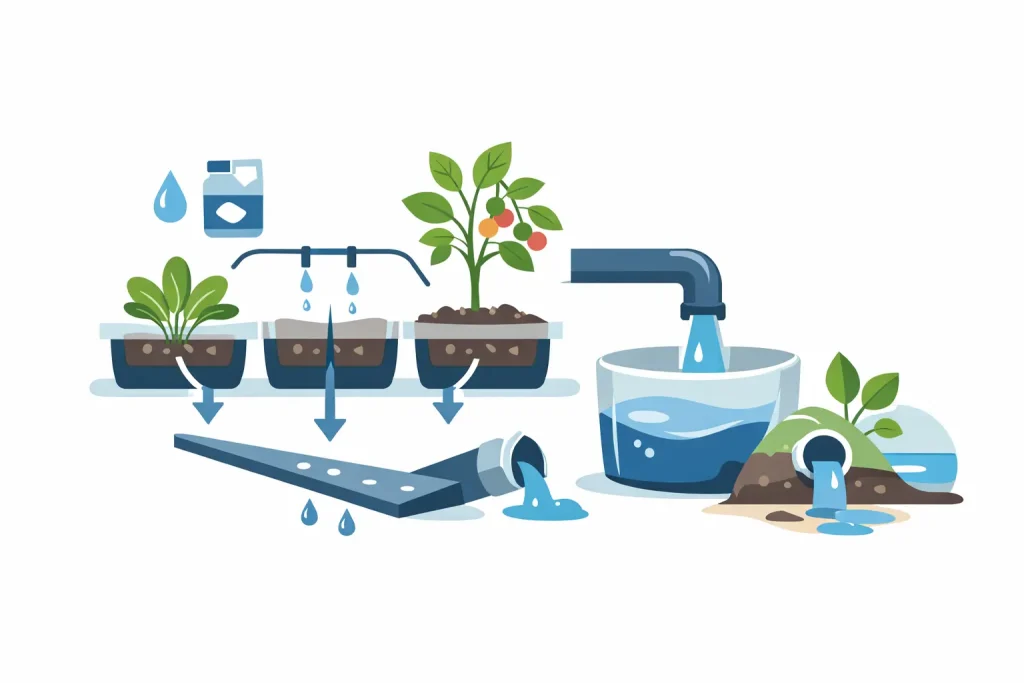
If your coco crop looks hungry one day and burnt the next, the issue is often not the base feed itself. It is how your run to waste nutrients are being mixed, delivered and cleared through the root zone. In a run-to-waste system, small errors stack up quickly because every feed changes the media chemistry, especially under strong lighting and fast transpiration.
What run to waste nutrients actually means
Run to waste is exactly what it sounds like. You feed plants in an inert or lightly buffered medium, the solution passes through the root zone, and the excess drains away instead of being recirculated. That waste runoff is not reused. The system is common with coco, slabs, pots and drippers because it gives tight control over what reaches the roots at each irrigation event.
The main advantage is consistency. Plants receive fresh nutrient solution rather than a tank that drifts over time as water evaporates and different elements are taken up at different rates. The trade-off is cost and management. You use more feed, you need proper drainage, and you cannot ignore runoff numbers if you want stable results.
For growers chasing reliable growth rates and cleaner steering through veg and flower, run-to-waste feeding is often simpler to control than recirculating hydro. Simpler does not mean forgiving, though. If EC is too high, pH is out, or irrigation timing is poor, coco can swing from ideal to problematic very fast.
How run to waste nutrients differ from recirculating feeds
Not every nutrient line performs the same way in every system. Some formulas are built with recirculating tanks in mind, where stability over time matters most. Others suit drain-to-waste better, where fresh solution is mixed frequently and delivered in measured shots.
With run to waste nutrients, growers usually aim for complete availability at the point of feeding. That means balanced macro and micro elements, predictable pH behaviour and compatibility with common additives such as root stimulants, PK products, enzymes and calcium-magnesium support where needed. In coco, calcium and magnesium management matters more than many new growers expect because the medium can hold onto cations and skew uptake if the feed plan is weak or inconsistent.
A recirculating system may tolerate some variation because the same solution remains in play and can be corrected in the tank. Run to waste has less buffering at system level. Each feed is a decision. If that decision is wrong three or four irrigations in a row, the root zone shows it.
Choosing run to waste nutrients for coco and inert media
Coco is the most common place growers talk about run-to-waste feeding, and for good reason. It combines hydroponic speed with the handling convenience of pots or fabric containers. It also rewards a nutrient line designed for coco rather than a generic soil feed.
A proper coco nutrient usually carries a calcium and magnesium profile suited to the medium, along with nitrogen ratios that support fast vegetative growth without making plants too soft. If you are running rockwool, mapito or another inert medium, the same principle applies. Use a feed intended for hydroponic uptake rather than relying on slow-release or heavily organic products that behave unpredictably through drippers.
Brand matters less than fit for purpose. Established lines from Canna, Athena, Shogun, Advanced Nutrients and similar manufacturers all have growers getting results, but the best choice depends on your irrigation style, water hardness and how much manual adjustment you want to do. Hard water feeds can simplify life in some UK areas. Soft water growers may need more support from the nutrient profile itself.
If you prefer a cleaner tank and fewer blocked drippers, mineral-based feeds are usually the straightforward option. Heavier organics can work in run to waste, but they demand more maintenance and are less suited to fine irrigation hardware.
Getting EC and pH right with run to waste nutrients
This is where most feeding problems begin. Growers either chase bottle charts too aggressively or feed too lightly for the environment they have created. Under high PPFD, active extraction and warm root-zone conditions, plants can process a lot of feed. Under weaker light or cooler conditions, the same EC can become excessive.
Start with the cultivar, the stage of growth and the medium moisture pattern. Young plants in freshly rooted coco need a lighter feed than mature plants with a fully established root mass. As a general rule, pH in coco and hydro media is kept slightly acidic so the full nutrient range remains available. If pH drifts too high, iron and other micros can become less available. Too low, and uptake balance shifts the other way.
Runoff EC tells you whether the root zone is accumulating salts. If your input EC is modest but runoff keeps rising, irrigation frequency or volume is usually off. If runoff is much lower than input and plants look pale, they may be underfed or drying back too hard between events. There is no magic number that fits every room, but there is a pattern to watch: input, runoff and plant appearance need to line up.
Why runoff matters
In run to waste, runoff is your feedback loop. Without it, you are effectively feeding blind. A modest amount of runoff helps prevent salt build-up and keeps the root zone closer to the composition of the feed going in.
Too little runoff can leave concentrated fertiliser in the pot, especially late in flower when plants are drinking heavily. Too much runoff wastes feed and can reduce oxygenation if the medium stays too wet. Most growers aim for controlled runoff rather than a flooded tray. The exact percentage depends on pot size, media structure and irrigation frequency.
Common mistakes with run to waste nutrients
The first mistake is treating coco like soil. Soil can tolerate wider wet-dry swings and often relies on buffered nutrient reserves in the pot. Coco performs better with frequent, measured fertigations and consistent nutrient availability. Plain water feeds in coco often create more problems than they solve unless you are correcting a specific issue.
The second mistake is overloading additives. A base nutrient, root stimulator, silica, cal-mag, bloom booster, carbohydrate and enzyme product can all have a place, but stacking everything at full rate rarely improves performance. It usually raises EC, complicates diagnosis and pushes costs up. If a room is underperforming, environmental control is often the limiting factor before feed choice.
The third is poor tank hygiene and sloppy mixing order. Some products need to be added one at a time and fully diluted before the next goes in. Concentrates mixed together directly can precipitate and reduce availability. Keep tanks clean, lines flushed and drippers checked. There is no point buying quality nutrients if the system delivers them unevenly.
Signs your run-to-waste feeding needs adjustment
Leaf tip burn with dark, overfed foliage usually points to excess strength. Pale new growth or interveinal chlorosis can suggest pH drift or a calcium-magnesium issue rather than simply not enough feed. Slow growth with a wet medium often means irrigation timing is wrong. Fast dry-backs with rising runoff EC point to under-irrigation in relation to plant demand.
Good growers separate deficiency from lockout. Adding more feed to a locked-out root zone often makes the problem worse.
Irrigation strategy matters as much as the nutrient bottle
Run to waste nutrients only perform properly when irrigation events match root-zone demand. In early veg, one or two feeds per day may be enough. In heavy flower, under strong LEDs and active climate control, multiple short irrigations can keep the media stable and productive.
The goal is not simply to keep the pot wet. The goal is to maintain a healthy balance of moisture, oxygen and nutrient availability. Long dry-backs can concentrate salts. Constant saturation can suppress root function. Dripper count, flow rate, pot size and media density all affect how evenly the feed spreads.
Automation helps because consistency beats guesswork. Timers, pumps, drippers and drainage management are not glamorous purchases, but they often improve crop performance more than another additive bottle. For growers building or upgrading a room, this is where a specialist supplier such as Hydroponic Centre is useful – getting the irrigation hardware and feed line matched properly saves time later.
When to change the nutrient strength
Plants do not need the same feed strength from rooted cutting to final swell. During early establishment, a lighter EC with a root-focused product is often enough. Through aggressive vegetative growth, demand rises. In bloom, phosphorus and potassium demand increases, but that does not mean every cultivar wants a heavy-handed PK push.
Some varieties are naturally light feeders and show burnt tips quickly. Others remain hungry deep into flower. Temperature, humidity, CO2 use and light intensity all shift the ceiling. If the room is not dialled in, copying a high-performance feed schedule from another grow usually ends badly.
A sensible approach is to increase strength only when plants are clearly processing the current feed well. Healthy colour, strong turgor, stable runoff and active growth are better indicators than the bottle chart alone.
Should you flush in a run-to-waste system?
It depends what you mean by flush. If runoff EC has climbed too far and the root zone is carrying excess salts, a corrective flush or reset feed can help restore balance. If you mean starving plants with plain water for long periods at the end, the benefits are less clear and the downside is obvious – reduced plant function when you still want the crop to finish properly.
Many experienced growers now favour a cleaner finishing strategy rather than an aggressive flush. Keep the root zone balanced, reduce unnecessary additives, and avoid letting the media become a salt store in the first place. That is a lot easier than trying to rescue an overfed crop in the final two weeks.
Run-to-waste feeding works best when you treat it as a controlled process, not a bottle-by-bottle experiment. Get the nutrient line, irrigation frequency and runoff management working together, and the plants usually tell you the rest.






