
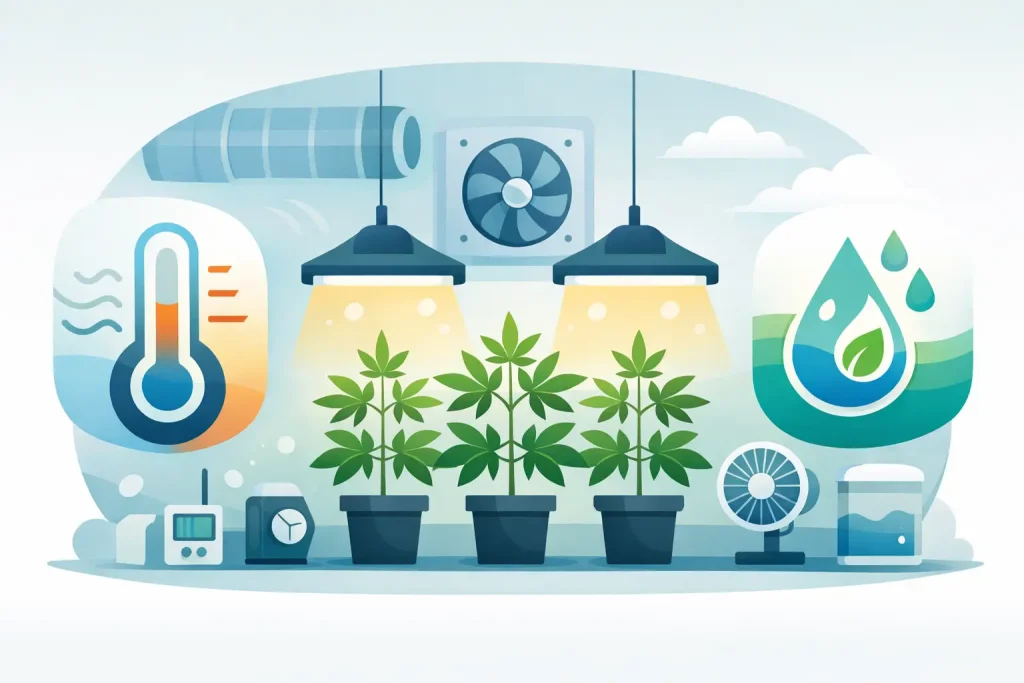
A healthy crop can look well fed and properly lit, then still underperform because the air is wrong. Get grow room temperature and humidity out of range for even a few hours and you start seeing slower uptake, limp growth, weak transpiration, mould pressure or stalled flowering. Climate is not a background detail – it is part of the system.
For indoor growers, temperature and relative humidity have to be managed together. Looking at one without the other usually leads to poor decisions. A room at 28°C can be workable with the right airflow and humidity, while 24°C can still cause problems if the air is too damp and stagnant. The aim is not chasing a single magic number. It is keeping the environment in a productive range for the crop stage, light intensity and room setup.
Why grow room temperature and humidity matter
Plants are constantly balancing water loss and nutrient uptake through transpiration. If your room is too hot and too dry, plants lose moisture too quickly, close stomata and start protecting themselves instead of growing. If it is too cool and too humid, transpiration slows, roots take up less efficiently and fungal risk increases.
This is why climate control affects more than leaf posture. It influences feed demand, calcium movement, internodal spacing, root-zone behaviour and final flower density. In hydroponic systems especially, where plants can grow aggressively under strong light, poor environmental control shows up fast.
A common mistake is trying to compensate elsewhere. Growers often add more nutrients, adjust pH repeatedly or increase irrigation frequency when the real issue is that the room is running warm with dry air, or cool with excessive humidity. Before changing the feed schedule, check the room.
Target ranges by growth stage
The right range depends on whether plants are rooting, vegging or flowering. Young plants generally prefer warmer conditions and higher humidity because they have limited root mass and lower water demand. Mature plants in flower need tighter humidity control to avoid disease pressure and quality loss.
Propagation and early rooting
Cuttings and seedlings usually perform best around 24-26°C with relative humidity in the 65-75% range. At this stage, high humidity supports water retention while roots are still developing. Too much heat under a propagation lid can cause soft growth, stretching and damping-off, so airflow still matters.
Vegetative growth
Once roots are established, many growers aim for 24-28°C lights on and roughly 55-70% relative humidity. The exact point depends on lighting type, plant size and air movement. Under stronger LED fixtures, leaf surface temperature can run lower than under HID, so room temperature sometimes needs to sit slightly higher to keep plants active.
Flowering
In flower, the priority shifts. Temperatures often sit around 24-26°C in lights-on periods, with humidity reduced to roughly 40-55%. Late flower usually benefits from the lower end of that humidity range, particularly in dense canopies or compact buds. This is where poor extraction and weak dehumidification become expensive.
Lights off conditions
Night-time climate matters as much as day-time climate. Large temperature drops between lights on and lights off can encourage condensation on plant surfaces and room materials. That creates ideal conditions for mildew and botrytis. A smaller drop is generally easier to manage, especially in sealed or heavily packed rooms.
How temperature and humidity interact
Room readings only tell part of the story. What matters is how warm the leaves are and how much moisture the air can hold at that temperature. Warm air holds more moisture than cool air, which is why the same relative humidity reading can behave very differently at different temperatures.
In practice, this means a room can look acceptable on paper while plants still show stress. A grower running high-intensity LEDs may find that air temperature needs to be slightly higher than expected because leaves are not receiving as much radiant heat. Another grower under HID may need stronger extraction to prevent heat stacking at canopy level.
This is also why cheap hygrometers placed at pot level or near an intake vent often give misleading readings. You want measurements at canopy height, in more than one area if possible. Hot spots and dead zones are common in tents and small rooms.
Equipment that actually controls the room
If the room is unstable, throwing one extra fan at it rarely solves the problem. Effective control comes from matching extraction, intake, circulation and moisture management to the heat load and plant volume.
Extraction fans remove heat and stale air. If your fan is undersized, temperatures climb and humidity builds during lights-off periods. Intake matters too. Passive intake can work in smaller tents, but larger setups often need properly sized ducting and a clear airflow path.
Circulation fans do a different job. They do not remove heat or moisture from the room, but they prevent stagnant pockets around leaves and help even out canopy conditions. Poor air movement is one reason growers see mildew in an otherwise acceptable room.
When humidity stays high despite adequate extraction, a dehumidifier is usually the correct fix. This becomes more important in late flower, during wet weather, or in UK properties where ambient moisture levels are already high. In colder months, heaters can also play a role, not just for warmth but for preventing damp spikes when lights go off.
Controllers are where the setup becomes more operationally reliable. A basic thermostat switch can automate extraction based on temperature. More advanced climate controllers can coordinate fan speed, heating and humidity control so the room stays within a tighter operating band. That saves time and reduces avoidable swings.
Troubleshooting common climate problems
Room too hot and too dry
Leaves may curl upwards, edges can crisp and plants often drink heavily while growth slows. This can happen when extraction is strong but incoming air is very dry, or when lighting intensity is too high for the room volume. In this case, simply adding more feed will not help. You need to reduce heat load, improve humidity control or rebalance airflow.
Room too humid in flower
This is one of the most common and most costly issues. You may notice swollen, dense foliage, slow substrate drying, musty smells or condensation on surfaces after lights off. Extraction may look fine during the day but fail at night when temperatures fall and relative humidity climbs. Dehumidification and night-cycle control are usually the answer.
Temperature swings between day and night
Big fluctuations stress plants and make humidity harder to manage. They can also affect stretch and flower development. If the room drops sharply after lights off, consider a heater, fan-speed controller or revised extraction schedule rather than letting the room crash overnight.
Good room readings but poor plant response
Check where sensors are placed, whether the canopy is too dense, and whether root-zone temperatures are drifting out of range. In hydro systems especially, nutrient solution temperature can undermine otherwise decent air conditions. A room may read correctly while roots sit too cold or too warm.
Grow room temperature and humidity in different setups
A small grow tent behaves differently from a dedicated room. Tents heat quickly, cool quickly and often suffer from layered air where the top of the canopy is much warmer than lower growth. Equipment sizing is critical because oversized extraction can strip humidity too aggressively, while undersized fans let heat pool under the roof.
Larger rooms are usually more stable but can hide localised issues. One corner may be damp, another may be running hot under a fixture, and airflow can weaken behind dense plant lines. Commercial-minded growers tend to benefit from multiple sensors and more deliberate circulation planning.
Hydroponic systems also tend to expose climate errors faster than soil-based setups because growth rates are higher and the margin for environmental inconsistency is smaller. Fast growth under high-performance nutrients and lighting only works when the room can support it.
Building a workable routine
The best results usually come from boring consistency. Check max-min readings daily. Review the room at lights on and lights off rather than relying on a single mid-day check. Watch how quickly humidity rises after irrigation and after the lamps switch off. Those patterns tell you more than isolated numbers.
It also helps to make one change at a time. If you alter extraction speed, watering frequency and light height in the same day, you will not know what solved the issue or made it worse. Controlled rooms respond well to methodical adjustments.
If you are upgrading equipment, prioritise what removes the actual bottleneck. Some growers need stronger extraction. Others need a proper dehumidifier, better duct routing or a controller that stops temperature and humidity from chasing each other all week. Hydroponic Centre stocks the main climate-control categories growers typically use for that job, from fans and filters to heaters and environmental controllers.
Get the air right and everything else becomes easier to read. Nutrient demand makes more sense, irrigation settles down and plants stop wasting energy on stress responses. That is usually when a room starts working like a system rather than a collection of parts.






