
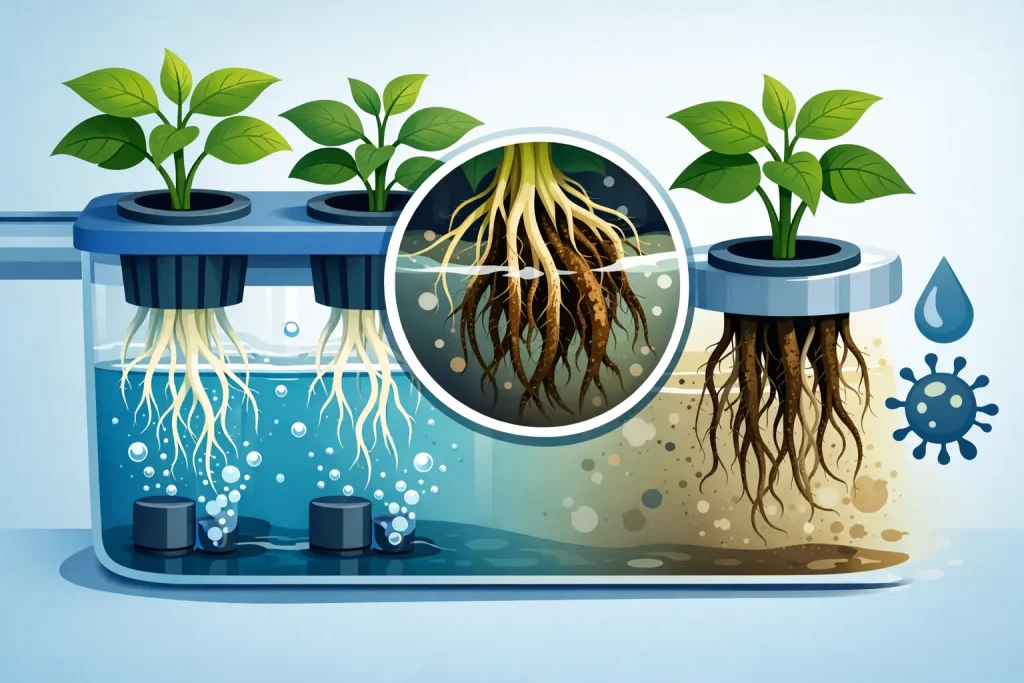
Brown roots, a sour reservoir smell, and plants that suddenly look hungry despite a full feed schedule usually point to the same problem. If you need to know how to control root rot, the first job is to stop treating the leaves and start looking at the root zone. In hydroponics and other controlled environments, root rot is rarely a random event. It is usually the result of poor oxygen levels, excessive water temperature, weak hygiene, overwatering in media, or an irrigation setup that is not draining as it should.
Root rot moves quickly because the root zone is where everything happens. Once roots lose oxygen and pathogenic organisms get established, uptake drops, growth stalls, and the plant starts showing stress above the canopy. By the time foliage symptoms are obvious, the root problem is often well underway. That is why control is part emergency response and part system correction.
How to control root rot at the source
The cause matters. Root rot is not one single issue with one single fix. In deep water culture, the main trigger is often warm, poorly oxygenated solution. In coco or soil, it is more likely to be chronic overwatering, poor drainage, or containers sitting too wet for too long. In recirculating systems, dead organic matter, blocked pipework, dirty tanks and unstable temperatures all increase risk.
The practical way to control it is to reduce the conditions pathogens prefer while helping the plant rebuild healthy white roots. That means cooler solution temperatures, more dissolved oxygen, cleaner system surfaces, better irrigation timing, and a nutrient regime that does not add extra stress.
Check the root zone before changing everything else
Lift the pot, inspect the drippers, open the reservoir, and actually look at the roots. Healthy roots are usually white to cream, firm, and fresh-smelling. Infected roots tend to be brown, slimy, matted, or soft, with a stale or swampy smell.
This inspection tells you whether you are dealing with genuine rot, nutrient staining, or a separate issue such as lockout. Some nutrients and additives can darken roots without causing disease. Sliminess, odour, and loss of vigour are the more useful indicators.
Get water temperature under control
In most hydro systems, solution temperature is a major factor. Once reservoir temperatures climb too high, dissolved oxygen drops and pathogens gain an advantage. Many growers aim for a root zone solution around 18 to 20C. Push much above that for sustained periods and problems become more likely, especially under strong lighting or in warm rooms.
If temperatures are running high, deal with the room and the reservoir together. Improve extraction, reduce heat build-up around tanks, insulate exposed pipework, and keep reservoirs out of direct light. In some setups, a water chiller is the cleanest long-term fix. Frozen bottles can work as a short-term measure, but they are inconsistent and labour-heavy.
Increase oxygen immediately
Roots need oxygen as much as they need feed. In DWC, RDWC, and other water-based systems, weak aeration can turn a minor issue into a reservoir-wide problem fast. Add or upgrade air stones, check pump output, and make sure there are no kinks or restrictions in the airline.
In drip, flood-and-drain, and run-to-waste systems, oxygen is more about wet-dry balance. Media that stays saturated for too long loses air space. If the pot feels heavy all the time and runoff is poor, the irrigation schedule or media structure needs adjusting.
Clean the system properly, not cosmetically
If root rot is active, partial cleaning is usually not enough. Slime and organic residue collect in tanks, lines, drippers, trays and pump housings. If you leave contamination in the system, fresh roots will grow straight back into the same problem.
Drain the reservoir, remove dead plant material, and clean all contact surfaces thoroughly. Pay attention to feed lines and fittings, not just the visible parts of the tank. Replace heavily fouled air stones or blocked drippers rather than trying to rescue them indefinitely. In severe cases, a full strip-down saves more time than repeated half-measures.
There is a trade-off here. Sterile approaches and biological approaches can both work, but they should not be mixed carelessly. If you are using system-cleaning products designed to keep the reservoir sterile, they can suppress beneficial microbes as well as pathogens. If you are running a biological root-zone programme, aggressive sterilising agents can undermine it. Pick a strategy and run it consistently.
Trim away the worst damage carefully
If roots are badly slimed or decayed, removing the worst dead material can help reduce the pathogen load. Do it gently and with clean tools. The aim is not to over-prune a stressed root mass, but to stop obviously dead tissue from continuing to foul the system.
After that, the plant needs a stable environment more than it needs a complicated rescue cocktail. Keep feed sensible, maintain oxygen, and avoid constant changes in additives.
Adjust feed strength and irrigation logic
A stressed root zone does not handle strong EC well. When uptake is compromised, heavy feeding often makes the plant look worse rather than better. In hydro, it is usually safer to run a slightly lighter nutrient strength while roots recover, then increase gradually once new white growth appears.
pH also needs to be in range for the system and crop. Wild swings in pH can add another layer of stress and make deficiency symptoms harder to interpret. Keep the solution stable and resist the urge to chase every leaf symptom with another bottle.
In coco and other media-based systems, root rot control often comes down to irrigation frequency and drainage quality. Too many small feeds into cool, saturated pots can leave the root zone permanently wet. On the other hand, letting coco dry too far can cause its own problems. The right schedule depends on pot size, plant size, media blend, room temperature and airflow. If conditions are cool and transpiration is low, back off frequency. If runoff is not clearing properly, improve drainage and reassess how much solution each event is delivering.
Improve the media and container setup
Heavy, compacted media hold too much water and not enough air. If you are repeatedly seeing root issues in pots, the fix may be physical rather than chemical. Air-pruning pots, fabric pots, better saucer management, and a looser media blend can all improve root-zone oxygen.
Standing pots in runoff is a common avoidable mistake. Once the base of the container stays submerged, the lower root zone remains deprived of air. Make sure waste solution is leaving the tray and not collecting under the plant.
Prevention is where most control happens
Anyone can respond once roots have turned brown. The better operators prevent the conditions that let rot start in the first place. That means treating the root zone as a controlled system, not just a hidden part of the plant.
Keep reservoirs light-tight. Light leaks encourage biological growth in nutrient solution and create instability you do not need. Keep temperatures consistent. Service pumps, airlines and drippers before they fail. Remove dead roots and leaf debris from trays and tanks. If you are recirculating feed, do not let the reservoir become a dumping ground for old solution and plant waste.
Propagation also matters. Root rot often starts earlier than growers think. Clones and seedlings placed into overly wet media, poorly oxygenated plugs, or dirty propagation trays can carry weakness into the whole cycle. Starting clean is easier than correcting later.
Biologicals, enzymes and system cleaners
These products have a place, but they are not substitutes for environmental control. Beneficial microbes can help occupy the root zone and support resilience when used correctly. Enzyme products can assist with breaking down dead root material. System cleaners can help keep irrigation hardware and reservoirs cleaner.
What they cannot do is compensate for a reservoir sitting too warm, a dead air pump, or pots that never dry back properly. Use them as part of a root-zone programme, not as cover for poor process.
When to act aggressively and when to monitor
Not every case needs a full reset. If a plant has slight discolouration but still has strong growth, clean-smelling roots, and stable environmental numbers, close monitoring and small corrections may be enough. If the smell is off, roots are visibly sliming, and several plants are fading at once, act quickly. In a shared system, hesitation spreads the problem.
For growers running high-value crops or tight turnaround schedules, the economics are simple. Early intervention costs less than lost growth, reduced yield, or a full crop replacement. That is why root-zone monitoring should sit alongside checks on EC, pH, canopy temperature and humidity.
If you run a serious indoor setup, how to control root rot comes down to discipline more than guesswork. Keep the root zone cool, oxygenated, clean and draining correctly, and most outbreaks never get the conditions they need. When problems do show up, respond at the reservoir, the media, and the irrigation schedule – not just at the leaves. Healthy roots do not need miracles. They need the system around them to make sense.
The useful habit is simple: inspect below the canopy as often as you inspect above it.






