
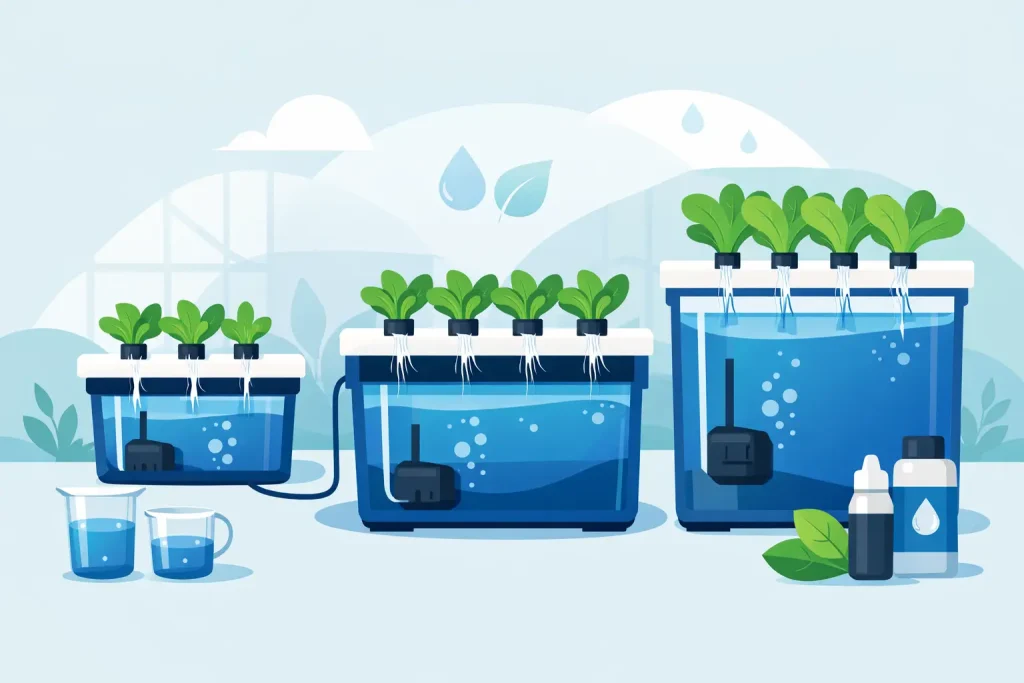
If your EC drifts too fast, your pH needs constant correction, or your pump seems to run a system that is always on the edge, reservoir size is usually the first thing to check. The best hydroponic reservoir size is not just about fitting enough nutrient solution under a tray or beside a tent. It directly affects stability, root-zone temperature, maintenance frequency and how forgiving the system is when plants start drinking hard.
A reservoir that is too small will work, right up until plant demand rises. Then you get rapid concentration swings, warmer solution, less dissolved oxygen headroom and more time spent topping up. Go too large and you add cost, floor-space pressure and unnecessary nutrient volume, especially in compact hobby setups. The right size sits in the middle – large enough to buffer change, but sensible for the system, plant count and grow room footprint.
What the best hydroponic reservoir size really depends on
There is no universal litre figure that suits every setup. A four-site DWC system under a strong LED does not need the same reservoir volume as a small run-to-waste coco feed tank, and neither behaves like a flood-and-drain table packed with mature plants.
The main variables are plant count, system type, crop size, irrigation frequency and how often you want to service the tank. Environmental conditions matter as well. Higher canopy temperatures, stronger airflow and harder transpiration all increase water uptake, which means a marginal reservoir becomes a problem much faster.
As a working rule, reservoir size should give you enough nutrient volume that daily uptake does not cause major swings in EC and pH. If plants can remove a large percentage of the tank volume in a day or two, the reservoir is undersized for practical use.
Best hydroponic reservoir size by system type
Deep water culture and recirculating DWC
DWC and RDWC benefit from larger reservoirs because the nutrient solution is the root environment, not just a feed source. More water volume means slower changes in temperature and nutrient concentration, which makes the whole system easier to manage.
For single large plants, many growers work comfortably with around 20 to 30 litres per plant as a minimum. If plants are expected to veg hard or finish large, 30 to 50 litres per plant gives a much better buffer. In RDWC, the control reservoir should also be sized so top-ups and adjustments affect the whole system gradually rather than causing abrupt change.
This is one area where undersizing hurts quickly. A small DWC tank may look efficient, but once root mass expands and water temperatures climb, the margin for error narrows. If you are choosing between two sizes and your space allows it, bigger is usually the safer option.
Flood and drain
Flood-and-drain systems need enough nutrient solution to complete the flood cycle while leaving a stable reserve in the tank. If the reservoir is only just large enough to fill the tray, the remaining volume after each cycle can be too low for consistent pump operation and stable nutrient strength.
A practical approach is to calculate the volume needed to flood the tray to the target height, then add significant extra capacity for stability. In many cases, the best setup is a reservoir that holds at least two to three times the volume used in a single flood. That gives enough working solution for multiple irrigations and a sensible margin for top-ups.
Drip systems in clay pebbles, coco or slabs
For drip-fed systems, reservoir size depends on whether you are recirculating or running to waste. In recirculating systems, larger reservoirs help avoid imbalances as plants selectively absorb water and feed. In run-to-waste setups, the reservoir is mainly a feed tank, so it can be smaller if you are happy to mix fresh solution more often.
Small tent growers often manage with 50 to 100 litres if plant numbers are low and feeds are mixed regularly. For more plants, larger pots or longer intervals between mixing, 100 to 200 litres quickly becomes more practical. The question is not whether a small tank can work – it can – but whether you want to refill it constantly during peak flowering.
NFT and aeroponics
NFT and aeroponic systems depend heavily on uninterrupted flow and stable nutrient availability. Because root exposure and delivery timing are more critical, these systems do better with reservoirs that avoid sudden drops in volume.
A modest NFT setup might run on a relatively small tank, but it should still provide enough capacity that a hot day does not strip the reservoir down to a risky level. Aeroponics is even less forgiving. If you are running high-frequency misting or spray cycles, erring on the larger side is sensible.
A simple way to size a reservoir
Start with plant count and expected plant size, then estimate peak daily water use rather than early veg consumption. Small plants make small reservoirs look adequate. Mature plants expose the real capacity issue.
If your system is recirculating, aim for at least several days of comfortable operating volume at peak demand, not just enough solution for one day. For many home growers, three to seven days of nutrient volume is a practical range. Closer to three days means more hands-on management. Closer to seven days gives better stability but takes more space and more nutrient stock to fill.
If you are running to waste, think in terms of mixing efficiency. A reservoir should be large enough to feed your planned irrigation schedule without leaving you constantly mixing tiny batches. Very small tanks often create more inconsistency because nutrient measurement errors become proportionally larger.
Why larger reservoirs are usually easier to run
The biggest advantage of extra volume is buffering. When plants drink five litres from a 40-litre reservoir, that is a meaningful change. The same five litres from a 150-litre reservoir is far less dramatic. pH tends to move slower, EC adjustments are less twitchy, and temperature takes longer to climb.
That matters most in warm grow rooms and under high-intensity lighting, where nutrient solution can drift out of range quickly. A larger reservoir also gives you more time if a float valve sticks, a top-up is delayed or a weekend gets busy.
The trade-off is straightforward. More volume means more floor space, heavier tanks, more nutrient to mix and more solution to drain during change-outs. If access is poor, a large reservoir can be awkward to clean properly, and poor cleaning cancels out the benefit of extra capacity.
Common sizing mistakes
One of the most common errors is choosing reservoir size around the tank that physically fits, rather than the volume the system needs. Space is always a constraint, but if the reservoir is too small for plant demand, you are building instability into the system from the start.
Another mistake is sizing for veg rather than late flower. Reservoir demand can change sharply once canopy mass, root mass and feed frequency increase. A system that feels easy in week two can become labour-heavy later on.
There is also a tendency to focus only on total volume and ignore usable volume. Pumps, outlets, return flow, air stones and minimum operating depth all reduce how much of the reservoir is actually practical. A nominal 100-litre tank rarely gives 100 litres of useful working capacity.
Reservoir size and maintenance workload
Reservoir size sets the rhythm of the grow. Small tanks mean more frequent top-ups, tighter monitoring and quicker corrections. That suits some growers, especially those who prefer fresh mixes and regular control. It does not suit anyone who wants the system to remain steady with minimal intervention.
Larger tanks reduce day-to-day pressure, but they also make each full change more involved. If you cannot drain and clean the reservoir efficiently, going oversized may create avoidable maintenance problems. Access, lids, inspection points and pump placement all matter as much as raw litre capacity.
For that reason, the best hydroponic reservoir size is usually the largest volume you can sensibly fit, clean, refill and keep cool within your room layout. That answer is less glamorous than quoting a fixed number, but it is the one that works in real grow rooms.
What to choose for a typical indoor grow
For a small hobby tent with a few plants in a drip or coco feed setup, 50 to 100 litres is often workable, with the larger end being noticeably easier to live with. For DWC with sizeable plants, 20 to 30 litres per plant is a reasonable starting point, and more is better if the crop is expected to finish large. For flood-and-drain, size the reservoir around flood volume first, then add enough reserve that the tank is not running near empty after irrigation cycles.
If you are expanding from a basic setup to a more demanding recirculating system, do not treat the reservoir as an afterthought. It is one of the main control points in the whole grow. Growers often spend heavily on lighting, nutrients and environment, then compromise on the tank that keeps those inputs stable.
A good reservoir is not just a container. It is part of system performance. Get the size right, and the rest of the grow gets easier to steer.
When you are deciding, think less about the smallest tank that can function and more about the largest one that still makes operational sense in your space. That is usually where the best results sit.






