
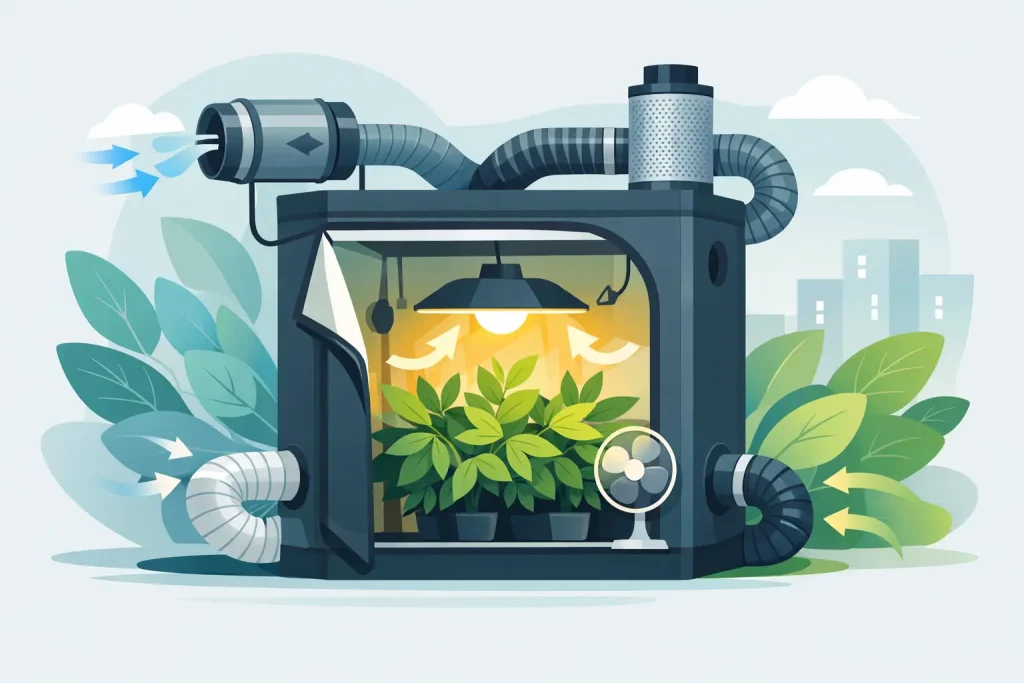
A tent that runs too hot at lights-on and too damp at lights-off usually has the same problem – poor grow tent ventilation. You can have decent lighting, good nutrients and a sound feeding schedule, but if stale air sits in the canopy, plant performance drops quickly. Heat stress, slow transpiration, weak stems, mould pressure and odour leaks all start showing up once air exchange falls behind the room load.
For most indoor growers, ventilation is not a finishing touch. It is part of the core system, on the same level as lighting and irrigation. If the extraction is undersized or the ducting layout is wrong, everything else has to work harder.
What grow tent ventilation is actually doing
At a basic level, a ventilation system removes warm, humid, stale air and replaces it with fresher air from outside the tent. That sounds simple enough, but the practical job is broader than that. Your extractor fan is dealing with heat from the lighting system, moisture released by transpiration, odour control through the carbon filter, and the constant need to keep air moving through the leaf surface.
Plants are not just using light and feed. They are responding to vapour pressure, leaf temperature and the availability of fresh air around the canopy. When extraction is too weak, humidity builds, temperatures drift upward and the microclimate around the leaves becomes less efficient. That often leads to slower growth in veg and more disease risk in flower.
This is why two tents with the same dimensions can need different fan setups. A low-wattage LED in a cool room places one demand on the system. A higher-output fixture, dense canopy and warmer ambient room place another.
Sizing grow tent ventilation properly
The usual starting point is tent volume, but that should only be treated as a baseline. A small tent with restrictive duct runs, a carbon filter and a warm lung room can easily need more extraction than the simple maths suggests.
Work out the cubic volume of the tent first by multiplying length, width and height. That gives you a rough air volume to exchange. From there, you need to account for real-world losses. Carbon filters add resistance. Long ducting runs reduce efficiency. Tight bends, silencers and poorly matched duct diameter all knock fan performance down further.
In practice, growers usually benefit from choosing an inline fan with some headroom rather than buying exactly to the minimum requirement. A fan controller then lets you dial it back if needed. That is generally better than running an undersized fan flat out and still not keeping conditions stable.
A common mistake is assuming bigger is always better. Oversized extraction can work well if it is controlled properly, but if it is too aggressive in a small tent it may strip heat too fast during lights-off, create unnecessary noise and make humidity harder to manage in cooler months. The right answer depends on your lighting load, ambient room temperature, season and whether odour control is a priority.
Negative pressure matters
A well-set tent should hold slight negative pressure. In simple terms, the tent walls should pull inwards a bit when the extraction is running. That tells you air is being drawn through the passive intake ports rather than leaking out randomly.
This matters most when you are using a carbon filter. If the tent is not under negative pressure, odour can escape through zips, seams or unused duct ports before it ever reaches the filter. If discretion is part of the brief, extraction and filtration need to be treated as one system.
Fan, filter and ducting layout
The standard tent setup is carbon filter inside the tent, connected to inline extractor fan, then ducting out of the tent and away from the grow area. That layout keeps odour under control at source and removes the hottest air from the upper part of the tent, where heat naturally collects.
Position the filter high if possible. Warm air rises, so it makes sense to extract from the hottest zone. Keep duct runs as short and straight as the space allows. Every unnecessary bend adds resistance. If you need to route around awkward corners, use broad curves rather than tight angles.
Duct size also matters. Reducing from a larger fan outlet to smaller ducting can choke performance. Matching the fan, filter and duct diameter keeps airflow more consistent and reduces strain on the system.
Acoustic ducting and silencers have their place, especially in noise-sensitive domestic setups, but they should be added with an understanding that every extra component affects airflow. Quiet is useful, but not if the room starts running hot and wet.
Intake air and circulation are not the same thing
Extraction alone does not complete the job. You also need a clean path for fresh air to enter the tent, either through passive vents or, in larger or more restrictive setups, through an active intake fan.
Passive intake works well in many small and medium tents, provided the intake area is adequate and the extraction fan is not fighting against a sealed environment. Open the lower vents so cooler incoming air enters beneath the canopy while hot air exits from the top.
Inside the tent, circulation fans are doing a different job. They move air around the leaves and through the canopy to prevent dead zones. Without circulation, you can still end up with humid pockets and weak airflow even if the extractor fan is technically exchanging air.
Aim for constant gentle movement across the plant surface rather than direct, harsh blasting. Leaves should flutter slightly, not whip around. Too much direct airflow can cause wind burn, especially in younger plants and under strong LED fixtures.
Heat, humidity and light cycles
Ventilation strategy changes across the cycle. In veg, plants are usually more forgiving, but once the canopy thickens and transpiration rises, humidity management becomes more critical. In flower, especially late flower, poor air exchange creates the kind of conditions where mould problems start quietly and spread fast.
Lights-on is normally the main heat load period, so extraction has to keep pace with fixture output. Modern LEDs often run cooler than older HID setups, but they still add heat to a closed tent, particularly in smaller spaces. A grower swapping from HID to LED may need less raw extraction, but not no extraction.
Lights-off can be trickier than some expect. Temperatures fall, but humidity often rises because the air holds less moisture as it cools. That means a tent that looks fine during the day can drift into risky humidity territory overnight. If this is happening, reducing ventilation is not always the fix. Sometimes you need steadier extraction, better circulation, or a dehumidifier in the room outside the tent.
Seasonal changes in the UK
UK growers often see big swings between winter and summer room conditions. In winter, incoming air may be cool enough that strong extraction drops tent temperatures too far, particularly during lights-off. In summer, the same setup may struggle because the intake air is already warm.
That is where fan speed controllers, thermostatic control and hygrometers earn their keep. Fixed-speed setups can work, but they give you far less flexibility once seasons change or plant mass increases.
Common grow tent ventilation mistakes
One of the most common issues is buying for tent size alone and ignoring the resistance created by the filter and ducting. Another is placing circulation fans badly so they only move air above the canopy while the interior stays stagnant.
There is also a tendency to over-focus on temperature and ignore humidity trends. A tent sitting at an acceptable temperature can still be running poor environmental conditions if relative humidity is too high for the growth stage.
Poor maintenance creates problems too. Carbon filters lose effectiveness over time, fan blades collect dust, and ducting can sag or loosen at the joins. Small faults in a ventilation system usually show up as gradual declines rather than immediate failure, so they are easy to miss until odour control slips or climate stability goes off.
If your tent smells outside the room, runs hotter than expected, or shows condensation and heavy leaf droop, check the whole airflow path rather than only the fan. Restrictions, leaks and poor placement are often the real cause.
When to upgrade your setup
If you are increasing light intensity, moving to a denser canopy, adding supplemental CO2-free environmental control, or shifting from hobby growing to more regular crop turnover, ventilation is usually one of the first systems that needs upgrading.
That does not always mean a much larger extractor. Sometimes the better move is a higher-quality inline fan, a more efficient carbon filter, improved duct routing, or better climate control accessories. EC fans, for example, offer better control and quieter operation than many basic AC models, which can make a real difference in tents that need fine adjustment rather than brute force.
Product choice should reflect how the space is actually used. A budget fan-and-filter kit can be enough for an entry-level tent. A more demanding environment benefits from better control, more stable pressure and components that hold performance over repeated cycles.
Good grow tent ventilation is not about chasing the highest airflow figure on the box. It is about matching extraction, intake, circulation and filtration to the real heat and moisture load in the tent. Get that right, and the rest of the room becomes easier to run, easier to troubleshoot and far more consistent from one cycle to the next.
If you are upgrading any part of a tent setup, start with the airflow path and be honest about where the weak point is – the fan, the filter, the ducting, the intake, or the control. Plants respond quickly when the air is right.






