
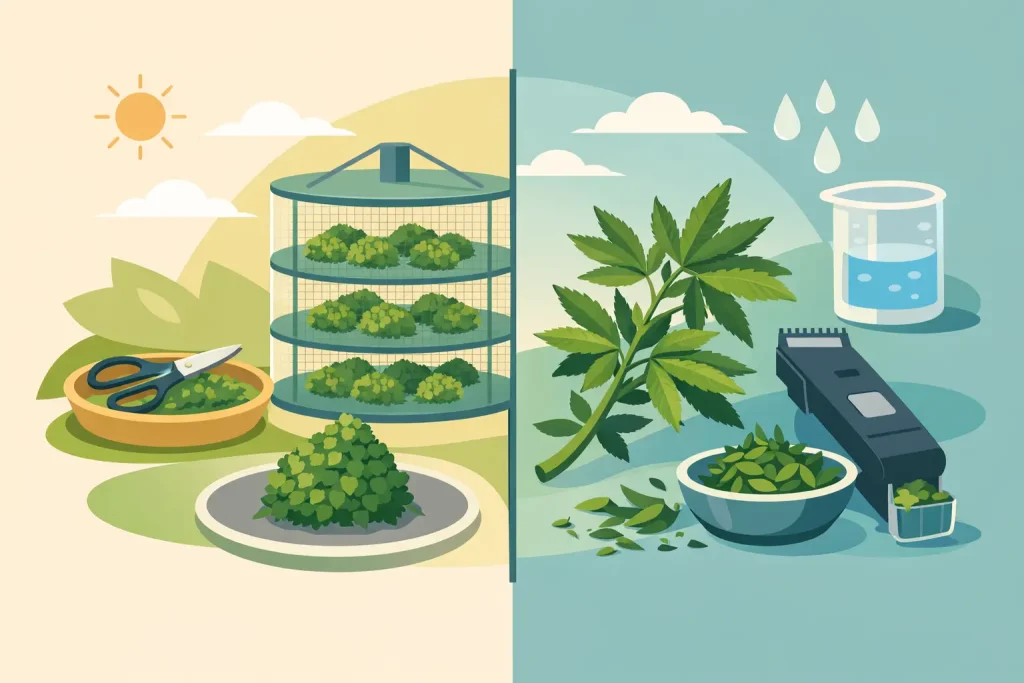
If you are deciding between dry trim vs wet trim, the right answer usually comes down to your drying room, your labour capacity and the finish standard you want from the final product. Both methods work. The difference is how they affect drying speed, handling time, terpene preservation and how much control you have over the end result.
For indoor growers, trimming is not just a cosmetic job at the end of a cycle. It changes how flowers dry, how evenly they cure and how efficiently you can turn a harvest around. If you are running a small tent and hand-trimming everything yourself, your priorities will be different from a grower processing a larger crop with drying racks, trimming scissors, gloves and trim bins set up for volume.
Dry trim vs wet trim: the core difference
Wet trimming means removing fan leaves and usually most of the sugar leaf immediately after harvest, before the plant has dried. You cut the plant down, strip it while the material is still fresh, then hang branches or place flowers on drying racks.
Dry trimming means harvesting first, hanging the plant whole or in larger branches with much of the leaf still attached, and trimming after the flowers have dried. In practice, many growers sit somewhere in the middle. They may remove the large fan leaves wet, then leave the tighter sugar leaf for a dry trim later.
That distinction matters because leaf material slows moisture loss. The more leaf left on the flower during drying, the slower and more buffered the dry tends to be. Strip more off at harvest, and the outside of the flower is exposed earlier.
When wet trim makes more sense
Wet trim is usually the faster option at the front end. The leaves are standing out from the flower, the stems are flexible and the material is easier to manipulate. If you want a quick, clean-looking result without handling dry, brittle buds later, wet trimming has a clear operational advantage.
It is also useful when ambient humidity is high and you need to reduce the risk of moisture hanging around inside dense flowers. By removing excess leaf immediately, you open the structure up and encourage a quicker dry. In a room where airflow is limited or environmental control is not especially tight, that can reduce the chance of mould developing during the first few days after harvest.
Growers working with very leafy cultivars often prefer wet trimming for the same reason. Heavy sugar leaf coverage can make dry trimming slow and awkward, especially if the plant architecture is tight. Wet trim lets you clear material before it curls in and clings to the bud.
There is also a simple labour argument. If you are processing a crop in one go and need to move through it quickly, wet trimming can be easier to organise. The material is softer, the leaves separate cleanly and you can get more done in a shorter window.
Where wet trim can work against you
The trade-off is drying speed. Once the protective leaf material is gone, flowers can dry too quickly, especially in smaller rooms with active extraction, strong circulation or low ambient humidity. Fast drying can flatten aroma, make the outer layer feel crisp before the core has equalised and reduce your margin for error during curing.
There is also more direct handling of fresh flowers. Wet buds are tacky, delicate and easy to mark up. If your trimming process is rough, or you are moving too quickly, that can affect bag appeal and resin retention.
For growers chasing a slower, more controlled dry, full wet trimming often feels too aggressive unless the drying environment is dialled in carefully.
Why many growers prefer dry trim
Dry trimming is usually chosen for quality control rather than speed. Leaving leaf on during drying acts as a buffer. Moisture leaves the flower more gradually, which can help preserve aroma and make the dry more forgiving. If your target is a steady dry rather than the quickest possible turnaround, dry trim often gives you more room to work.
This is especially relevant in controlled indoor environments where growers can manage extraction, circulation and temperature with some precision. If your drying area is properly set up, hanging whole plants or larger branches can produce a more even result across the batch.
Dry trim can also improve the final finish. Once the flowers have set, it is easier to shape them consistently without the soft, freshly harvested look that wet-trimmed flowers sometimes take on. Some growers prefer the denser, more natural presentation that comes from trimming after drying.
Another point is resin handling. Dry flowers are less sticky than wet ones, so there is often less smear on gloves and scissors. You still need to keep tools clean, but the process can feel more controlled if appearance matters.
The downside of dry trim
Dry trimming is slower and more labour-intensive. As flowers dry, small leaves tighten against the bud and become harder to remove cleanly. That means more scissor work, more attention and more time per unit processed.
It also demands a suitable drying setup. If humidity is already high, leaving too much plant material on can stretch the drying period too far and increase the risk of mould or stale-smelling flowers. Dense cultivars are the main concern here. If airflow through the drying room is poor, a whole-plant dry can create problems rather than solve them.
There is also a handling issue at the end of the process. Dry flowers are more brittle. If the trim team is heavy-handed, you can knock trichomes off more easily than you would during a careful wet trim.
Dry trim vs wet trim for indoor growers
For most indoor growers, the real question is not which method is best in theory. It is which method fits the room and the workload.
If your drying environment runs a bit dry, or you use powerful extraction and circulation, dry trimming often gives a safer pace. The extra leaf slows things down and helps avoid overdrying in the first 48 to 72 hours.
If your environment tends to run humid, or you have limited control over post-harvest conditions, wet trimming may be the safer choice. Removing leaf mass early can stop moisture building up where you do not want it.
Labour matters just as much as climate. A single grower processing a moderate harvest may not want a long dry trim session several days later. On the other hand, if quality is the priority and the batch size is manageable, dry trimming can be worth the extra time.
Cultivar also changes the decision. Airier flowers with less sugar leaf are often straightforward to dry trim. Dense, leafy flowers can be frustrating dry and may be better tackled wet or with a hybrid approach.
A practical middle ground
A lot of experienced growers do not treat dry trim vs wet trim as a strict either-or choice. They remove the large fan leaves at harvest, leave the sugar leaf in place during drying, then carry out a final trim once the flowers are ready.
That approach solves a few problems at once. It reduces excess moisture, improves airflow around the hanging branches and still slows the dry compared with a full wet trim. It also spreads the labour more sensibly. The rough work is done on harvest day, and the detail work happens later when the flowers are easier to assess for final finish.
For small-scale indoor cultivation, this is often the most practical system. It keeps the harvest moving without forcing an overly fast dry.
Equipment and workflow still matter
Whatever method you choose, trimming quality comes down to process. Sharp trimming scissors, clean gloves, trim trays or bins, drying racks where appropriate and a properly managed drying area all make more difference than growers sometimes admit. Poor workflow turns either trimming method into a bottleneck.
If you are wet trimming, keep tools clean and avoid overhandling. If you are dry trimming, make sure the flowers have dried evenly before you start, otherwise you end up trimming material that is still too soft in the middle and too crisp on the outside.
It also helps to think in batches. Do not cut more than you can process properly in the available time. Rushing the trim because the harvest volume got ahead of the room setup is where quality starts to fall away.
So which one should you use?
Use wet trim if you need speed, if humidity is a concern or if the crop is leafy enough to make later trimming inefficient. Use dry trim if your drying conditions are controlled, if terpene retention and finish quality are the priority, or if you want a slower dry with more protection around the flower.
If conditions are somewhere in between, use a hybrid method. For many growers, that is the most reliable option because it matches the reality of indoor harvests rather than forcing a hard rule.
The best trimming method is the one that fits your room, your cultivar and the amount of labour you can actually put on the job. Get those three aligned, and the trim becomes part of a stable post-harvest workflow rather than a last-minute compromise.






