
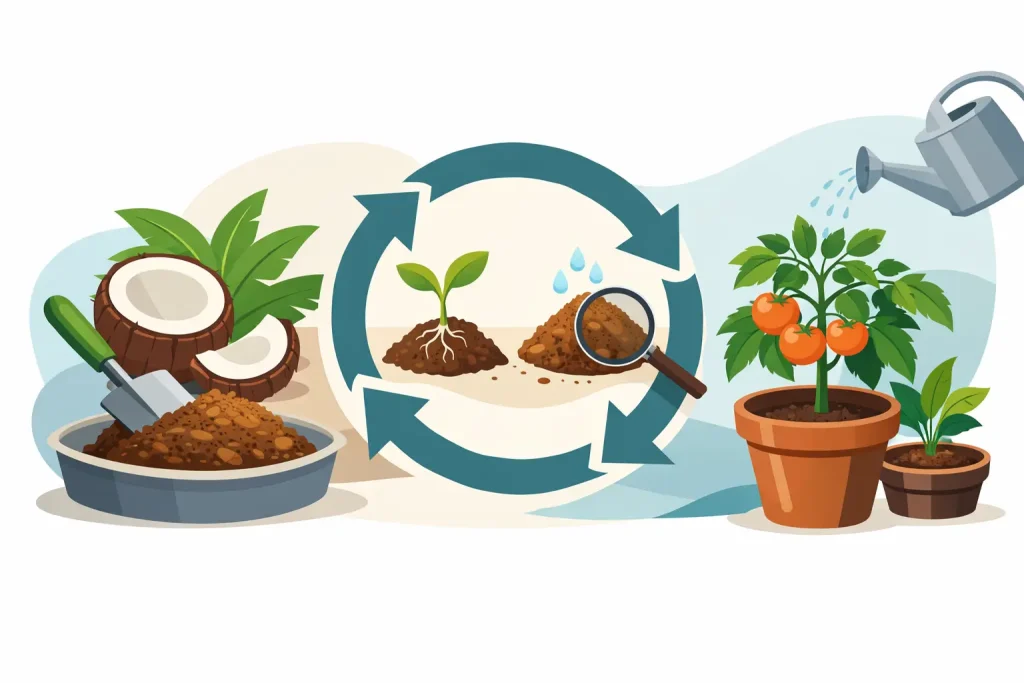
If you are staring at a pile of spent coco after harvest and wondering, can you reuse coco coir, the short answer is yes. The more useful answer is that you can reuse it when the structure is still sound, salt levels are under control, and you are prepared to clean and rebuffer it properly. If not, fresh media is usually the faster and safer option.
Coco is not a single-use medium in the same way as some propagation plugs or heavily degraded composts. Good-quality coco has a stable structure, solid air-to-water balance and decent lifespan across more than one crop cycle. That is why plenty of growers reuse it, especially in run-to-waste systems, drip-fed pots and larger containers where the volume of media starts to add up. But reused coco is only worth it if it does not create more problems than it solves.
Can You Reuse Coco Coir for Every Grow?
Not for every grow, and not in every setup.
If the previous crop was healthy, root disease-free and fed on a sensible schedule, reusing coco can work well. If you had pythium, fusarium, fungus gnat pressure, severe lockout, heavy salt build-up or badly compacted root zones, reusing that same media is a gamble. Coco holds on to cations and nutrient residues, so poor crop management in one cycle can carry into the next.
The other factor is crop value. If you are running a high-value flowering room where consistency matters, fresh coco often makes more commercial sense. If you are filling mother plant pots, trial containers or lower-risk veg spaces, reused coco can be perfectly practical.
What Makes Coco Reusable?
Coco coir is reusable because it breaks down more slowly than many peat-based mixes. It keeps a useful pore structure for oxygen around the root zone, and when it is properly buffered it handles calcium and magnesium more predictably. That said, each cycle knocks the media about a bit.
Roots left in the pot decompose. Fines increase. Drainage can slow down. Salts from nutrient feed can accumulate, especially if runoff was inconsistent. If you have been irrigating multiple times a day in a heavy-feed schedule, that old coco may look fine on top while carrying a lot of residual EC lower down.
This is why reused coco is never just a case of shaking out the root ball and planting again. You need to assess it as media, not as waste you are trying to save.
When Reusing Coco Coir Makes Sense
Reusing coco makes the most sense when the media still drains freely and has not turned dense or muddy. If the texture remains open and fibrous after removing old roots, you are starting from a workable base.
It also helps when the previous nutrient programme was stable. Moderate EC, regular runoff and no obvious deficiencies or toxicity issues usually mean less corrective work. In practical terms, growers who stay on top of irrigation and root-zone management are the ones most likely to get good results from a second run.
Mixing old coco with a portion of fresh coco or fresh perlite is often the sensible middle ground. You keep some cost efficiency without relying on tired media for the full root zone.
When Fresh Coco Is the Better Option
Sometimes fresh media is simply the better operational decision.
If the old coco smells sour, stays waterlogged, shows algae crusting, contains pest larvae, or came from plants with poor root health, binning it is usually the right call. The same applies if you are trying to troubleshoot a room. Reusing questionable media adds another variable you do not need.
Fresh coco is also the cleaner option when you need uniformity across multiple pots or slabs. Commercial growers and serious hobbyists often value repeatability more than squeezing one more cycle out of a medium. The labour involved in washing, treating and buffering old coco is real, and that labour has a cost.
How to Reuse Coco Coir Properly
The process matters more than the intention. If you want reused coco to perform properly, treat it like media prep.
Remove roots and old debris
Start by breaking up the old root ball and pulling out as much root mass as possible. You will never get every fine root out, and that is fine, but large woody sections should go. If you leave too much dead material in the pot, decomposition can affect air content and microbial balance.
Wash out residual salts
Flush the coco thoroughly with clean water until runoff drops to a more reasonable EC. If you have an EC meter, use it. Guesswork is less useful here than a quick reading. Old coco can carry far more salt than it appears to on the surface.
For growers in hard-water areas, the source water itself matters. If your base water is already high in EC, flushing with it may not reduce salt levels as effectively as expected.
Rebuffer before reuse
This is the step many growers skip, then blame the coco.
Coco should be buffered again with a calcium and magnesium source before planting. Once reused, the cation exchange sites are not magically reset. If you refill pots with washed coco and go straight into feeding, you can see early calcium and magnesium issues, weak establishment or odd deficiencies that are really media-related.
A proper buffering soak helps stabilise the medium before the next crop goes in.
Restore structure if needed
If the coco has become too fine or compacted, mix in fresh perlite or some fresh coco. This improves drainage and root-zone oxygen. In many cases, 20 to 50 per cent fresh material is enough to bring tired media back into a more usable range.
Check for pests and disease risk
Do not ignore hygiene. If there is any suspicion of root disease or a significant pest issue, reusing the media may not be worth it. Some growers try sterilisation methods, but results vary and the process can be more trouble than simply starting with fresh bags.
Common Problems With Reused Coco
The main issue is inconsistency. One pot may drain well while another stays heavy. One section of media may have acceptable EC while another is still loaded with salts. That unevenness can show up as patchy growth, slower rooting and feed-response problems.
Compaction is another common problem. Reused coco that has broken down too far will hold less oxygen. In fast-growing crops, that can reduce root vigour and make overwatering easier, especially in cooler rooms.
There is also the hygiene side. Fungus gnats, root aphids and pathogens are easier to carry over when media is reused casually. If your grow room is tightly controlled and clean-downs are routine, the risk is lower. If housekeeping has been loose, old media gives problems somewhere to hide.
Is Reused Coco Worth It Financially?
That depends on scale and labour.
For a small tent grow, the cost of fresh coco may be low enough that reusing it barely saves anything once your time is factored in. For larger pot counts, beds or regular crop turnover, the savings can be meaningful, especially if your process for washing and buffering is already dialled in.
The sensible question is not just whether you can save money on media. It is whether reused coco maintains enough performance to protect yield and crop quality. Saving on substrate only makes sense if you are not giving that saving back through slower growth, extra troubleshooting or reduced output.
Best Use Cases for Reused Coco
Reused coco tends to perform best in less sensitive applications. Vegetative stages, mother plants and general-purpose container growing are usually more forgiving than high-intensity flowering runs where everything needs to stay predictable.
It can also work well when blended with fresh media rather than used alone. That approach reduces risk while still cutting waste and media cost. Many experienced growers treat reused coco as part of the mix, not the entire answer.
If you are sourcing cultivation media and irrigation gear from a specialist supplier such as Hydroponic Centre, it usually makes sense to look at the whole system rather than the bag of coco on its own. Drainage, runoff management, enzyme use, root health products and feed strength all affect whether reused media performs properly.
A Practical Rule for Deciding
If the old coco is clean, open in structure, low in residual salts and free from disease, reusing it is reasonable. If any of those points are questionable, fresh media is the safer move.
That is really the line. Coco can be reused, but it should earn its place in the next crop. Good growers are not sentimental about substrate. If the media still does the job, prep it properly and use it. If it is likely to slow the room down, replace it and keep the cycle moving.
A bag of fresh coco is cheaper than a crop full of root-zone issues, but good coco does not need throwing away after one run just because the calendar says harvest is finished.






