
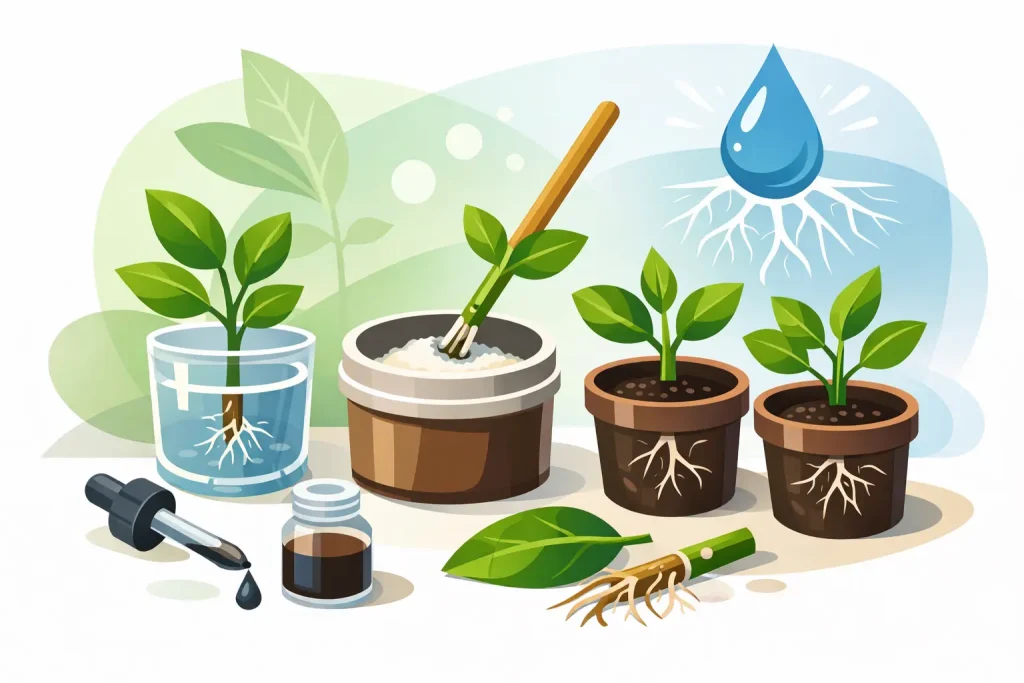
A tray of fresh cuttings can look perfect on day one and still fail by day seven. In most cases, the problem is not the scissors or the genetics. It is the rooting environment, and the root stimulant for cuttings is only one part of that system. Used properly, it can speed up callus formation, improve strike rates and help young plants establish a stronger root mass before transplant.
For indoor growers, that matters because weak propagation slows everything downstream. A poor start affects veg time, uniformity, feed scheduling and space efficiency. If you are running a tent, a dedicated propagation area or a small commercial room, getting cuttings to root consistently is one of the simplest ways to tighten up the whole cycle.
What a root stimulant for cuttings actually does
A root stimulant for cuttings is designed to encourage early root initiation and support the first stage of development after the cutting has been taken from the mother plant. Depending on the product type, that usually means either applying a rooting hormone directly to the cut stem, feeding low-strength root-promoting compounds into the propagation medium, or combining both.
That distinction matters. A rooting gel or powder is usually applied once, at the point of sticking the cutting. Its job is to support root initiation at the wound site. A liquid root stimulant is generally used in the media or reservoir during propagation and early transplant. Its role is broader – helping root development, reducing stress and improving early vigour.
Growers often use the term loosely, but these products are not interchangeable. If you treat a liquid additive like a direct replacement for a cloning gel, you may get slower or less reliable results. If you rely only on a gel and ignore temperature, humidity and media moisture, the stimulant will not rescue the batch.
Choosing the best root stimulant for cuttings
The best option depends on your propagation method, how many cuttings you run at a time and how tightly you control the environment. There is no single best product for every room.
Gels and powders
Gels are the standard choice for many growers because they coat the stem evenly and stay in place when the cutting goes into a plug, cube or peat-free propagation medium. They are clean to use, straightforward to dose and well suited to repeatable workflows. Powders can work well too, but they are a bit less tidy and can be inconsistent if too much is left on the stem.
For manual propagation with rockwool cubes, rooting plugs or small starter blocks, a gel is usually the easiest option. It gives direct contact with the cut site and reduces the risk of the active ingredient washing off immediately.
Liquid root stimulants
Liquid products come into their own when you want support beyond the initial strike. They are useful in propagation trays, hand-watered starter pots, coco, light mixes and hydroponic systems where young roots need a low-stress start. Many contain seaweed extracts, B vitamins, humic compounds or other ingredients aimed at root mass and plant recovery.
They are particularly useful after roots have emerged. At that point, the cutting is no longer just trying to initiate roots – it is trying to build enough root structure to handle transplant and early feeding.
Combined use
In many setups, the most effective approach is direct application plus a mild liquid feed programme built for propagation. That means using a rooting gel on the stem, then keeping the media lightly charged with a low-EC root stimulant. It is a practical combination because it covers both phases – initiation and establishment.
Matching the product to the propagation system
If you propagate in rockwool, stem contact and moisture balance are the main concerns. A gel works well here because it adheres to the cut surface and sits neatly inside the planting hole. Just avoid over-saturating the cube. If the cube is too wet, oxygen availability drops and the stem can stall or rot.
If you use peat-free plugs or organic starter media, gels still make sense, but liquid stimulants can be especially useful as part of a gentle hand-watering regime. Organic-based products often pair well with these media, although cleanliness matters. In a warm propagator, any overly rich feed can create hygiene problems fast.
For aeroponic or cloning machines, direct rooting compounds may still be used, but some systems perform better with clean stems and a carefully managed reservoir. It depends on the machine, the spray cycle and the product formulation. Thick gels can sometimes be less practical in high-turnover cloners if they contaminate collars or water. In those systems, a clean, low-strength liquid programme may be the better fit.
Application matters more than most growers think
The cutting should be taken from healthy, hydrated stock and trimmed with a clean blade. Once cut, time matters. The stem should go quickly into water or straight into the chosen root stimulant for cuttings to avoid air entering the tissue and slowing uptake.
Do not drown the stem in product. With gels and powders, even coverage on the lower section is enough. If you cake a powder on too heavily or leave excess gel dripping, you can create an anaerobic pocket around the stem once it is inserted into the media.
Media moisture is another common failure point. Damp is correct. Wet is not. The stem needs contact moisture, but also air. Too much water is one of the main reasons cuttings collapse before roots appear.
Then there is environment. Most cuttings root best with high humidity at first, moderate warmth at root zone level and restrained light intensity. Push the light too hard and transpiration rises before roots can support it. Run the room too cool and root initiation drags. Run it too hot and you invite disease pressure.
What to expect, and when to worry
A stimulant improves the odds, but it does not make every cultivar behave the same way. Some varieties throw roots quickly and aggressively. Others sit for longer, especially if stems are woody or the cuttings were taken from less-than-ideal material.
In a stable environment, many soft-stem cuttings show early rooting signs within several days, with stronger development following in one to two weeks. If you see yellowing, stem collapse, mushy tissue or a sour smell in the tray, the problem is usually moisture, hygiene or temperature rather than a lack of stimulant.
Equally, not every slow batch is a failed batch. Growers often overcorrect by adding more feed or keeping the propagator too wet. That usually makes things worse. A cleaner approach is to hold the environment steady and let the root zone breathe.
Common mistakes with root stimulants
Overfeeding is a regular issue. Fresh cuttings do not need a full nutrient programme. Until roots emerge, they are not processing feed in the same way as established plants. A high EC around the stem can stress the cutting and delay rooting.
Mixing too many additives is another one. A root stimulant, a cloning gel, a vitamin booster and a microbial product may all sound compatible, but the result can be unnecessary complexity in a stage that benefits from control and restraint. Keep the propagation stack simple unless you have already tested a more layered approach.
Storage gets overlooked as well. Gels, powders and liquids all need to be kept sealed and handled cleanly. If you dip stems directly into the main container, contamination risk goes up. Decant what you need for the session and discard the remainder.
When a root stimulant is worth paying for
If you are taking the odd cutting once or twice a year, basic rooting products will often do the job provided the environment is right. But if you are propagating regularly, consistency matters more than shaving a few pounds off the input cost.
A reliable root stimulant for cuttings earns its keep when it reduces batch losses, shortens propagation time and produces more even transplants. That is especially relevant in controlled indoor setups, where poor propagation affects canopy timing, irrigation planning and space usage. For growers building out a proper workflow, product choice should be made alongside tray format, plug type, humidity control and propagation lighting – not in isolation.
The useful mindset is to stop looking for a miracle bottle. Good propagation comes from a clean cut, the right direct rooting product, the right media moisture and a stable environment that does not force the cutting to work too hard before roots arrive. Get those parts aligned and the stimulant starts doing what it is supposed to do.
If your cuttings have been inconsistent, start by simplifying the process rather than adding more products. One well-matched root stimulant, one suitable propagation medium and tighter control over humidity and temperature will usually take you further than a shelf full of additives.






