
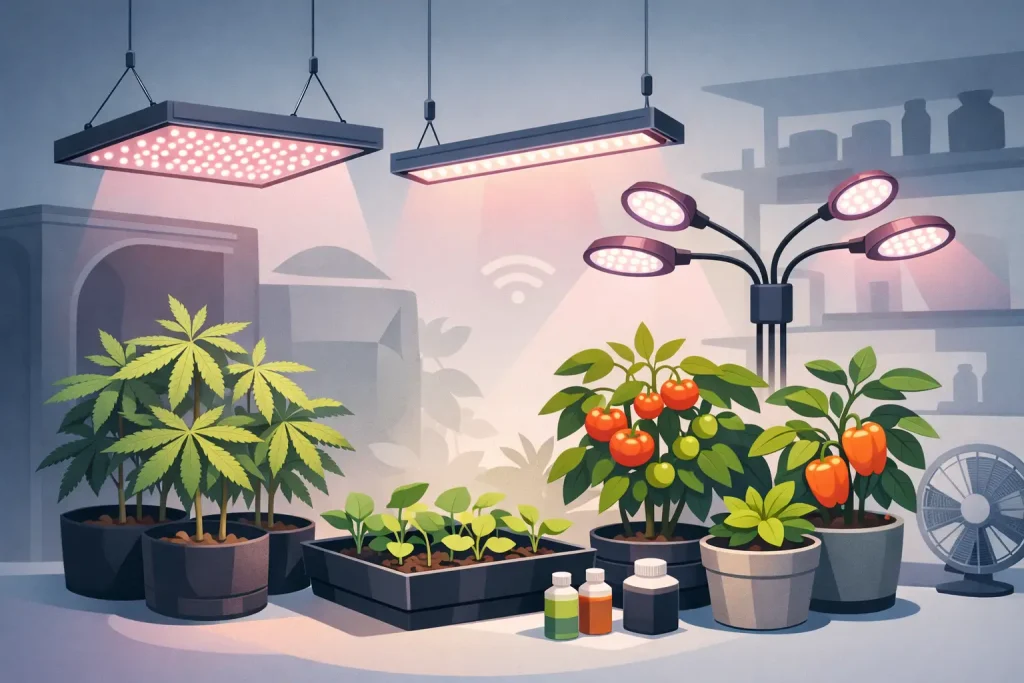
Cheap LED panels look fine until you hang one over a live canopy and realise half the footprint is underlit. That is the real issue with the best budget LED grow lights – not the headline wattage, but how much usable light you get across the space you actually need to cover.
For most growers, budget does not mean buying the lowest-priced fixture on the page. It means getting enough PPFD, decent efficiency, stable drivers and workable heat levels without paying for a premium badge or features you will never use. If you are building out a small tent, upgrading from blurple units, or trying to keep power draw sensible, the right value LED can do the job well. The wrong one usually costs more later.
What makes the best budget LED grow lights worth buying
At the budget end of the market, the main filter is performance per pound. You are not chasing the most advanced commercial fixture. You are looking for a unit that can support healthy growth, handle a realistic flowering cycle and run reliably in a controlled environment.
Start with actual coverage, not marketing claims. A light advertised for a 4 x 4 area may only deliver acceptable flowering intensity over the centre, with weaker edge performance. In practice, many lower-cost fixtures are more honest in veg than in bloom. If your target is dense flowering, tighter canopy spacing and stronger lower-site development, it is safer to size the fixture around flowering coverage rather than maximum possible footprint.
Efficiency matters because it affects both output and running cost. A budget LED with a more efficient diode layout can outperform a cheaper, less efficient panel while drawing similar power. Over time, that means more usable light for the same electricity spend and less wasted energy as heat. In a tent, that heat difference can also reduce how hard your extraction system has to work.
Build quality is the next trade-off. Budget does not have to mean poor, but there is usually a line. A basic bar fixture or quantum-board style light with a decent driver, passive cooling and straightforward dimming is often better value than a heavily branded unit with flashy casing and thin performance data. Look for fixtures that tell you what they are, not ones trying to hide behind vague labels.
How to match a budget LED to your grow space
The best budget LED grow lights are only good value if they suit the space. Most mistakes happen here.
Small propagation areas and shelving
For clones, seedlings, herbs and early veg, you do not need extreme intensity. A lower-powered LED strip, compact board or small full-spectrum fixture is usually enough. The goal is even spread, low heat and enough output to keep growth short and healthy without stressing young plants.
This is where overspending is common. If the space is a shelf, propagator station or small nursery corner, a high-powered flowering fixture is wasted money and creates unnecessary environmental management issues.
60 x 60 cm and 80 x 80 cm tents
This is a common entry point for home growers and one of the strongest use cases for budget LED fixtures. A good-value light in this class should provide strong veg performance and enough flowering intensity for a compact canopy, especially with sensible plant numbers and training.
If you are choosing between two fixtures at similar price points, favour the one with better spread and dimming control over raw claimed wattage. In a smaller tent, the ability to back the light off during early stages is useful, and a more even footprint usually gives better results than a brighter hotspot in the middle.
1.2 x 1.2 m tents and larger
This is where budget lighting gets more complicated. You can still run a value-led setup, but trying to flower a larger area with an underpowered fixture usually leads to airy corners and uneven development. In many cases, two smaller fixtures provide better uniformity than one cheap central panel.
If your target is a full canopy in a 1.2 x 1.2, it often makes more sense to buy a sensible mid-range LED once than replace an inadequate budget fixture after one cycle. Budget is about cost control, not under-lighting a productive space.
Best budget LED grow lights by type
There is no single best format for every room. The right option depends on canopy shape, headroom and whether you prioritise low upfront spend or long-term flexibility.
Quantum-board style LEDs
These remain a strong choice for growers who want simple setup and respectable efficiency without paying top-end money. They are easy to hang, generally easy to dim and well suited to small and medium tents. The downside is spread. In larger spaces, a single board can create stronger centre intensity than edge coverage.
For straightforward tent growing, they still represent one of the most practical budget-friendly formats, especially if you are moving on from older blurple fixtures.
LED bar fixtures
Bar-style lights have become more attractive even at lower price points because they solve one of the biggest budget-light problems – uneven coverage. By distributing diodes across multiple bars, they can deliver a more consistent footprint and better canopy penetration across the whole area.
The catch is price. Entry-level bar fixtures are not always the cheapest upfront, but they can be better value where uniformity matters. If you are lighting a full tent rather than a few plants under the centre, this format is often the smarter buy.
Compact full-spectrum panels
These suit small spaces, mother plants and propagation zones. They are usually simple, affordable and easy to manage in terms of heat. Just be realistic about output. Many compact panels are ideal for veg and small-scale grows but become stretched when asked to flower dense canopies beyond their true coverage area.
Red flags when comparing cheap grow lights
If a fixture has no meaningful data, treat that as data. The lower end of the market still contains plenty of inflated wattage claims, vague spectrum language and unrealistic coverage statements.
Be careful with equivalent wattage marketing. What matters is actual wall draw and the intensity delivered at canopy level, not comparisons to older HID systems. A light claiming to replace a much larger HPS unit is rarely a bargain if it cannot support the same flowering performance.
Watch for poor thermal management as well. Excess heat shortens component life and can destabilise performance over time. A budget LED should still be able to run consistently through repeated cycles without driver issues, excessive case temperature or dramatic output drop.
Noise is another factor growers overlook. Some low-cost fixtures use active cooling that adds fan noise and introduces another potential failure point. Passive cooling designs are often the better option in small indoor environments where simplicity matters.
Where to spend and where to save
If you are building on a budget, spend on light before accessories. A better fixture will usually improve outcomes more than minor upgrades elsewhere. Light quality drives structure, spacing and flower development, and weak lighting cannot be fixed later with nutrients or additives.
You can save money by being disciplined about the actual footprint, avoiding oversized claims and choosing proven design formats over novelty features. You do not need app control, decorative casing or inflated spectrum jargon. You need stable output, usable spread and sensible efficiency.
There is also a case for buying with expansion in mind. A fixture that works now in an 80 x 80 tent but can later be paired with a second unit in a larger room may be better value than a one-off purchase with no upgrade path. For growers steadily improving a setup, modularity counts.
Best budget LED grow lights for different growers
For first-time tent growers, the best option is usually a dimmable full-spectrum fixture with honest flowering coverage and straightforward hanging hardware. Keep it simple and get the environment right.
For growers replacing older HID or blurple units, look for improved efficiency and wider spread rather than just matching wattage labels. The gain is often in uniformity, canopy control and lower heat load.
For more experienced cultivators running perpetual cycles or separate veg and flower areas, budget LEDs make most sense when assigned by task. Use lower-powered, efficient fixtures for propagation and veg, then reserve stronger, better-spread units for flowering zones. That is a more efficient way to spend than trying to make one cheap light do everything.
If you are comparing options across a specialist retailer such as Hydroponic Centre, the real advantage is being able to weigh light output against the rest of the room build – extraction, tent size, circulation, timers and irrigation – rather than buying a fixture in isolation.
The real question before you buy
The best budget LED grow lights are the ones that fit the canopy, not the ones with the lowest price tag. A light that covers your space properly, runs efficiently and gives you room to manage plant height and temperature is cheaper in practice than a bargain fixture that needs replacing after one poor cycle.
Buy for the area you are genuinely flowering, leave yourself some adjustment range, and treat exaggerated claims with caution. If the numbers are unclear, the risk usually is not worth the saving. A sensible LED bought once is still the better budget decision.






