
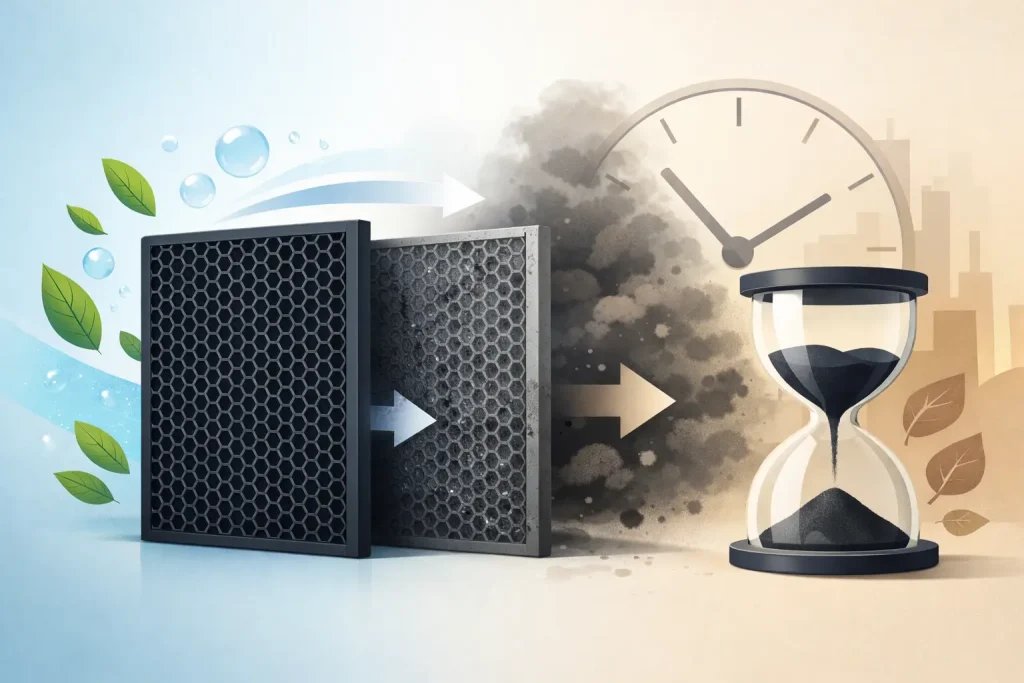
If your extraction setup starts letting odour through halfway into flower, the question gets very simple very quickly – do carbon filters wear out? Yes, they do. Activated carbon is a consumable medium, and once enough of its pore structure is occupied by volatile organic compounds, airflow contaminants stop binding effectively and smells begin to escape.
For indoor growers, that matters more than it does in most other applications. A carbon filter is not there for aesthetics. It is part of the core environmental control package, alongside fans, ducting and air movement. When it starts to lose efficiency, the problem is usually noticed late – not when the filter first begins to decline, but when odour control is already compromised.
Do carbon filters wear out in real grow room use?
They do, but not all at the same rate. The label lifespan on a filter is only a rough guide because real-world performance depends on how the room is run. Two growers can install the same filter on the same day and get very different service life from it.
The basic reason is straightforward. Activated carbon works by adsorption. Odour molecules stick to the huge internal surface area within the carbon bed. Over time, that available surface area becomes less effective as more compounds are trapped. Once the carbon is saturated, or close enough to saturation, odour removal drops off.
In a grow room or tent, filter wear is usually accelerated by three things: excessive humidity, poor pre-filtration and incorrect fan matching. If the environment is damp, airborne moisture competes with odour compounds and can reduce adsorption efficiency. If the pre-filter sleeve is dirty or missing, dust and fine particulates contaminate the carbon bed. If the fan is too powerful for the filter, contact time drops and air passes through too quickly for efficient scrubbing.
What actually causes a carbon filter to stop working?
A lot of growers assume a carbon filter only fails because the carbon is old. Age matters, but operating conditions matter more. A filter stored properly and used in a stable environment can last a good while. A filter run hard in a hot, humid room with poor maintenance can drop off much sooner.
Carbon saturation
This is the main one. Every carbon bed has a finite adsorption capacity. Once that capacity is used up, the filter cannot keep trapping odour at the same rate. You may still get some reduction, but not the level needed for proper control.
High humidity
Humidity is hard on carbon filtration. When relative humidity stays too high, moisture occupies adsorption sites and reduces how effectively odour molecules are captured. In late veg and flower, where plant mass and transpiration increase, this becomes more relevant. If your climate control is weak, your filter life usually is too.
Dust and debris
The white pre-filter sleeve is not optional packaging. It is there to catch larger particles before they reach the carbon. If it clogs up, airflow suffers. If it is absent or badly fitted, the carbon bed gets contaminated. Either way, performance drops.
Poor fan and filter matching
Every filter has an airflow rating. If your extractor fan is oversized relative to the filter, air spends less time in contact with the carbon. That means lower odour capture, even if the filter itself is not fully spent. In practice, that can look like a worn-out filter when the issue is actually system design.
Long operating hours
A filter running continuously on an active extraction system will wear out faster than one used intermittently. That sounds obvious, but it is worth stating because many growers compare lifespan in months rather than actual usage. A filter running 24/7 through multiple cycles is doing a very different job from one used lightly in a hobby tent.
How long should a carbon filter last?
For most indoor growing setups, a reasonable expectation is around 12 to 24 months of use. That is a broad range because build quality, carbon grade, bed depth and room conditions all make a difference.
A budget filter in a warm, humid tent with heavy odour load may struggle before the one-year mark. A higher-spec unit with properly managed humidity, a clean pre-filter and sensible fan speed control can go longer. This is one of those areas where cheaper upfront can become more expensive over time.
Bigger is not always better either. An oversized filter can give more headroom and slower airflow, which often helps, but only if the rest of the extraction setup is matched correctly. The goal is balanced airflow, not simply maximum size.
Signs your carbon filter is wearing out
The first sign is usually obvious: smell where you should not have any. If odour is escaping outside the tent or room despite sealed ducting and correct airflow direction, the filter should be one of the first things you check.
A second sign is that odour control only works at lower fan speeds or during less demanding stages of growth. As plant odour intensifies, a marginal filter often gets exposed. Early veg may seem fine, then late flower tells the truth.
Reduced airflow can also be a clue, although that does not always mean the carbon itself is spent. A heavily clogged pre-filter sleeve, dirty ducting or fan issues can create similar symptoms. That is why it helps to inspect the full extraction chain before replacing parts blindly.
If you have already ruled out leaks, loose duct connections, negative pressure problems and humidity issues, persistent smell usually points back to a tired filter.
Can a carbon filter be refreshed or refilled?
Sometimes, but usually not in a way that makes sense for most growers. Some filter designs allow carbon replacement, but many are sealed units intended to be replaced once performance drops. Even on refillable models, the job is messy, time-consuming and easy to get wrong if the carbon type, density or packing is off.
There is also a difference between cleaning a filter and restoring it. Washing the outer sleeve helps airflow and protects the core. It does not reactivate spent carbon. Once adsorption capacity is gone, it is gone.
Claims that you can fully revive a saturated carbon filter with simple home methods should be treated cautiously. In practical grow room use, replacement is normally the reliable answer.
How to make a carbon filter last longer
Filter life is mostly about reducing avoidable stress on the system. Keep humidity under control, particularly during lights-off and late flower. Clean or replace the pre-filter sleeve when it gets dirty. Make sure your fan is correctly sized for the filter and use a speed controller where appropriate rather than running everything flat out by default.
It also helps to keep the room clean. Dust, media particles and general debris all add load to the extraction system. If you are running coco, dry amendments or loose substrates, fine particulates can build up faster than you think.
Position matters as well. A filter mounted securely, with good airflow around it and sensible duct routing, will generally perform better than one fitted into a cramped setup with sharp bends and restrictions.
For growers running multiple cycles per year, it is worth treating carbon filters as planned maintenance rather than emergency replacement kit. That is easier operationally than waiting for odour breakthrough and then scrambling for a fix.
Is it the filter, or another ventilation problem?
This is where a bit of troubleshooting saves money. Not every odour issue means the carbon is spent. If the room has lost negative pressure, unfiltered air may be escaping through passive vents, zips or gaps. If ducting has come loose, air may be bypassing the filter altogether. If humidity is too high, filter performance can dip even when the carbon still has useful life left.
Check the obvious first: sleeve condition, fan operation, duct seals, room pressure and humidity levels. If all of those are in order and the smell remains, replacement is the sensible move.
For serious growers, this is why extraction should be specified as a complete system rather than as isolated parts. Filter, fan, controller and ducting need to work together. Hydroponic Centre customers typically already think that way, and it pays off here.
When should you replace a carbon filter?
Replace it when odour control is no longer dependable, not when it has completely failed. In practice, that means acting at the first clear signs of breakthrough after you have checked the rest of the system. If discretion matters, there is no benefit in squeezing an extra few weeks out of a filter that is already underperforming.
If you run back-to-back cycles, it is sensible to assess the filter between rounds rather than during peak flowering. Waiting until the room is at its highest odour load is poor timing for ventilation decisions.
A carbon filter is one of those components that tends to be ignored when it works and suddenly becomes urgent when it does not. Treat it like any other wear item in a controlled environment setup. If the environment is clean, dry and properly balanced, it will last longer. If not, it will tell you soon enough.
The useful habit is simple: do not wait for the smell to make the decision for you.






