
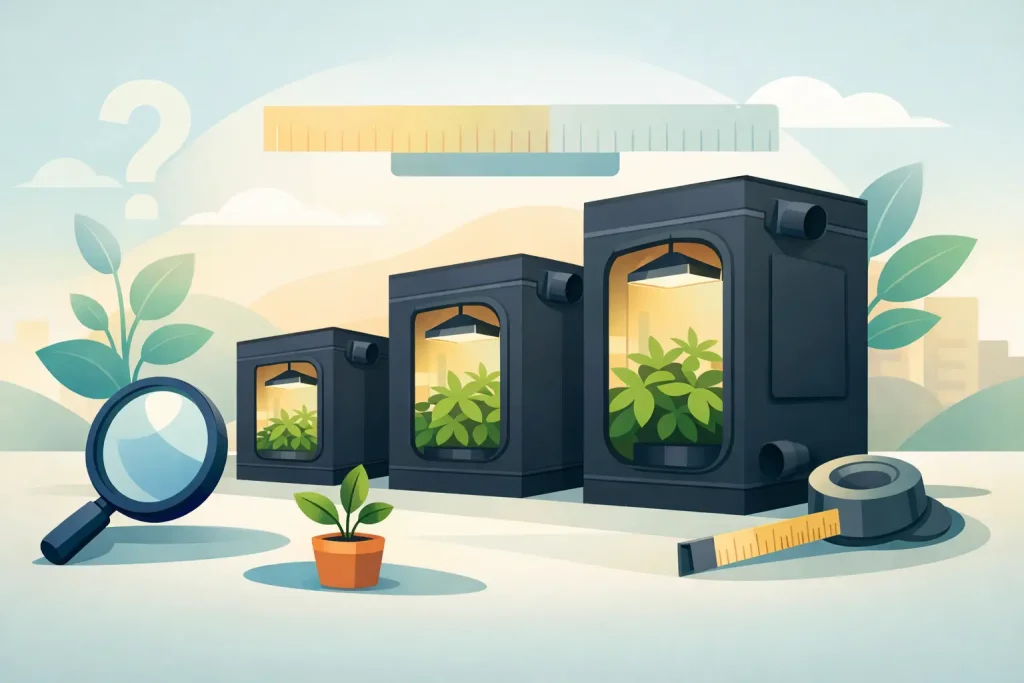
Choosing the wrong tent usually shows up later – cramped canopy, poor airflow, awkward access, or a light that runs too hot for the footprint. If you are asking what size grow tent you need, the answer is not just plant count. Tent size has to match your lighting, extraction, growing system, working space and the way you actually manage the crop.
A tent that looks fine on paper can become inefficient very quickly once you add a carbon filter, fan, ducting, reservoir, trays and cables. That is why the best approach is to size the tent around the full setup, not just the pots.
What size grow tent depends on
The first variable is canopy area. A small number of large plants can fill the same footprint as a bigger number of smaller plants, so floor space matters more than the raw plant count on its own. A 60 x 60 cm tent suits a compact grow with limited training and smaller containers. A 120 x 120 cm tent gives a very different working area and allows stronger lighting, better spacing and more flexibility.
Height matters just as much. Tent height is not only for plant growth. You also need room for the fixture, the hangers, the gap between light and canopy, and the clearance above the light for heat management. Once you account for pot height and saucers or a hydro system base, usable plant height is always less than the tent specification suggests.
Equipment load is the next factor. Extraction kit, carbon filters, clip fans, silencers, ducting and irrigation parts all take space. In small tents, overhead equipment can reduce usable headroom quickly. In larger tents, the issue is usually making sure the airflow pattern still works across the full area.
Common grow tent sizes and who they suit
A 60 x 60 cm tent is generally the entry point for growers with limited space. It suits a single plant or a very compact multi-plant run, especially under a smaller LED fixture. It is manageable, discreet and cheaper to equip, but there is very little margin for error. If the genetics stretch hard or the environmental control is weak, it becomes crowded fast.
An 80 x 80 cm tent is often a better small-grow option because it gives extra working room without moving into a large footprint. That extra space helps with airflow, training and access around the canopy. For many home growers, this is where a tent starts to feel practical rather than tight.
A 100 x 100 cm tent sits in a useful middle ground. It can support a productive canopy without demanding the extraction and power draw of a larger room-style setup. It also gives more flexibility with pot size, irrigation layout and fixture choice.
A 120 x 120 cm tent is one of the most versatile sizes for serious home cultivation. It suits a wider range of lighting systems, gives enough floor area for stronger yields, and allows a more even environmental spread. If you want room to work, train plants properly and avoid overcrowding, this size is often the point where setup decisions become easier.
A 150 x 150 cm or 240 x 120 cm tent moves into a more advanced category. These sizes can be highly productive, but they only make sense if the rest of the equipment is scaled correctly. More floor area means more lighting power, more extraction demand and a greater need for uniform airflow. If the supporting kit is under-specced, a larger tent can perform worse than a well-built smaller one.
Plant count is only a rough guide
Growers often start with the question, how many plants fit in a tent. That is understandable, but it is not the best sizing method. Plant count changes with genetics, veg time, training method and container size. Four plants in a 120 x 120 cm tent can be perfect in one cycle and excessive in another.
If you run hydroponic systems, the footprint is even more important. A deep water culture setup, flood-and-drain tray or run-to-waste arrangement may limit the layout long before the canopy fills the tent. Reservoir access also matters. If you cannot reach the system to top up, drain or inspect it easily, the tent is too small for the workflow.
For soil or coco grows, pot diameter and runoff management need proper allowance. It is easy to underestimate how much space trays, catchment and hand access take up once the crop is established.
Match the tent to the light, not the other way round
One of the most common mistakes is buying a tent first and then forcing the lighting choice to fit. A better method is to decide what canopy area you want to cover and then match the tent to a sensible fixture for that footprint.
A tent that is too large for the light leaves weak edges and wasted floor area. A tent that is too small for the light creates excess heat, limited hanging height and poor uniformity. Even with efficient LED fixtures, spacing still matters. The best result comes from a tent footprint that suits the fixture’s intended coverage rather than the maximum number printed on a box.
Height becomes critical here. If the light needs a safe working distance from the canopy, a short tent may force more aggressive training or smaller plant sizes than planned. That can be fine if it is deliberate, but not if it comes as a surprise halfway through the cycle.
Ventilation changes the sizing decision
Any realistic answer to what size grow tent works best has to include ventilation. As tents get larger, the volume of air to move increases. The filter and fan need to be matched to the cubic capacity of the tent, but also to the heat load from lighting and the resistance created by ducting and filtration.
In smaller tents, the challenge is often physical fit. A carbon filter and extractor can take a large chunk of overhead space. In larger tents, the challenge is performance across the whole canopy. Dead spots, hot zones and weak negative pressure are more likely if airflow has not been planned properly.
If odour control is non-negotiable, do not size the tent so tightly that the extraction kit becomes an afterthought. Build the layout around it from the beginning.
Don’t ignore access and maintenance
A grow tent is not just a box for plants. It is a working environment. You need to be able to water, prune, train, inspect for pests, check runoff, adjust irrigation and clean the space between cycles. If every task involves pushing through foliage or moving pots around, the tent is undersized for the way you grow.
This matters even more with higher-frequency feeding regimes, automated irrigation or hydro systems. Daily access is part of performance. A slightly bigger tent often pays for itself in easier crop management and fewer avoidable issues.
For growers using propagation kit, drying racks or separate veg and flower areas, it also makes sense to think beyond the current cycle. Buying for the next stage of the setup can be more cost-effective than replacing a tent after one run.
So what size grow tent should most growers choose?
If space is restricted and the aim is a compact, manageable setup, 60 x 60 cm or 80 x 80 cm can work well with disciplined plant control and correctly matched equipment. If you want a more forgiving tent with better workflow, 100 x 100 cm is a stronger option.
For growers who want a productive all-round size with room for proper lighting, extraction and canopy management, 120 x 120 cm is often the most practical choice. It is large enough to perform well and small enough to keep equipment costs reasonable.
If you are stepping into 150 x 150 cm, 240 x 120 cm or larger, make sure the rest of the system is designed to the same standard. Bigger is not automatically better. A well-balanced tent with the right light, airflow and access will outperform a larger tent that is overcrowded, under-ventilated or awkward to manage.
The right tent size is the one that still works properly once every piece of equipment is installed and the crop is at full size. If you size it around the complete system rather than the empty floor area, you will make better buying decisions from the start.






