
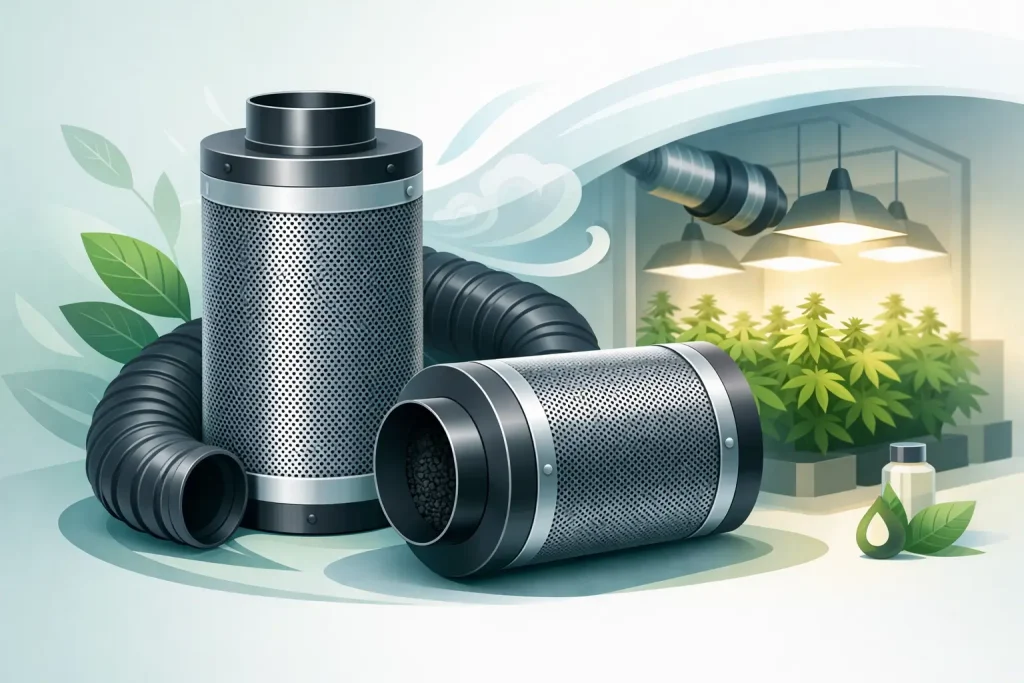
Odour problems rarely start when the lights go on. They start when a room is otherwise running well, plants are healthy, airflow is strong, and flowering begins to push aroma into every weak point in the setup. That is where carbon filters earn their place. In an indoor grow, they are not an optional extra for neatness. They are a working part of your ventilation system, and if they are undersized, badly matched, or fitted poorly, the rest of the extraction setup will not cover for it.
What carbon filters actually do
Carbon filters are built to scrub odour from extracted air before it leaves a tent, room, or duct run. Inside the housing is activated carbon, usually pelletised or granulated, with a high surface area that traps volatile organic compounds responsible for strong plant smells. The air is pulled through the carbon bed by an inline fan, and that contact time is what makes the filter effective.
For growers, the practical point is simple. A carbon filter does not mask smell. It removes a large proportion of the compounds causing it. That difference matters, because masking sprays and gels may help in the surrounding area, but they do not solve the source issue inside the extraction system.
Performance depends on more than just having a filter present. Fan speed, room temperature, humidity, duct layout, and the quality and depth of the carbon all affect results. A premium filter matched correctly to the fan will usually outperform a cheaper unit pushed beyond its rated airflow.
Choosing carbon filters by fan size and airflow
The first buying decision is not brand or price. It is matching the filter to the extraction fan and the air volume in the space. If a fan is moving more air than the filter can effectively scrub, odour can pass through before the carbon has enough contact time to do its job.
A small tent with a 4 inch extraction setup needs a different filter from a larger flower room running a 6 inch or 8 inch fan. That sounds obvious, but growers still get caught out by choosing around diameter alone. Diameter only tells you what will physically connect. The more important figure is the airflow rating, usually shown in cubic metres per hour.
As a rule, the filter should be able to handle the fan output at the speed you expect to run most often. If you are using a fan controller and planning to run the fan lower than maximum, you have more flexibility. If the fan will be running hard during warm periods, it makes sense to leave some headroom rather than sizing the filter right to the limit.
This is one of those areas where bigger is not automatically better. An oversized filter can work well, but it also adds weight, takes more room in the tent, and may be awkward to mount. In smaller grow spaces, that can reduce usable head height and complicate duct routing.
Why airflow matching matters more than many growers expect
A carbon filter is only as good as the extraction path around it. If air is escaping through unsealed joins, open ports, poor tent zips, or positive pressure in the room, the filter is treating only part of the problem. The goal is controlled negative pressure, where air is being drawn in and then forced through the filter and fan system before leaving the space.
That is why a decent fan and filter pairing matters more than treating the filter as a standalone product. In practice, odour control is a system job.
Where to position carbon filters in a grow room
In most tent setups, the standard arrangement is filter inside the tent, fan attached directly or via short ducting, then exhausting out of the tent and away from the grow area. This keeps odour capture close to the source and pulls the warmest, most aromatic air from the top of the space.
That layout works because heat rises and most growers are already extracting from the upper section of the tent. It also helps keep the tent under negative pressure. For many hobby and intermediate setups, this is the cleanest and most reliable option.
There are cases where growers mount the fan and filter outside the tent to save internal space. It can work, but it requires more attention to sealing and duct routing. The longer and more complex the duct run, the more resistance you introduce, and that can reduce effective airflow. Tight bends make it worse.
If discretion is critical, keep the run short, keep joins tight, and avoid leaving any untreated air path between the room and the extraction point. A well-sized filter with poor installation can still leak smell into the surrounding area.
What affects real-world filter performance
The product listing may give you a rated airflow and expected service life, but real grow rooms are rarely ideal test conditions. High humidity is one of the main factors that can reduce how effectively carbon filters work. When the carbon bed is exposed to consistently damp air, adsorption efficiency drops.
This is particularly relevant late in flower, when growers may already be managing dense canopy transpiration and trying to keep relative humidity under control. If extraction is weak and humidity is high, odour control often slips at the same time. The fix is not always a new filter. Sometimes the issue is climate management or insufficient fan performance.
Temperature, dust, and debris also matter. Most carbon filters use a pre-filter sleeve for a reason. That outer layer catches larger particles before they clog the carbon bed. If the sleeve is dirty and left unattended, airflow falls off. Reduced airflow can then raise temperatures and create a knock-on effect across the room.
Quality of carbon matters as well. Better filters typically use higher-grade activated carbon, sensible bed depth, and more consistent construction. Cheaper units may look similar from the outside but deliver shorter service life or poorer odour removal under load.
When a carbon filter starts to fail
The usual sign is straightforward. Odour begins to appear outside the grow space even though the fan is running and ducting appears intact. Before replacing the filter, check the obvious points first: fan speed, negative pressure, duct leaks, blocked pre-filter, and any change in room humidity.
If those are all in order and smell is still escaping, the carbon is likely spent. Activated carbon does not regenerate itself in normal use. Once its adsorption capacity is used up, replacement is the practical answer.
How long carbon filters last
There is no single lifespan that fits every setup. Usage hours, humidity levels, fan speed, crop intensity, and filter quality all influence service life. Some growers will get well over a year from a filter in stable conditions. Others working in hotter or more humid rooms, or running heavy-aroma cultivars continuously, may need to replace sooner.
The key is to treat lifespan claims as a range, not a guarantee. If odour control is mission-critical, waiting until the filter is clearly failing is not always the best approach. Many experienced growers replace preventatively once performance starts to drift rather than stretching a filter to the end.
Routine maintenance is simple enough. Wash or replace the pre-filter sleeve as needed, keep dust loads down where possible, and make sure the extraction fan is not struggling against unnecessary duct resistance. Good maintenance will not make exhausted carbon new again, but it does help you get proper use from the filter.
Are all carbon filters the same?
Not really. At a glance, most cylindrical filters look similar, but the details make the difference. Carbon grade, bed depth, mesh quality, flange fit, casing strength, and manufacturing consistency all affect how the filter performs and how long it holds up.
For entry-level growers, a budget filter may be enough in a small tent with moderate odour pressure. For larger tents, perpetual harvest spaces, or rooms where discretion is non-negotiable, it usually makes sense to buy on performance rather than just diameter and price.
This is also why recognised ventilation and odour-control brands tend to stay popular. The upfront cost may be higher, but stable airflow ratings and more dependable carbon quality often make them the safer option in working grow environments.
Carbon filters in a complete extraction setup
If you are building or upgrading a room, think of the filter as one part of a chain that includes the inline fan, ducting, clips, connectors, fan controller, and sometimes a silencer. Weakness anywhere in that chain affects the result.
A badly matched fan can pull too hard or not hard enough. Cheap flexible ducting with multiple bends can choke airflow. Poorly supported mounting can cause strain and vibration. Even a simple issue like a loose clamp can turn into a persistent smell leak.
That is why growers often get the best results by selecting extraction components together rather than mixing whatever is available. Hydroponic Centre stocks filters, fans and ventilation hardware as separate lines, but in practice they need to work as one system.
If the grow is in flower, odour control is already on the clock. Choose the filter by airflow, keep the extraction path tight, and do not expect shortcuts to cover for poor matching. A carbon filter does its best work when the rest of the room lets it.






