
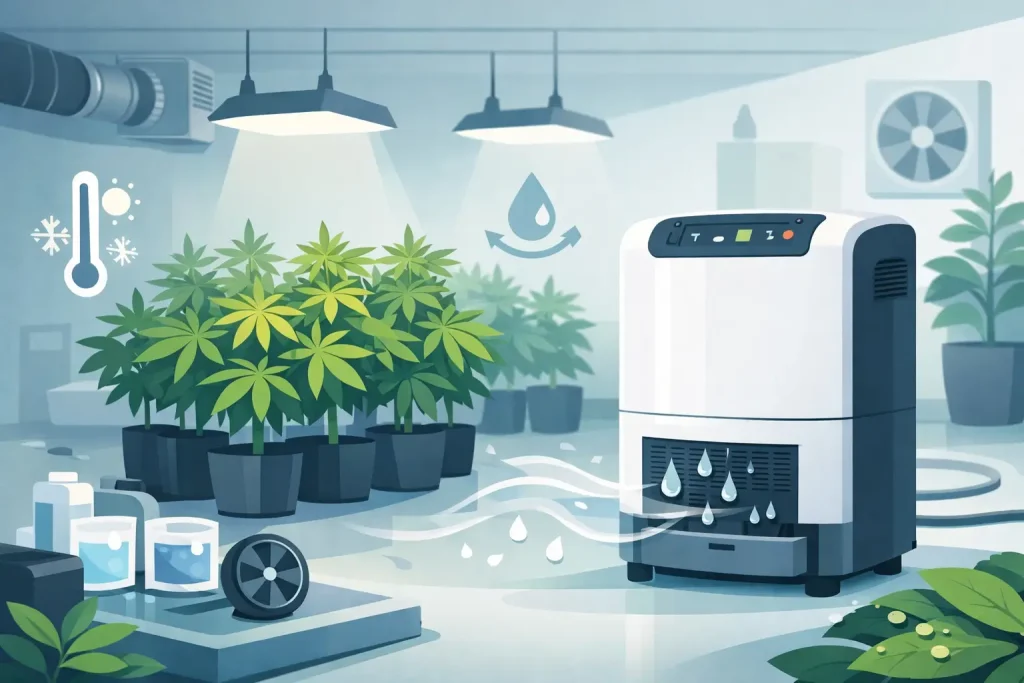
A dehumidifier is often bought after the first signs of trouble: wet tent walls at lights-off, a heavy smell in the room, slow drying media, or flowers that feel denser and damper than they should. This grow room dehumidifier guide covers how to choose capacity, place the unit properly and run it with extraction so humidity stays controlled rather than merely reduced.
Humidity management is not about making the air as dry as possible. Plants need moisture in the air, especially when young. The job is to remove the excess produced by transpiration, irrigation and temperature swings before it settles on foliage, feeds mould or pushes the root zone towards poor oxygen availability.
Why a dehumidifier matters in a grow room
Every irrigated plant releases water vapour through its leaves. As canopy size increases, that moisture load rises sharply. A small propagation area may barely affect room humidity, while a fully stocked flowering tent can overwhelm an extractor fan during dark periods or wet weather.
Warm air holds more moisture than cool air. When grow lights switch off, air temperature drops and relative humidity climbs, even if the actual amount of water in the air has not changed. That is why a room reading 55% RH under lights can reach 70% or more shortly after lights-off. Condensation can then form on cold ducting, tent fabric, walls and plant surfaces.
High humidity slows transpiration. This can reduce nutrient movement through the plant and leave dense flowers vulnerable to botrytis and other fungal issues. Low humidity has its own cost: plants can transpire too quickly, media dries unevenly and young plants can struggle to establish. Stable conditions beat constant correction.
Grow room dehumidifier guide: choosing the right size
Dehumidifiers are commonly sold by litres removed per day. This figure is useful, but it is not a direct match for tent size. Manufacturers often state maximum extraction under warm, very humid test conditions. In a cooler room at 50-60% RH, the same unit will remove considerably less water.
Start with the space that contains the moisture, not only the tent footprint. If the tent is open to a bedroom, loft or utility room, the dehumidifier is effectively treating that larger volume. If the tent is sealed or mostly sealed, calculate its internal volume and allow for the crop’s stage of growth.
A modest 10-12 litre unit may suit a small tent in a warm, well-ventilated room with a young or moderate canopy. Once plants are large, several are being irrigated frequently, or the surrounding room is naturally damp, a 20 litre-plus model is usually the more realistic starting point. Larger rooms, multiple tents and high-density cultivation may require commercial-grade equipment or more than one unit.
Do not buy solely on the lowest stated wattage. An undersized dehumidifier can run continuously without reaching set point, use more electricity over time and still leave humidity peaks untreated. A correctly sized unit should have enough headroom to pull RH down after irrigation or lights-off, then cycle rather than struggle all day.
Compressor or desiccant?
Compressor dehumidifiers are usually the practical choice for heated grow rooms. They remove significant moisture efficiently in typical cultivation temperatures and suit ongoing use in a lung room, grow room or larger tent area.
Desiccant units perform better at lower temperatures, making them useful in cold garages, sheds and unheated outbuildings. They can also add noticeable heat to the space. That may be useful in winter, but it is a drawback if high temperatures are already limiting the room. Their electricity consumption is often higher for continuous operation.
For most indoor growers, a compressor unit with an adjustable humidistat and continuous-drain option gives the best balance of capacity, running cost and control.
Set humidity by growth stage, not one fixed number
Relative humidity targets depend on plant age, room temperature, airflow and cultivar. The figures below are sensible working ranges rather than rules to follow blindly.
Seedlings, cuttings and newly rooted plants generally tolerate 65-75% RH while roots establish. Keep air moving gently, not directly at tender foliage. During vegetative growth, many growers work around 55-70% RH, adjusting according to temperature and plant response. In flowering, aim progressively lower as flowers form and density increases. Around 45-55% RH is a common target, with the lower end more appropriate for dense crops and humid conditions.
The lights-off period deserves separate attention. A controller that allows day and night set points is useful because the room’s moisture risk often rises after lights go out. If night-time temperatures fall significantly, simply keeping the same RH target may not be enough. Reduce the temperature drop where possible, increase air exchange, or set a lower night RH target to prevent saturation.
Use a reliable hygrometer at canopy height and verify it against a second metre. A sensor next to an intake, heater, dehumidifier outlet or tent wall can give misleading readings. For larger rooms, monitor more than one point. Humidity is rarely identical in every corner of a full canopy.
Position the unit so it treats the room, not one corner
A dehumidifier needs free airflow around its intake and outlet. Do not press it against a wall, hide it behind reservoirs or point the dry exhaust directly at plants. Localised dry air can stress leaves while the centre of the canopy remains humid.
In many setups, placing the unit in the lung room is the cleanest approach. The unit dries the incoming air before it is drawn through the tent by the extraction system. This keeps heat, noise and water collection outside the growing area, while preserving valuable floor space around the plants.
A dehumidifier inside the tent can work where the surrounding room is not suitable or the tent is more enclosed. Allow for its heat output and make sure extraction is sufficient. If the extractor immediately pulls out all the dry air the unit produces, the equipment may run constantly with limited effect. The answer may be a larger unit in the lung room, improved sealing, or a revised extraction strategy rather than simply lowering the humidistat.
Keep circulation fans running beneath and above the canopy. Dehumidification removes moisture from the room air, but airflow prevents humid pockets forming between leaves and inside dense flower sites.
Drainage, heat and electrical load
A full water tank stops most domestic dehumidifiers. In a productive room, that can happen quickly. Continuous drainage is strongly preferable where the unit will run regularly. Use the correct hose size, keep the run downhill where possible and check it for kinks, algae or blockages. If water must be lifted, use a condensate pump rated for the job.
Dehumidifiers add heat. In a cool grow room this can reduce heating demand, but during warmer months it may increase the burden on extraction or air conditioning. Treat the unit as part of the overall climate system, alongside lights, fans, heaters and any CO2 equipment. Do not size cooling and extraction without accounting for its wattage.
Electrical safety is equally practical. Keep plugs, extension leads and controls away from reservoirs and drainage points. Do not overload a single socket circuit with lighting, heaters and a large dehumidifier. In the UK, use suitable RCD protection for equipment operating around water.
Common mistakes that keep RH high
The most common problem is relying on extraction alone. Extraction can remove humid air, but its effectiveness depends on the incoming air being drier. In a wet spell, a damp loft or a poorly ventilated property, the air coming in may already be near the desired RH.
Another mistake is allowing large temperature swings. Turning lights off into a cold room creates an immediate relative-humidity rise. Running a small heater, scheduling the light cycle for cooler night hours, or reducing the temperature difference can make dehumidification far more effective.
Overwatering also creates a moisture problem that no climate unit can fully hide. Let the medium dry back appropriately for the crop and system. Check for leaks from irrigation lines, loose reservoir lids and standing run-off. These are avoidable sources of humidity.
Finally, clean the filter and inspect the coils. Dust restricts airflow and reduces performance. A dehumidifier working in a grow environment deals with fine particles, nutrients and organic matter, so routine maintenance is part of keeping its extraction rate dependable.
A good climate setup is measured in stable readings, dry surfaces and consistent plant behaviour, not the size of the dehumidifier alone. Select capacity with headroom, run it where airflow supports it, and review the room after every major change in canopy size, irrigation frequency or season.






