
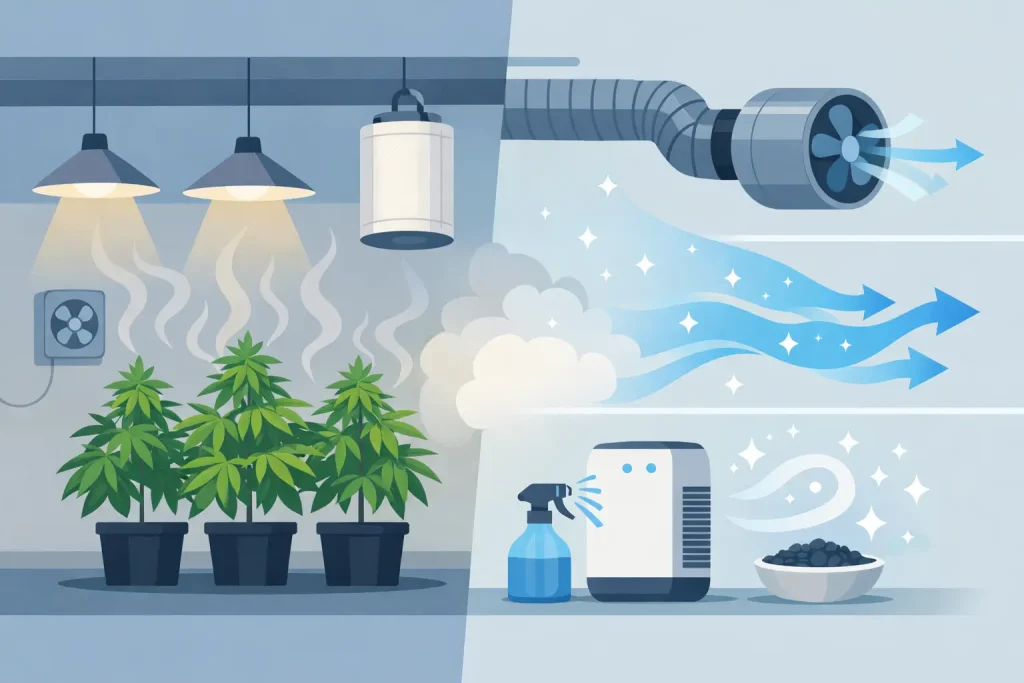
A grow room can look tidy, run at the right temperature and still give itself away as soon as the door opens. If you are working out how to reduce grow room smell, treat odour control as part of the ventilation design, not a fragrance problem to cover up. The reliable fix is to capture, filter and exhaust odorous air before it reaches the rest of the property.
Smell usually becomes more noticeable as plant mass increases, temperatures rise and flowering progresses. A properly sized extraction system with a matched carbon filter does most of the work, but its performance depends on the tent, ducting, intake arrangement and day-to-day housekeeping around it.
Start by finding where the smell is escaping
Before buying more equipment, establish whether odour is leaving through the extraction outlet, a passive intake, duct joints, tent zips or the room surrounding the tent. Run the extraction fan with the grow space closed. A tent should pull in slightly at the sides, showing that it is under negative pressure. This means air is being drawn into the tent through intended intakes rather than being pushed out through gaps.
If the tent is ballooning, or air can be felt leaving around zips and cable ports, the extraction fan is not moving enough air, the intake fan is too powerful, or there is a restriction in the duct run. Correcting pressure is often more effective than adding odour neutralisers.
Check the full route from filter to outlet. Loose ducting, unsealed reducers and perforated flexible duct can allow unfiltered air to escape. A smell that appears only outside the growing area can also indicate that filtered exhaust is being released too close to an open window, air brick or neighbouring boundary.
How to reduce grow room smell with carbon filtration
An activated carbon filter is the core piece of odour-control equipment in most indoor setups. Air is pulled through the carbon bed, where volatile organic compounds responsible for the smell are adsorbed before the air enters the extractor and ducting. For the system to work consistently, every litre of extracted air needs to pass through a suitable filter.
Match the filter and fan to the real airflow requirement
Start with the volume of the grow space in cubic metres: length x width x height. A fan should theoretically replace that volume regularly, but real installations have resistance from the carbon filter, duct bends, duct length, silencers and reducers. Hot lamps, humid conditions and longer runs may require a higher-capacity fan than the basic room-volume calculation suggests.
The filter must be rated to handle at least the fan’s working airflow. Pairing a large extractor with a small filter can force air through the carbon too quickly, reducing contact time and odour removal. Pairing an oversized filter with an undersized fan is less problematic, although it adds cost and can be awkward in a compact tent.
Use matching duct diameters wherever possible. Reducing a 150 mm fan and filter to 125 mm ducting creates resistance, raises fan noise and cuts actual extraction performance. Keep duct runs short and straight, with gentle bends instead of sharp turns. Aluminium tape or proper duct clamps should seal every joint.
Install the filter on the extraction side
For most tents, position the carbon filter inside the grow space and connect it directly to the extractor fan. The fan pulls air through the filter and pushes cleaned air along the duct run. This arrangement maintains negative pressure and avoids pushing strongly scented air through ducting before it is filtered.
Make sure the pre-filter sleeve is fitted around the carbon filter. It catches dust, fibres and debris that would otherwise block the carbon surface. Wash or replace the sleeve when dirty, then dry it completely before refitting. Do not wash the carbon filter itself.
Carbon filters are consumable items. Their usable life varies with humidity, temperature, fan speed, plant odour and runtime. If the system was effective but smell starts returning with the tent sealed and fan running, a depleted filter is a likely cause. Replacing the filter is more dependable than trying to revive old carbon.
Control heat and humidity before they amplify odour
Warm, humid air carries odour more readily, and poor environmental control can make a borderline extraction setup fail. High humidity also shortens carbon filter performance over time. Keep temperatures and relative humidity within the range appropriate for the crop and growth stage, using adequate extraction, circulation fans, heating or dehumidification where required.
An extraction controller can help by increasing fan speed when temperature or humidity climbs. This is useful in smaller tents where a fixed-speed fan either runs louder than necessary at lights-off or cannot respond quickly to a heat spike. The trade-off is straightforward: higher airflow improves odour management but may increase noise and reduce available heat during colder periods.
Do not confuse circulation with extraction. Oscillating fans move air around the canopy, reducing stagnant pockets and helping plant health, but they do not remove smell from the room. You still need a correctly specified extractor, carbon filter and discharge route.
Seal the tent and manage the surrounding room
A quality grow tent is easier to keep discreet because it has decent zips, stitched seams and properly designed duct ports. Even so, inspect it regularly. Close unused ports, draw cords tight around cables and irrigation lines, and repair damaged zips or pinholes. Avoid overfilling cable ports, as this leaves gaps that can leak odour.
The room containing the tent matters too. If extraction discharges into that same room, odour will build up despite good filtration, especially when a filter is ageing. Exhaust should be directed to a suitable location outside the growing area, subject to the practical layout of the property and safe ventilation requirements.
Where an intake fan is used, keep it weaker than the extractor or run it on a controller that preserves negative pressure. In many small tents, passive intakes are sufficient. Opening too many intake flaps can reduce the negative pressure that keeps odours inside the filtration path.
Remove secondary sources of grow room smell
Not all odour comes directly from live plants. Stagnant runoff, old root material, nutrient spills, wet fabric pots and unemptied waste can produce a sour smell that a carbon filter will not fully solve. Routine cleaning protects both discretion and plant hygiene.
Keep reservoirs covered and lightproof, particularly in recirculating hydroponic systems. Check water temperature, aeration and cleanliness if the reservoir smells earthy, sulphurous or stale. Remove dead leaves from the floor and avoid leaving trimmed material in open bins. A sealed waste container is a simple but worthwhile addition during heavy defoliation or harvest work.
Clean spills promptly, including nutrient residue beneath trays and around pumps. In coco and soil-based setups, avoid standing water in saucers. In hydro systems, inspect pipework, drains and filters as part of normal maintenance. A healthy root zone should not create a strong, unpleasant odour.
Use odour neutralisers in the right place
Odour neutralising gels, blocks and sprays can be useful in the wider room, hallway or extraction area, but they are not a substitute for carbon filtration. Never place strong fragrances inside the tent or close to the air intake. Plants and carbon filters can be affected by airborne oils, while scented products may merely mask a fault that needs correcting.
Use neutralisers as a secondary measure where appropriate, and choose products intended for grow-room odour control rather than household air fresheners. If you find yourself relying on them every day, revisit fan capacity, filter condition, tent pressure and exhaust routing.
A practical odour-control check
When smell becomes noticeable, work through the system in order: confirm the fan is running at the expected speed, check the tent is pulling inward, inspect all duct connections, make sure the pre-filter is clean, and assess the age and rating of the carbon filter. Then check temperature, humidity, reservoir hygiene and any plant waste around the room.
A quiet, well-sealed setup with the right fan, filter and ducting is easier to live with than a powerful system fitted as an afterthought. Build odour control into the grow room from the start, maintain it through each cycle, and you will spend far less time trying to chase smells once flowering is underway.






