
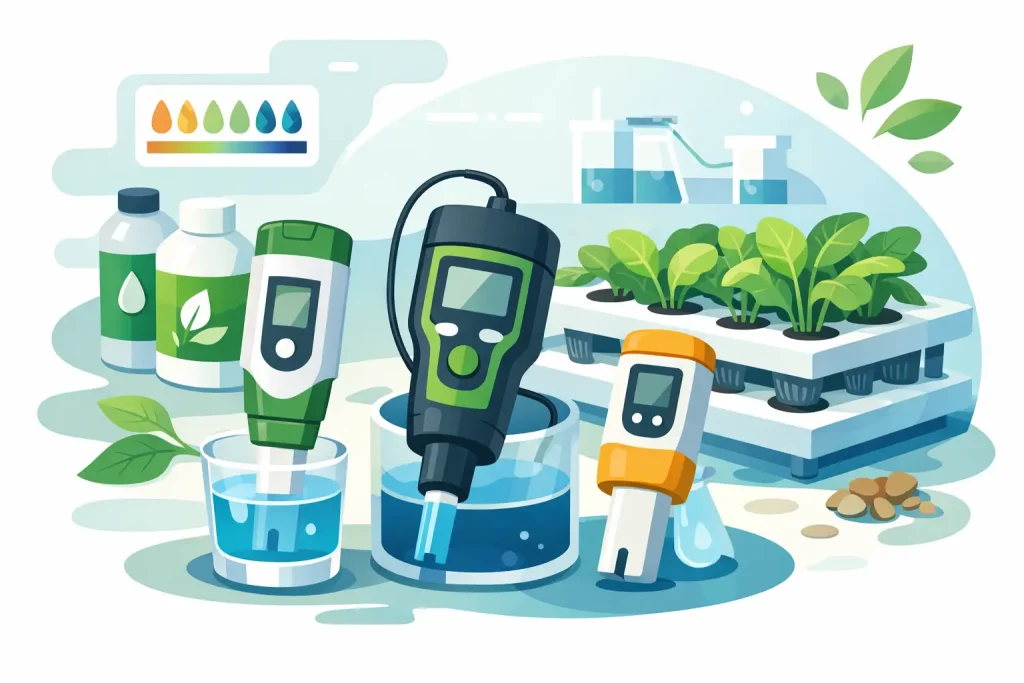
A nutrient tank can look perfectly clean while sitting half a pH point out of range. The plants will usually show the result before the grower sees the cause: slower new growth, inconsistent feeding response, or deficiency symptoms that make little sense beside an acceptable EC reading. That is why the top hydroponic pH testers are not simply another accessory. They are a working tool for mixing nutrients, checking reservoirs and keeping root-zone conditions stable.
For most hydroponic crops, a solution pH around 5.5 to 6.2 gives a useful availability range for the main nutrients and trace elements. The exact target depends on the crop, medium, nutrient line and system, but consistency matters more than chasing a single number. A dependable pH meter lets you make small, measured corrections before a reservoir drifts far enough to affect uptake.
What separates top hydroponic pH testers from basic options
The best tester is the one suited to how often you mix, test and maintain nutrient solution. A basic pocket pen can be entirely adequate for a small hand-fed setup if it is calibrated regularly and stored correctly. In a larger recirculating system, where a reservoir supplies multiple plants and remains in use for days, better accuracy, a replaceable probe and faster readings become worth paying for.
A usable hydroponic pH tester needs a clear display, sensible calibration process and a probe that responds quickly without wandering. Automatic temperature compensation is also valuable. Nutrient solution temperature changes during mixing and through the light cycle, and temperature affects pH measurement. Compensation does not fix a badly calibrated meter, but it removes one avoidable variable.
Avoid treating pH test drops or strips as a direct replacement for a meter. They are useful as a rough backup check and can help confirm that a digital reading is wildly wrong. Their colour scale, however, is too broad for routine adjustment where 0.1 or 0.2 pH can matter.
The main tester formats and where they fit
Pocket pH pens
Pocket pens are the standard choice for many tent growers. They are compact, quick to use and easy to keep alongside nutrients and measuring jugs. A good pen is ideal for checking fresh feed daily, testing run-off when necessary, and spot-checking a reservoir.
The trade-off is probe life. Cheaper pens often have fixed electrodes, so once the probe becomes slow, unstable or damaged, the whole unit may need replacing. They also need more disciplined calibration than growers sometimes expect. A pen that was accurate a month ago is not necessarily accurate after repeated exposure to nutrient salts and pH adjusters.
Waterproof meters with replaceable probes
For frequent use, a waterproof meter with a replaceable electrode is the practical step up. This format suits larger reservoirs, DWC systems, flood-and-drain tables and serious coco feeding schedules. If the probe eventually degrades, replacing the electrode is usually more economical than replacing the complete meter.
Look for a proper protective cap, multi-point calibration and an electrode designed for hydroponic solutions. A well-built meter should give a stable reading without needing to wait excessively, even after several checks during a busy feed mix.
Bench and continuous monitors
Bench meters and continuous monitors make sense where testing is part of a daily operational routine. Small commercial rooms, multi-tank systems and growers managing large recirculating volumes benefit from a larger display, dedicated probe holder and repeatable measurement process.
Continuous pH monitoring can flag drift before it becomes a crop issue, but it does not remove maintenance. Probes still require cleaning, calibration and storage solution. An unattended monitor with a fouled probe only gives false confidence at a higher price point.
Features worth paying for
Accuracy figures can be misleading if considered alone. A stated accuracy of ±0.01 pH sounds impressive, but it is only meaningful when the meter is calibrated with fresh buffer solutions and the probe is in good condition. For typical hydroponic use, a reliable, repeatable meter that reads to 0.1 pH is more useful than a high-specification unit that receives poor maintenance.
Prioritise two- or three-point calibration. Most feeding takes place in the mildly acidic range, so calibration at pH 7.0 and pH 4.0 provides a useful working reference. Three-point calibration can offer extra assurance, particularly where the meter is also used for source-water checks or different nutrient programmes.
A replaceable probe is a major advantage for growers who test every day. Also consider the availability of calibration sachets, storage solution and cleaning fluid. The meter is only part of the purchase. If the correct consumables are not kept in the grow room, calibration gets delayed and readings become less dependable.
Backlit displays, hold functions and Bluetooth logging can be convenient, but they are secondary to probe quality and calibration. For most growers, spend the budget on a recognised horticultural or water-testing meter rather than extra app features.
Match the meter to the growing system
For a small coco or soil-based hand-feeding setup, a quality pocket pen is normally enough. Test the mixed nutrient solution before feeding, and occasionally measure run-off to identify a developing root-zone issue. Do not use run-off pH as the sole instruction to make large feed changes – it is a diagnostic clue, not a complete picture.
DWC and RDWC growers should place more emphasis on speed, repeatability and waterproof construction. In these systems, pH can move as plants feed, water temperature changes and reservoir volume drops. Daily checks are routine, and a replaceable-probe meter is usually the sensible long-term option.
For NFT, flood-and-drain and other recirculating systems, check the reservoir at a consistent time each day. A single reading immediately after adding water, nutrients or pH adjuster can be misleading. Allow the solution to circulate thoroughly, then retest before making another correction.
Run-to-waste growers need a meter that is practical to use repeatedly during mixing. Feed pH should be checked every batch. If you are measuring several tanks or stock solutions, choose a meter with easy calibration controls and a probe that can be rinsed quickly between samples.
Calibration and probe care decide the result
Even the best pH meter becomes unreliable when stored dry or left coated in nutrient residue. The glass electrode needs to remain hydrated. Never store it in distilled or reverse-osmosis water, as this can draw ions from the probe and shorten its useful life. Use the manufacturer-recommended storage solution and keep the cap secure.
Calibrate before the first use, then establish a routine based on workload. Heavy daily use usually justifies calibration every week, while a meter used occasionally should be checked before important reservoir changes. If readings become slow, jump around, or differ from a second test, clean and recalibrate before adjusting the feed.
Use fresh pH 7.0 and pH 4.0 buffer solution. Sachets reduce contamination because each portion is used once. If using bottles, pour a small amount into a clean container and never return used buffer to the bottle. Rinse the probe with clean water between solutions, blot it gently rather than rubbing the glass bulb, and follow the meter’s calibration prompts exactly.
When checking nutrient solution, rinse the probe before and after use. Do not dip it directly into concentrated nutrient bottles, pH Up or pH Down. Mix nutrients into the full water volume first, allow the solution to settle or circulate, then measure. Make adjustments in small increments, especially in smaller tanks where a few millilitres can cause a sharp change.
Common pH testing mistakes in the grow room
The most expensive mistake is over-correcting. A grower sees pH 6.4, adds too much acid, sees 5.2, then adds alkali to bring it back. Each correction changes the solution chemistry and makes stability harder to judge. Add a small amount of pH adjuster, mix thoroughly and wait for a stable reading.
Another common issue is measuring immediately after nutrients are added. Some products need time to dissolve and distribute, particularly in cold water or larger reservoirs. Circulation, adequate mixing and a short pause produce a reading you can act on.
Finally, do not confuse pH with EC. A correct pH does not mean the feed strength is right, and an acceptable EC does not mean nutrients are available. Using both meters as part of the same check gives a far clearer view of what the plants are receiving.
The right pH tester should make your feeding routine quicker, not create another task to avoid. Choose a format that matches your reservoir size and testing frequency, keep calibration and storage fluids on hand, and treat stable readings as part of basic system maintenance. Plants respond best when the root zone is managed with the same consistency as lighting, irrigation and climate.






