
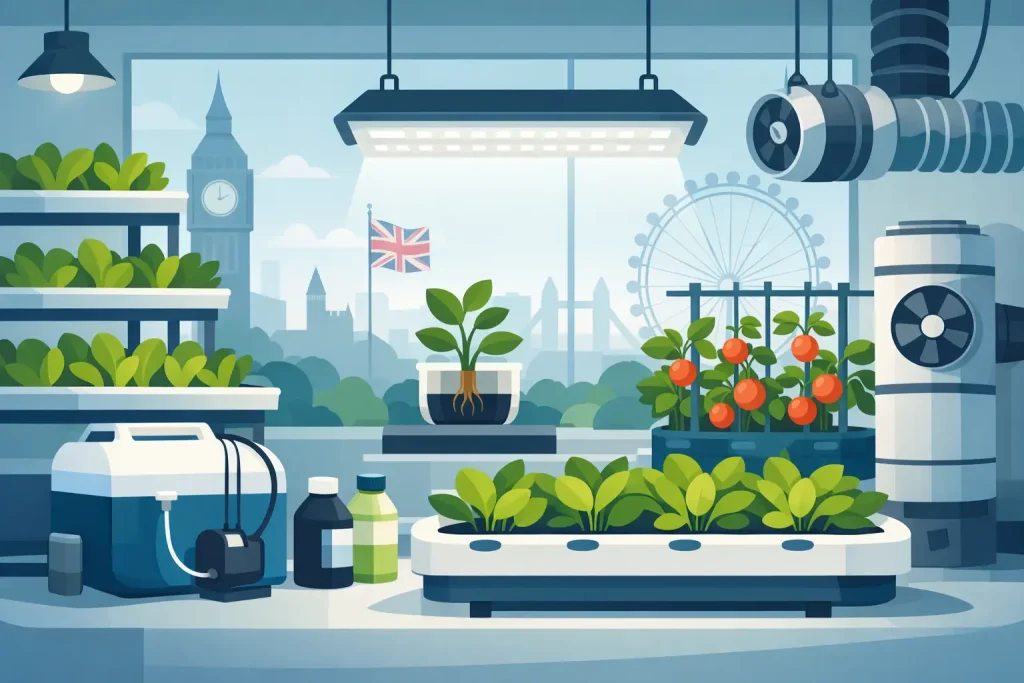
A grow room rarely fails because one major item was missing. More often, it is the mismatch between components: a powerful LED with inadequate extraction, hard water used with an unsuitable feed, or an irrigation system without enough run-off management. Buying UK hydroponic supplies works best when every part of the room supports the next stage of the cultivation process.
For a small tent, that may mean a straightforward soil or coco set-up with a dimmable LED, extraction kit and hand-fed nutrients. For a higher-output room, it can mean a complete system built around water storage, dosing, automation, air movement and repeatable environmental control. The right kit depends on crop type, plant count, available space and how much daily attention the system can realistically receive.
Build the grow room around the environment first
Before choosing nutrients or a hydro system, establish the physical limits of the space. Measure the usable footprint and height, not just the nominal tent size. Leave room for the light fixture, safe hanging distance, filter, ducting and access to plants. A packed tent may look productive at first, but restricted airflow and poor access make training, inspection and cleaning harder.
Lighting should match the canopy area rather than simply chasing the highest wattage. Modern full-spectrum LEDs are a practical option for many indoor growers because they offer efficient output and manageable heat compared with older lamp technology. The fixture still needs to be sized correctly. A unit designed for a small propagation area will not provide even coverage across a full flowering tent, while an oversized light can create heat stress and unnecessary electricity use if it cannot be dimmed.
Ventilation is not an optional extra. An inline fan, carbon filter and correctly sized ducting remove warm, humid air while helping manage odour. Fan capacity needs to account for tent volume, duct length, bends, filter resistance and the heat produced by lighting. Long duct runs and sharp turns reduce performance, so it is usually better to keep the extraction route short and direct where possible.
Add circulation fans inside the growing area to prevent still air around the canopy. These are not a substitute for extraction. Their job is to keep leaves moving gently, reduce damp pockets and support stronger stems. Aim airflow above and through the canopy rather than pointing a fan continuously at one plant.
Choosing UK hydroponic supplies by growing method
The growing method determines the equipment and consumables needed through the full cycle. Start with a system that suits the grower’s workload as well as the intended output.
Coco is popular because it offers a hydroponic-style feeding approach with the familiarity of pots. It responds well to frequent nutrient solution applications and provides good aeration around the roots. However, it requires consistent feeding, correct pH and adequate run-off to prevent salt build-up. Fabric pots, quality coco, drip stakes or hand-watering equipment, nutrient tanks and EC and pH meters form a solid working set-up.
Soil is usually more forgiving for growers who prefer a slower, less equipment-heavy routine. Organic or mineral feeds can both be used, depending on the chosen approach. The trade-off is that soil can be slower to correct when overwatered or overfed, and it does not offer the same immediate control over the root zone as an active hydroponic system.
Deep water culture, or DWC, gives roots direct access to oxygenated nutrient solution. It can support rapid growth when water temperature, oxygen levels, pH and EC are stable. It is less forgiving of power cuts, warm reservoirs or neglected maintenance. Use a suitable air pump, air stones, non-return valves, correctly sized buckets or modules, and keep spare fittings on hand.
Flood-and-drain and run-to-waste systems are good options where repeatable irrigation is the priority. Timers, pumps, pipework, drippers, filters and water storage all need to work together. Run-to-waste can offer strong control in coco or rockwool, but it creates drainage to manage. Recirculating systems can reduce nutrient waste, although the reservoir needs closer monitoring because the nutrient balance changes as plants feed.
Nutrients, additives and water quality
A nutrient range should be chosen as a system, particularly for mineral feeding. Base nutrients are designed to provide the main macro and micronutrient profile. Grow and bloom formulations generally change the ratios as the plant moves from vegetative growth into flowering or fruiting. Use the manufacturer’s feeding guidance as a starting point, not an instruction to feed at maximum strength from day one.
Additives have a place, but they should solve a specific problem or support a defined stage. Root stimulants can help establishment after transplanting. Silicon products may support structural strength. Enzyme products help break down dead root material, while beneficial microbes can suit compatible biological programmes. Bloom boosters are widely used, but they cannot compensate for weak lighting, poor root health or unsuitable temperature and humidity.
Water quality decides how predictable any feeding plan will be. In many parts of the UK, tap water is hard and already contains a significant mineral content. This can affect starting EC and influence whether a hard-water or soft-water nutrient is appropriate. A basic EC meter and pH meter are essential tools, not luxury accessories, for active hydroponic feeding.
Calibrate meters regularly and store pH probes correctly. A cheap meter that reads inaccurately can cause more problems than no reading at all. Keep pH up and pH down separate, use them carefully, and never add concentrates directly together. Fill the reservoir with water first, add nutrients one at a time, mix thoroughly, then test and adjust.
The consumables that keep a system running
Growers often budget for lights, tents and systems but overlook the items that are repeatedly used, cleaned or replaced. A reliable supply of media, pots, nutrient bottles, pH and EC calibration solutions, filters, drippers, pipe, connectors and spare pumps prevents a small fault from interrupting the crop.
Propagation is another area where the correct consumables make a noticeable difference. Starter plugs, trays, humidity domes, heat mats, low-output propagation lighting and rooting products help create stable early conditions. Once rooted, young plants need gradual adjustment to stronger light and lower humidity. Moving them too quickly from a dome into a dry, brightly lit room can slow establishment.
For pest and disease control, routine inspection is more useful than reacting after an outbreak spreads. Check leaf undersides, new growth, the root zone and sticky traps regularly. Choose treatment products according to the issue and the crop stage, and keep the room clean. Dead leaves, spilled nutrient solution and standing water attract problems that no bottle alone will fix.
Plan for maintenance, not just installation
A good system should be easy to inspect and clean. Place reservoirs where they can be emptied, keep pumps accessible, and avoid routing pipework so tightly that a blocked dripper becomes difficult to trace. Label irrigation lines if multiple zones are used. Small details save time when plants are actively feeding and a fault needs correcting quickly.
Electrical safety needs the same attention as plant care. Keep plugs, timers, drivers and extension leads away from reservoirs and floor-level spills. Use suitable RCD protection, avoid overloading circuits and create drip loops in every cable run. Humid spaces are demanding on equipment, so check connections, fan noise and timer operation as part of the weekly routine.
It also pays to buy equipment with the next crop in mind. A dimmable light can suit both early growth and a fuller canopy. An oversized extraction fan run on a controller is often quieter and more flexible than a fan working flat out. On the other hand, there is no need to fit commercial-scale automation into a tent that is hand-watered twice a week. The best value comes from equipment that reduces a real bottleneck.
Hydroponic Centre stocks the categories needed to build, maintain and upgrade a controlled growing space, from propagation tools and nutrients to lighting, irrigation, fans and filtration. When comparing products, focus on compatibility, serviceability and the repeat consumables the set-up will require rather than treating each purchase as a separate decision.
A reliable grow room is built one sensible choice at a time. Set the environment first, measure the water, choose a feeding method you can maintain, and keep the parts most likely to wear or block within reach. That approach leaves more time for observing the plants and less time correcting avoidable faults.






