
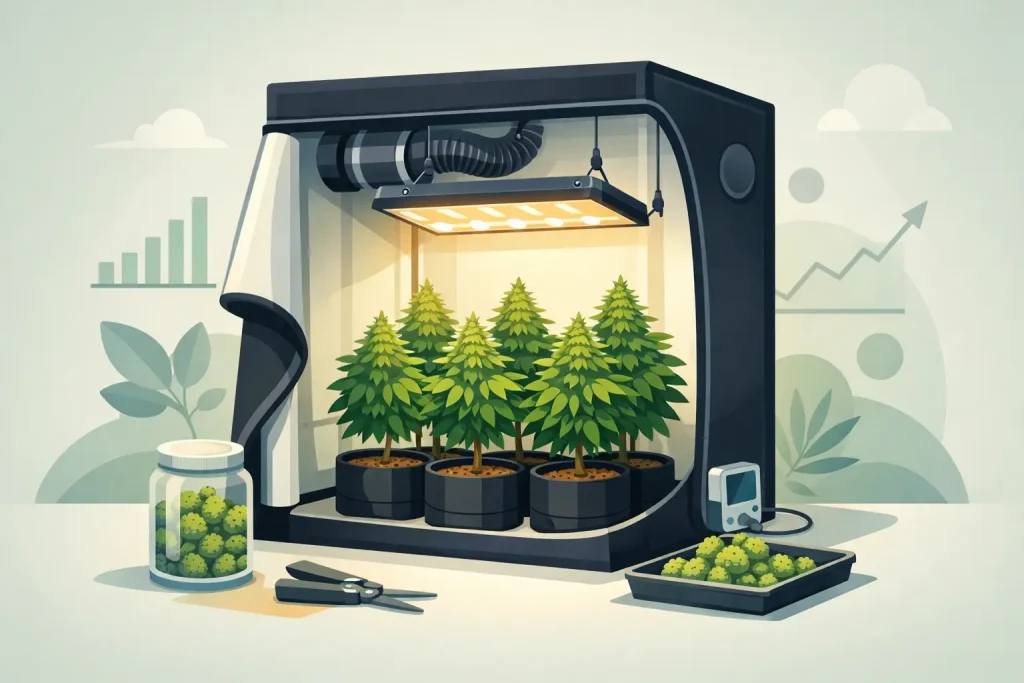
A small tent yield example is only useful when the conditions behind the number are clear. A grower pulling 350 g dry from a 1.0 x 1.0 m tent under an efficient LED is operating a very different room from one producing 150 g under an underpowered lamp with poor extraction. Tent size sets the ceiling, but lighting, canopy management, root-zone control and environment decide how close you get to it.
For legal indoor flowering crops, the most reliable way to estimate output is to work backwards from the lit footprint and actual wattage, then adjust expectations for experience and system efficiency. Dry, trimmed yield is the only figure worth comparing. Wet harvest weight can look impressive but is not a useful planning metric.
A small tent yield example, worked properly
Take a 1.0 x 1.0 m grow tent. This is a common small-room footprint: large enough for a productive canopy, but compact enough to need disciplined airflow, heat management and plant spacing. The example below assumes a healthy, established crop grown through its full flowering period.
| Setup factor | Working example | |—|—| | Tent footprint | 1.0 x 1.0 m | | Lighting | 480 W full-spectrum LED | | Growing method | Coco coir with drip irrigation | | Canopy area used | Approximately 0.8 to 0.9 m² | | Extraction | Inline fan and carbon filter, matched to heat load | | Final yield target | 300 to 400 g dry, trimmed |
That 300 to 400 g range works out at roughly 0.6 to 0.8 g per watt. It is a credible target for a well-run tent using modern LED lighting, a level canopy and stable conditions. It is not an automatic result of fitting a 480 W fixture. A new grower, a crop that has suffered stress, or a tent with marginal ventilation may finish closer to 200 to 280 g. An experienced operator with a uniform, fully lit canopy may exceed the range, but that should be treated as a strong result rather than the baseline.
The key point is that the tent itself has not produced the yield. The productive area under usable light has. A 1.0 x 1.0 m tent with only a 0.6 m² uneven canopy will not perform like a fully utilised square metre, regardless of how many pots are on the floor.
Why grams per watt are only part of the picture
Grams per watt remain a practical shorthand because they connect harvest to the cost and output of the light. They are not a complete measure of performance. Two 480 W LEDs can produce different results if one spreads photons evenly across the canopy while the other creates a central hotspot and weak corners.
For a 1.0 x 1.0 m flowering area, the objective is even intensity rather than chasing the highest possible reading directly beneath the fixture. The crop needs enough light across the whole canopy, with suitable hanging height and dimming to avoid bleaching or heat stress at the tops. A PAR meter gives a clearer picture than judging brightness by eye, particularly with efficient modern LEDs.
If the environment is not supplemented with additional carbon dioxide, pushing light intensity past what the crop can use often gives diminishing returns. Leaves may transpire harder, nutrient demand can become less forgiving, and canopy temperatures can rise. In a small tent, those problems develop quickly because there is little air volume to absorb mistakes.
A more useful question than “What can this light yield?” is “Can the room maintain the climate and root-zone conditions required for this light level?” If the answer is no, dimming the fixture slightly can improve crop consistency and final quality.
The factors that move a small-tent yield
The biggest yield losses in compact tents usually come from uneven canopy development, weak environmental control and inconsistent feeding rather than from a lack of bottled additives. Start with the system basics.
Canopy coverage and uniformity
A flat, even canopy makes the best use of a fixed light footprint. Taller plants or branches shade lower sites, while shorter plants receive less intensity than the upper layer. The result is smaller, less dense material lower down and an uneven finish at harvest.
Training, sensible spacing and early removal of weak lower growth can direct the plant’s resources towards productive sites. The exact method depends on crop type, cultivar, veg time and number of plants. There is no universal plant count for a 1.0 x 1.0 m tent. Fewer larger plants can fill the same canopy as more compact plants, provided the root zone and irrigation are managed correctly.
Do not overcrowd the tent simply to fill empty floor space. Dense foliage restricts airflow, increases humidity pockets and makes routine inspection harder. A canopy that looks slightly less crowded but receives even light and moving air is often the higher-yielding option.
Temperature, humidity and airflow
A small tent is easy to heat and easy to overheat. LED fixtures produce less radiant heat than older high-intensity lamps, but their drivers and diodes still add meaningful heat to a confined space. Extraction needs to remove that load without pulling the tent so hard that temperatures become difficult to hold, especially during colder UK months.
Good circulation fans should move leaves gently across the canopy and prevent still air beneath it. They should not blast one section of foliage continuously. Uneven airflow can cause localised stress, while stagnant corners encourage moisture-related problems that can reduce harvest quality late in flowering.
Humidity targets depend on temperature, crop stage and room conditions. What matters operationally is stability. Repeated swings caused by lights switching, undersized extraction or a poorly placed humidifier make nutrient uptake less predictable. A reliable temperature and humidity monitor is not an optional extra when yield is the objective.
Root zone and irrigation frequency
Coco, DWC, flood-and-drain and run-to-waste systems can all produce strong results in a small tent. The better choice is the one you can monitor and maintain accurately. Coco with frequent drip feeds offers control and fast growth, but demands attention to nutrient strength, pH, runoff and irrigation timing. DWC can be highly productive, but reservoir temperature and oxygen levels need close control. Soil-based media can be simpler for some growers, though it reacts more slowly to overwatering and feeding errors.
A healthy root zone supports a consistent canopy. Letting plants repeatedly dry back too far, allowing EC to climb in the medium, or using an irregular hand-watering routine can limit growth without immediately showing dramatic symptoms. By the time the canopy looks undersized, the production potential has already been reduced.
A second example: the 0.6 x 0.6 m tent
Smaller tents need more realistic expectations. A 0.6 x 0.6 m tent has 0.36 m² of floor area, just over a third of a 1.0 x 1.0 m tent. With a quality 150 to 200 W LED, a sensible dry yield range is often around 100 to 180 g for a well-managed crop.
The temptation in a compact tent is to use a light that is too powerful for the area. That can create a narrow operating window: the fixture must be run high, dimmed heavily, or both. Selecting a properly matched LED usually makes heat, hanging height and canopy management easier. The best small-tent setup is not necessarily the one with the largest wattage figure.
Plan the room around the limiting factor
Before buying more nutrients or adding another booster, identify what is currently holding the tent back. If leaf temperatures are high, improve extraction or reduce heat load. If the corners of the canopy are weak, review fixture coverage and plant layout. If growth is inconsistent between irrigations, examine the root zone and feeding schedule. If dense foliage stays damp after lights out, increase circulation and reduce crowding.
Hydroponic Centre equipment categories are useful here because a yield issue is rarely just a lighting issue or just a nutrient issue. It is usually a system issue involving the light, fan, filter, irrigation hardware, growing medium and measurement tools working together.
Use yield examples as a benchmark, not a promise. Build a stable environment first, measure what the crop is receiving, and make one meaningful improvement at a time. That approach produces a more repeatable harvest than chasing an ambitious grams-per-watt number.






