
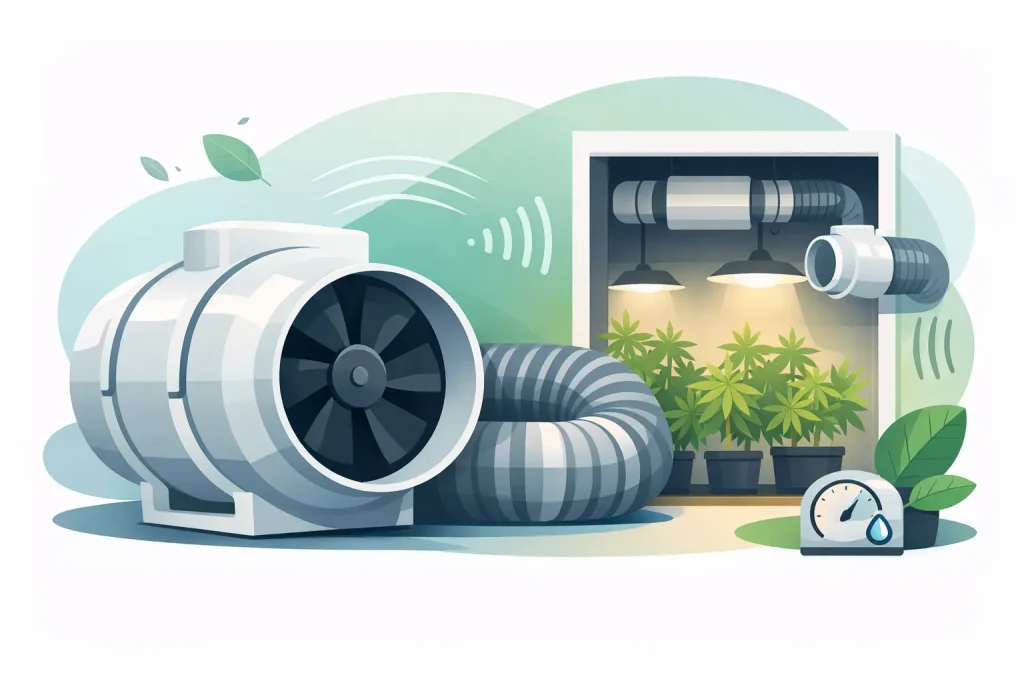
A fan labelled quiet can still become the loudest part of a grow room once it is connected to a carbon filter, ducting and a speed controller. The best silent extractor fans are not simply the lowest-decibel units on a product page. They are correctly sized inline fans that can move the required air at a reduced speed, without struggling against filter resistance or transmitting vibration through the tent frame.
For indoor growers, quiet extraction is about more than comfort. A stable, controlled exhaust maintains negative pressure, removes heat and humidity, supports effective odour filtration and gives plants a more consistent environment. The objective is a fan system that does its job without forcing you to run it flat out.
What makes an extractor fan genuinely quiet?
No active extractor fan is silent. The useful question is how much noise it produces at the speed needed for your room, and what type of noise that is. Air turbulence, motor noise, vibration and restrictive duct runs all contribute. A fan may sound unobtrusive on its own but become noticeably louder once air is pushed through a carbon filter and several bends of flexible ducting.
Mixed-flow and EC inline fans are usually the strongest options where low noise matters. Mixed-flow designs develop better pressure than basic axial fans, so they cope more effectively with filters, ducting and bends. EC motors add efficient, fine speed control. This lets you select a larger-capacity fan and run it below maximum output, which is often quieter than choosing a smaller fan that has to operate at full speed.
Traditional AC fans remain a practical choice for budget builds. However, their speed control can be less refined, and some combinations of fan and controller can create an electrical hum at lower settings. If quiet running is a priority, match the fan with a controller designed for that motor type rather than assuming any plug-in controller will perform the same way.
Best silent extractor fans by grow-room requirement
The right fan category depends on tent volume, lighting load, filter size, duct route and the conditions outside the tent. A small propagation space and a warm flowering room need very different extraction capacity.
Small tents and propagation areas
For smaller tents, such as 60 cm to 90 cm footprints, a compact 100 mm or 125 mm mixed-flow fan can be sufficient when paired with an appropriately sized filter. The quieter choice is often the larger compatible diameter running slowly, provided space allows it. A 125 mm fan turned down generally produces less pressure noise than an undersized 100 mm fan driven constantly at maximum.
Do not overspecify blindly. A very large fan on a small tent can make temperature and humidity control harder if it removes conditioned air too quickly. It can also pull tent walls in excessively. The aim is steady exchange and negative pressure, not maximum airflow at all times.
Standard 1.2 m grow tents
A 1.2 m tent with a carbon filter, modern LED lighting and a typical duct run commonly suits a 125 mm or 150 mm inline fan, depending on tent height and heat load. This is where a quality EC fan with a variable controller begins to make a clear difference. It has enough headroom for warm weather or late-flower humidity, but can run at a restrained output for most of the crop.
For many growers, this is the practical sweet spot: a 150 mm fan, a 150 mm carbon filter and matching ducting, controlled to maintain the target temperature and humidity rather than left on one fixed setting. Reducing fan speed by a small amount can make a substantial difference to perceived noise.
Larger tents and high-output rooms
Rooms using several powerful fixtures, sealed or semi-sealed layouts, long duct runs, or larger filters need pressure capability as well as free-air airflow. A high-capacity 200 mm EC or acoustic inline fan is normally a better choice than trying to make a smaller fan work harder.
Check the fan’s airflow figure carefully. Manufacturers may quote maximum free-air flow, but a carbon filter, ducting, silencers and bends reduce real-world performance. A fan that appears excessive on paper may be correctly sized once those restrictions are included. This reserve capacity is useful during summer, but it only benefits noise levels if the fan is then controlled down during normal operation.
Size the system for resistance, not tent volume alone
Tent volume gives a starting point, but it should not be the final calculation. Multiply length by width by height to find the room volume, then consider how frequently the air needs replacing. Lighting heat, ambient temperature, plant density and dehumidification strategy all affect the answer.
More importantly, account for system resistance. Every carbon filter, duct bend, reducer, backdraught shutter and long duct section adds pressure loss. Flexible ducting with sharp turns is especially inefficient and can create a rushing sound. Keep the route as short and straight as possible, use the same diameter throughout where practical, and avoid reducing a large fan outlet to smaller ducting.
Filter matching matters too. A filter with too little airflow capacity restricts the system and can shorten its working life. One with an oversized flange can force the use of reducers, which introduce further turbulence. Match the duct diameter and airflow range of the fan and filter from the outset.
Noise reduction starts with installation
Even one of the best silent extractor fans will sound poor if it is mounted directly to a tent pole or hard surface. Vibration travels through lightweight frames, timber and plasterboard far more readily than most growers expect.
Suspend the fan using ratchet hangers, straps or purpose-made anti-vibration mounts. Do not allow the fan body to rest against the tent frame. If the fan must sit outside the tent, place it on a dense rubber mat or isolated platform rather than directly on a floorboard or shelf.
Acoustic ducting can reduce breakout noise, particularly on the exhaust side, but it is not a cure for an incorrectly sized system. It works best as part of a sound-reduction package: a fan with spare capacity, sensible speed control, straight ducting and isolated mounting. A duct silencer can also help in larger systems, though it adds resistance and needs to be included in the fan-sizing decision.
Positioning is another trade-off. Pulling air through a filter inside the tent is the usual arrangement for odour control, and it keeps the fan cleaner. Mounting the fan after the filter, with the fan outside the tent, can free up headroom and may make vibration control easier. Either arrangement can work well if all connections are secure and the duct path is efficient.
Fan controllers: where quiet operation is won or lost
A basic stepped controller is a cost-effective way to reduce airflow, but it may not offer the smoothest fan operation. Some AC fans buzz or hum when voltage is reduced. If that happens, the issue may be the controller-fan pairing rather than a faulty fan.
Temperature-controlled and humidity-controlled controllers are more useful where conditions change through the day or between growth stages. They raise extraction as heat or humidity rises, then bring it back down when the target is met. This avoids the constant full-speed operation that wastes electricity, dries a room unnecessarily and creates avoidable noise.
EC systems are generally the cleanest route to low-speed control. Their precise adjustment and efficient motors make them well suited to growers who need a quiet tent in a bedroom, loft, spare room or shared building. They cost more upfront, but the additional control can justify it in a permanent or higher-value setup.
Common mistakes when choosing a quiet fan
The most frequent mistake is buying to the maximum airflow figure alone. A high number looks reassuring, but it says little about performance through a filter or how manageable the fan will be at low speed. The second is using undersized ducting and reducers because it is cheaper or easier to fit. This often creates more noise than the fan itself.
Another issue is treating the carbon filter as an afterthought. If odour control is required, size the extraction system around the filter from day one. Finally, do not confuse low fan noise with a quiet room. Air rushing through ducting, a vibrating tent pole and an open exhaust point can all defeat an otherwise good fan choice.
For a dependable setup, buy capacity you can turn down, keep ducting full-size and direct, and isolate the fan from the structure. That approach gives you quieter extraction now, while leaving enough performance in reserve when your crop and climate demand it.






