
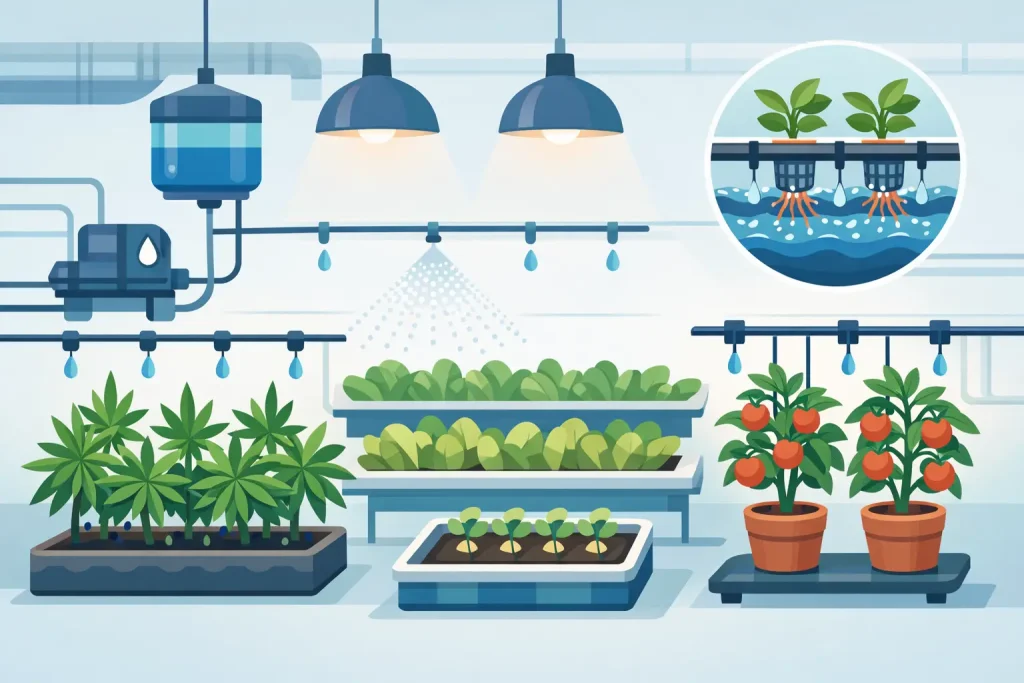
A hand-watered grow can look perfectly manageable until plants reach peak demand. Then one missed feed, an unevenly soaked pot or a rushed nutrient mix can show up in plant health and final yield. The best irrigation systems remove that inconsistency, but the right choice depends on the growing medium, plant count, reservoir capacity and how much control the room needs.
For an indoor grow room, irrigation is not simply about getting water from a tank to a pot. It is a way to control feed frequency, root-zone moisture, runoff and labour. A system that performs well in coco may be unsuitable for deep-water culture, while a simple dripper setup can be more useful than a complex recirculating system for a small tent.
What makes an irrigation system right for your grow?
Start with the root zone rather than the pump. Coco, rockwool, clay pebbles and soil hold water differently, so they need different feed volumes and intervals. Coco and rockwool are commonly irrigated little and often, particularly under high light. Soil generally needs longer gaps between watering, while recirculating hydroponic systems need stable reservoir conditions and reliable aeration.
The next consideration is scale. A two-plant tent does not always justify multiple valves, manifolds and controllers. At the same time, a larger run-to-waste setup becomes difficult to manage accurately by hand. Choose a system that gives each plant a consistent delivery rate, can be cleaned without dismantling the whole room, and has enough headroom for expansion.
Drainage matters just as much as delivery. If you are feeding to waste, use correctly sized trays, stands and runoff collection. Standing runoff raises humidity, attracts pests and makes it harder to judge whether plants are receiving the intended volume. In recirculating systems, ensure the return line can handle the pump flow without backing up.
Best irrigation systems by growing method
Dripper systems for coco, soil and rockwool
Dripper irrigation is the most flexible option for pot-based indoor growing. A submersible pump pushes nutrient solution from a reservoir through mainline pipe, smaller distribution tubing and dripper stakes or rings. A timer controls the number and duration of feeds.
This format is particularly effective for coco. Multiple short feeds can maintain a balanced moisture level and help manage nutrient strength in the root zone. In rockwool, drippers provide the precision needed to steer crop development through feed timing and runoff. For soil, use fewer and longer events, with enough time between feeds for the medium to dry back appropriately.
The trade-off is maintenance. Fine drippers can block if nutrients are not mixed thoroughly, reservoir water is dirty or pipework is left unused between runs. Use a filter where appropriate, keep the reservoir covered, and flush lines with clean water at the end of a crop. Pressure-compensating drippers are worth considering for larger layouts because they help keep output even across the line.
Flood and drain systems for trays and clay pebbles
Flood and drain, also called ebb and flow, periodically fills a tray with nutrient solution before allowing it to drain back to the reservoir. It works well with clay pebbles, rockwool blocks and pots placed in a flood table. The flood saturates the lower root zone, while the draining action pulls fresh air back into the medium.
This is a tidy system for uniform plant sizes and organised bench layouts. It also avoids individual drippers at every pot, which reduces the number of small parts to inspect. For growers using clay pebbles, flood and drain can offer a forgiving balance of moisture and oxygen around the roots.
Its limitation is shared water. If one plant develops a root problem, the reservoir can carry pathogens through the system. Keep the tank temperature stable, monitor pH and EC regularly, and clean trays, fittings and pipework thoroughly between cycles. Flood height and duration must also suit the pot size and medium, rather than being copied from another setup.
Run-to-waste irrigation for precise feeding
Run-to-waste is a dripper-based method where fresh nutrient solution is delivered to each plant and excess runoff is removed rather than returned to the reservoir. It is common in coco and rockwool because it gives the grower direct control over what enters the root zone at every irrigation event.
For high-demand crops, this can be one of the best irrigation systems for maintaining consistency. You can measure input EC and pH, check runoff, and adjust the programme before root-zone conditions drift too far. It also avoids recirculating disease pressure or gradually changing nutrient ratios in the tank.
The obvious cost is water and nutrient use. In the UK, drainage disposal needs sensible planning, particularly at larger scale. A waste pump or properly positioned runoff tank may be required, and the system needs enough tray capacity to prevent spills. The extra consumption is often justified where crop steering and reliable nutrient delivery are priorities.
Recirculating systems for DWC and NFT
Deep-water culture and nutrient film technique use a shared reservoir that continually supplies the root zone. In DWC, roots sit in highly oxygenated nutrient solution. In NFT, a shallow film of solution flows through channels, keeping roots moist while leaving plenty of access to air.
These systems can produce fast, clean growth when water temperature, dissolved oxygen, pH and EC are tightly controlled. They also use less water than run-to-waste systems. However, they are less tolerant of equipment failures. A stopped circulation pump, blocked channel or failed air pump can affect plants quickly, especially in warm grow rooms.
Recirculating hydroponics suits growers who are prepared to inspect the system every day. Use reliable pumps, air stones and check valves, keep spare critical components available, and avoid overfilling reservoirs. A reservoir thermometer is not optional in this type of setup: warm nutrient solution holds less oxygen and increases the risk of root disease.
Core components that determine performance
A good layout is only as reliable as its smallest component. Pump output must be matched to the lift height, pipe length and number of outlets. A pump that is too small gives poor flow at the furthest drippers; one that is oversized can make balancing and runoff management harder. Check the manufacturer’s flow curve rather than relying on maximum litres-per-hour figures alone.
Use opaque reservoirs and pipework wherever possible. Light reaching nutrient solution encourages algae, which can block filters and drippers. Position the reservoir outside the brightest part of the grow area if space allows, and keep the lid closed to limit contamination and evaporation.
Timers need to be accurate enough for the feed strategy. Basic segment timers may work for soil watering, but short, frequent coco feeds call for a digital timer capable of multiple daily programmes. For more advanced rooms, irrigation controllers, solenoid valves and separate zones allow different plant sizes or crop stages to be watered independently.
Do not overlook fittings. Barbed connectors, taps, elbows, tees and pipe clips should match the tubing diameter exactly. A slow leak beneath a tray can become a serious issue in a tent, particularly near electrical equipment. Run the system with plain water first, inspect every joint, and check that no dripper is delivering more or less than the rest.
Setting a feed schedule without guessing
There is no universal timer programme. Plant size, pot volume, room temperature, light intensity, humidity and medium all affect water use. A newly rooted plant in a large pot needs far less frequent irrigation than a mature plant under a high-output LED.
For coco and rockwool, begin conservatively, then observe pot weight, moisture content and runoff. Increase frequency as root mass and light levels rise rather than dramatically increasing the length of each feed. With soil, let the container become noticeably lighter before watering again. Constantly saturated soil restricts oxygen at the roots, regardless of how well the nutrient mix is prepared.
Measure what the system is doing. Collect runoff from representative plants, especially those at the beginning and end of the line. Uneven runoff often points to blocked drippers, poorly levelled trays or pressure differences. Recording pH, EC, reservoir temperature and irrigation times makes troubleshooting much quicker when plants stop responding as expected.
Common irrigation mistakes that cost growers time
The most frequent mistake is treating irrigation as a fit-and-forget purchase. Nutrient salts accumulate, roots can enter fittings, filters clog and timers can be knocked or reset after a power cut. A quick daily inspection of the reservoir level, pump operation and runoff area is far cheaper than correcting a dry crop.
Overcomplicating a small system is another problem. If a basic pump, timer, manifold and quality drippers will meet the requirement, additional valves and controllers create more potential failure points. Conversely, do not cut corners on a system that will run many plants. Uniform delivery and dependable drainage are where a larger setup earns its cost.
Hydroponic Centre stocks the individual irrigation parts needed to build around the medium and method you actually use, whether that means a straightforward dripper line or a full flood-and-drain arrangement. Build the system so it is easy to inspect, easy to clean and easy to adjust when plant demand changes – that is what keeps irrigation working when the grow room is at its busiest.






