
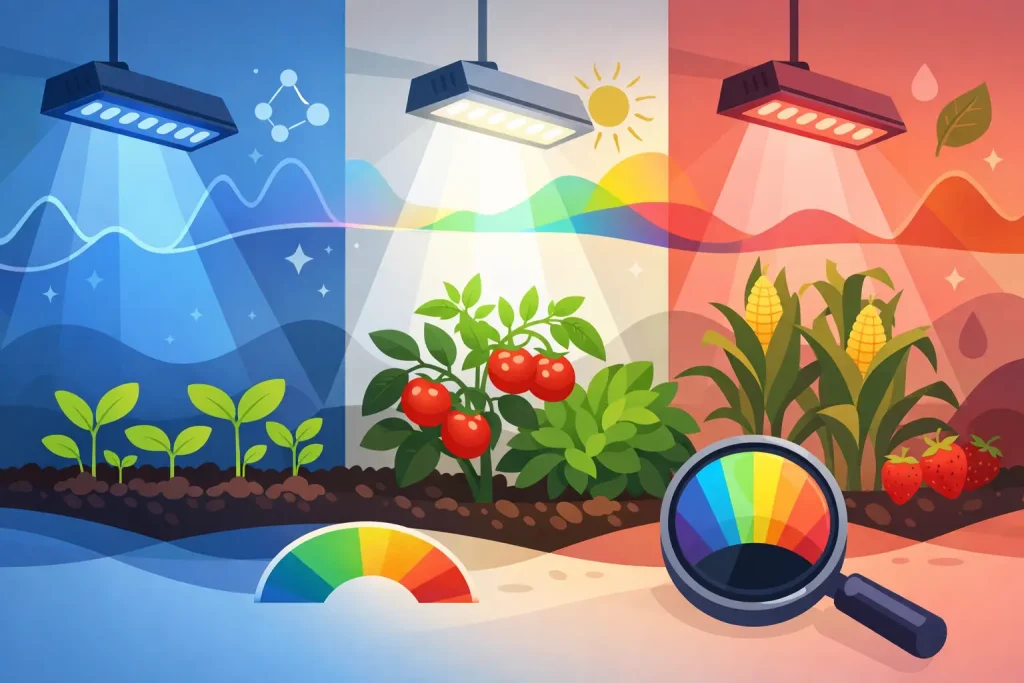
A fixture can look bright, run cool and still leave a crop underperforming. That is usually not a simple “more watts” problem. Choosing grow light spectrum means matching the light quality to plant stage, cultivar response, canopy density and the intensity the fixture can actually deliver at leaf level.
For most indoor growers, a quality full-spectrum LED is the sensible starting point. The decision then becomes more specific: whether to use one spectrum throughout the cycle, add targeted far-red or UV, or run a dedicated vegetative and flowering fixture. The right answer depends on the crop, the available headroom and how tightly the rest of the room is controlled.
Choosing Grow Light Spectrum Starts With Plant Stage
Plants use photons across a wider range than the old red-and-blue LED marketing suggested. Chlorophyll absorbs strongly in blue and red regions, but green wavelengths also penetrate deeper into a dense canopy and contribute to photosynthesis. A modern white horticultural LED typically provides a broad, workable spectrum without forcing the grower to build a complicated multi-fixture setup.
For propagation and early vegetative growth, a spectrum with a meaningful blue component is useful. Blue light generally supports compact structure, leaf development and controlled internodal spacing. This does not mean seedlings need an intensely blue fixture. At this stage, gentle PPFD, sensible hanging height and stable temperature matter more than chasing a narrow spectral peak.
During vegetative growth, broad-spectrum white light remains practical because it supports balanced growth and makes crop inspection easier. Leaves, pests, nutrient issues and irrigation faults are harder to spot under heavily purple light. A fixture in the 4000K to 6500K white range often suits veg areas, although colour temperature is only a rough description of the spectrum rather than a complete performance specification.
Flowering and fruiting crops generally benefit from a greater proportion of red light, especially between 600nm and 700nm. Red photons are efficient for photosynthesis and can support flowering responses in many short-day crops. A warmer full-spectrum fixture, commonly around 3000K to 3500K, often provides a strong all-round flowering profile while retaining enough blue and green light for plant balance and canopy penetration.
The practical point is simple: plants do not need one colour for veg and another for flower as a strict rule. They need the right total light, delivered consistently, with a spectrum appropriate for their stage and crop response.
Spectrum Is Only One Part of Fixture Selection
A perfect-looking spectrum chart cannot compensate for insufficient photon output. Before selecting supplementary bars or changing fixtures, check the PPF of the unit, its efficacy in µmol/J, the recommended coverage area and, crucially, the PPFD map at realistic hanging heights.
PPFD measures the photons landing on a square metre each second. DLI measures the total photons received over the full lighting period. Spectrum influences how plants respond to those photons, but intensity and photoperiod determine how much usable light the crop receives each day. A high-output flowering spectrum hung too high may produce less useful canopy light than a lower-powered fixture positioned correctly.
For a small tent, an even spread is usually more valuable than a central hotspot. Bar-style LEDs are often effective over rectangular canopies because they distribute light across the whole footprint and reduce the need to hang the fixture excessively high. In larger rooms, modular fixtures allow better layout planning and make it easier to maintain consistent PPFD from one bench or tray to the next.
Dimming is equally valuable. A dimmable full-spectrum fixture can be run gently over cuttings, raised through veg and pushed harder once the canopy is established. It also gives you room to respond to seasonal changes in room temperature, nutrient uptake and CO2 strategy without replacing the light.
Broad Spectrum Versus Dedicated Veg and Flower Lights
One broad-spectrum LED used from propagation to harvest is the lowest-complication option. It reduces equipment changes, keeps the electrical layout straightforward and allows a consistent workflow across the grow room. For growers running several plant stages in separate spaces, it also makes spare fixtures and replacement planning easier.
Dedicated vegetative and flowering spectra can make sense where each area has a fixed purpose and crop turnover is high. A cooler, blue-leaning veg fixture may help maintain compact plants under long photoperiods, while a warmer flowering fixture can concentrate output towards red wavelengths. The gain is usually incremental, not miraculous, and it should be weighed against the cost of running separate equipment.
Older blurple LEDs were designed around narrow blue and red bands. They can grow plants, but their visual working conditions are poor and their spectral control is often overstated. A high-quality white LED with supplementary red or far-red capability is generally easier to use, easier to inspect under and better suited to mixed cultivation tasks.
HPS remains relevant in some high-intensity flowering rooms, particularly where growers already have suitable reflectors, ballasts and heat management. Its warm output can produce good flowering results, but it adds substantially more radiant heat than an efficient LED. In a confined UK grow tent, that extra heat can either assist during winter or create a ventilation problem, depending on the room and season.
When Far-Red and UV Are Worth Adding
Far-red sits just beyond the conventional PAR range, roughly 700nm to 750nm. It affects phytochrome signalling and can influence shade-avoidance responses, leaf angle and flowering behaviour. Used carefully, far-red may be useful for specific crops or advanced lighting programmes. Used without a clear reason, it can encourage stretching and make canopy control harder.
Far-red is not a universal yield button. A grower dealing with excessive internodal spacing, weak stems or limited vertical headroom should not add it simply because a fixture has the option. Start with a stable broad-spectrum base, proper PPFD and good environmental control. Then trial far-red on a small section of the crop and compare plant structure, finish time and final quality.
UV requires even more caution. Small doses of UVA may influence plant morphology and secondary metabolite production in some crops, but the results are cultivar-specific and the margin for error is narrower. UVB is more stressful again. It demands accurate timing, suitable equipment and proper eye and skin protection. For most growers, money is better spent first on an efficient main fixture, airflow, extraction and reliable environmental monitoring.
Match Spectrum to the Rest of the Grow Room
Lighting cannot be selected in isolation. Higher photon levels increase demand for water, nutrition, CO2 and temperature control. If the root zone is too cold, humidity is poorly managed or irrigation is inconsistent, moving to a more intense flowering spectrum will expose those weaknesses rather than fix them.
Check leaf temperature rather than relying only on ambient air readings. LEDs produce less radiant heat than HID lamps, so leaves can run cooler even when the room thermometer appears correct. That affects transpiration and VPD. Raising room temperature slightly, adjusting airflow or refining irrigation frequency may be necessary after an LED upgrade.
Canopy distance matters too. Follow the manufacturer’s starting height, measure PPFD if possible, and watch the crop for bleaching, upward leaf curl, stalled growth or excessive stretching. Move in small increments and allow time for the plants to respond. A PAR meter is a useful tool for repeatable production, but even without one, fixture specifications, dimming control and careful crop observation can prevent obvious mistakes.
A Practical Buying Decision
For most tent and small-room growers, choose a dimmable, efficient full-spectrum LED sized properly for the canopy. Select a fixture with published PPF, realistic coverage guidance and a spectrum that includes broad white output with sufficient red for flowering. Prioritise even distribution, driver quality and heat management over novelty wavelength claims.
If you operate separate propagation, veg and flowering areas, dedicated spectra may be worthwhile once the basics are already right. Add far-red only where you have a defined crop response to target, and treat UV as a specialist tool rather than a starting requirement. Hydroponic Centre’s lighting ranges are best approached in the same way as nutrients or irrigation: select the specification that fits the system you are actually running, not the largest claim on the box.
The most productive spectrum is the one your plants can use day after day without heat stress, patchy coverage or an overloaded environment. Build from a dependable full-spectrum base, record what the crop does, and make targeted changes only when the results justify them.






