
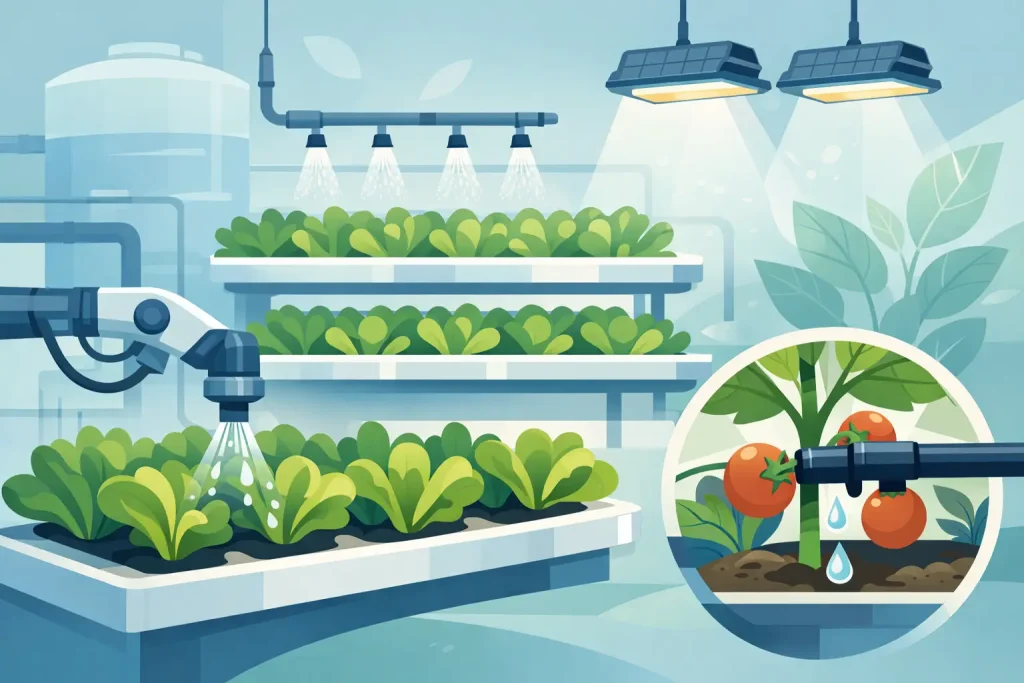
A missed hand feed can be corrected. A poorly specified irrigation setup can repeat the same mistake across every plant, several times a day. That is why watering systems need to be chosen around the growing method, root-zone volume, nutrient programme and room layout – not simply by the number of pots on the floor.
For indoor growers, automation is mainly about consistency. It gives each plant a repeatable feed volume at predictable intervals, makes run-off easier to manage, and removes some of the variation that creeps in when watering is done manually. The trade-off is that an incorrectly timed or poorly maintained system can overwater an entire crop just as efficiently.
Start with the medium and feeding method
The growing medium sets the basic rules. Coco coir, rockwool and other inert media are usually fed little and often, with nutrient solution delivered from a reservoir through drippers or feed stakes. These setups are commonly run to waste, meaning excess solution drains away rather than returning to the tank. This keeps the feed fresh at the root zone and gives the grower a clear run-off sample for checking EC and pH.
Soil or soil-heavy mixes normally need longer gaps between irrigations. They hold water for longer, and frequent timer events can leave the root zone saturated. A dripper system can still work well in soil, but it needs lower frequency, sensible pot drainage and a schedule based on pot weight rather than a generic timer setting.
Recirculating systems suit growers who want to reuse nutrient solution. Flood-and-drain tables, some drip systems and certain hydroponic formats return solution to the reservoir after each cycle. They can be efficient, but the tank must be monitored more closely because pH, EC and water temperature can move as plants feed. If one root zone develops a problem, recirculation can also carry it through the system.
Deep water culture and aeroponic systems are different again. Here, roots are in direct contact with nutrient solution or a highly oxygenated spray, so pump reliability and dissolved oxygen are central to plant health. These are not systems to leave unchecked for long periods, particularly in a warm grow room.
The watering system needs a complete flow path
A reliable build is more than a tank, pump and timer. Each component has to work at the required pressure and flow rate, from the reservoir outlet to the final dripper. A weak pump, restrictive filter or undersized distribution line can mean plants closest to the tank receive more than plants at the end of the run.
For a typical dripper setup, the core parts are a reservoir, submersible pump, irrigation timer and distribution pipework. Add a filter before the smaller feed lines, then use equal-length runs where possible. Drippers, manifolds or feed stakes should be selected for the delivery rate required, rather than mixed at random across the same zone.
Before fitting everything into a tent or room, run a plain-water test. Check every outlet, measure how much each plant site receives over a set period and inspect for leaks. It is much easier to correct uneven delivery when trays, pots and crop canopies are not in the way.
Reservoir size is not just about convenience
A larger reservoir reduces the frequency of mixing nutrient solution, but it can make drift harder to spot. If the volume is excessive for the plant count, solution may sit for too long while its temperature changes and pH gradually shifts. Smaller reservoirs are easier to refresh, though they require more regular top-ups.
As a working approach, choose a reservoir that covers the expected demand between planned checks, with enough spare capacity to prevent the pump running dry. The right size depends on plant size, room temperature, lighting intensity, medium, container volume and how often the system will run. A reservoir for young plants should not be sized solely for peak flowering demand, but the system should allow for that later increase.
Keep the tank covered to limit light exposure. Light in nutrient solution encourages algae, which blocks filters and drippers. Airstones can help keep solution moving and improve oxygen levels, especially where a reservoir is kept for more than a day, but they do not replace good hygiene or regular solution changes.
Timing should be measured, not guessed
The most common automation error is using a timer schedule copied from another room. A plant under lower-power lighting in a cool room will not use water at the same rate as a densely planted crop beneath high-intensity fixtures. Media also dry at different speeds, and large fabric pots behave differently from small plastic pots.
Start with short irrigation events and confirm what reaches the root zone. In coco or rockwool, the aim is generally even moisture and controlled run-off, not a pot that remains heavy and waterlogged. Check the first and last plants on each line. If the end of the line is dry while the first pots are producing excessive run-off, the issue is distribution, not the schedule.
Run-off is useful data in run-to-waste setups. Compare the EC and pH of the input solution with the drainage from representative pots. A sharp rise in run-off EC can indicate salt accumulation or insufficient volume. Very high run-off percentages, however, waste water and nutrients without automatically improving root-zone conditions. The target depends on the medium, feed strength and crop stage.
Do not set a system and walk away for a week. Check pot weight, leaf posture, tank level, run-off and emitter output after any change to lighting, environment, nutrient strength or plant size. A timer gives consistency, but only observation tells you whether that consistency is correct.
Build for maintenance from day one
Irrigation failures are usually practical rather than mysterious: a blocked dripper, a kinked pipe, a clogged filter, a timer reset after a power interruption or a reservoir allowed to run low. Position the tank where it can be opened and cleaned without dismantling the room. Use pipe clips and grommets where lines pass through trays or tent walls, and avoid sharp bends in microtube.
Filters should be accessible and cleaned routinely. In hard-water areas, scale and mineral deposits can restrict small emitters over time. Organic additives, beneficial products and thicker nutrient mixes can also leave residue in pipework if the system is not flushed. Flush with clean water between crops, inspect drippers individually and replace inexpensive parts before they become a crop-wide problem.
Electrical safety matters as much as plumbing. Keep timer connections, plugs and extension sockets above floor level and away from possible spills. Use suitable protection for electrical circuits, make drip loops in cables, and never rely on a tray lip to contain a major leak. A water alarm near the reservoir or outside the tent is a sensible safeguard for unattended rooms.
Choose automation that suits the scale of the room
A simple pump and digital timer is often enough for a small coco setup. It is inexpensive, easy to understand and straightforward to repair. As plant numbers increase, manifold-fed systems, multiple irrigation zones, solenoid valves and more accurate controllers can make management easier. They also add more points of failure, so the benefit has to justify the complexity.
Separate zones are useful when young plants and mature plants share a room, or when different media require different feeding patterns. One timer programme cannot properly serve both a thirsty slab of coco and a lightly rooted pot of soil. If zones are not practical, keep similar plants and media together rather than trying to compensate with mismatched drippers.
For growers expanding from hand watering, a basic run-to-waste system is often the most manageable first step. It provides controlled delivery without requiring the same level of reservoir management as a fully recirculating setup. Once flow rates, run-off and daily demand are understood, upgrading to larger tanks, extra zones or more advanced controllers becomes a calculated decision rather than an expensive experiment.
The best irrigation setup is not the one with the most fittings. It is the one you can inspect, clean and adjust quickly while delivering the right amount of nutrient solution to every root zone. Build it neatly, test it under real conditions, and let measured plant response set the schedule.






