
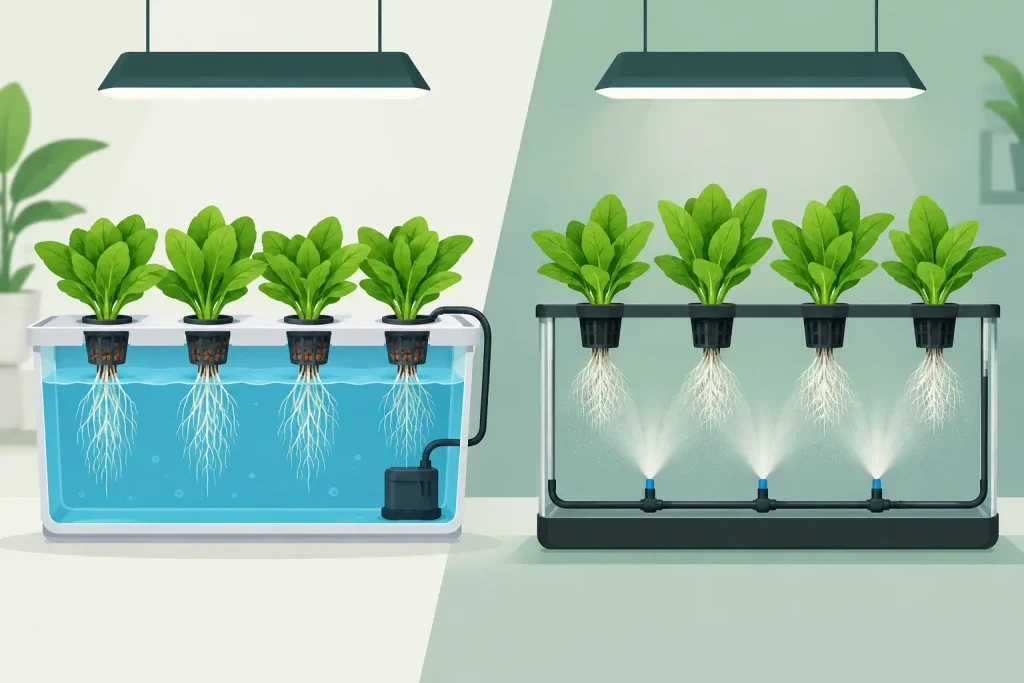
A root zone can look perfectly clean while causing the biggest problem in the grow room. Low dissolved oxygen, a blocked sprayer or nutrient solution running too warm can slow growth long before the leaves show obvious symptoms. That is why the hydroponics vs aeroponics decision should start with daily management capacity, not just the promise of faster growth.
Both methods grow plants without soil, using a mineral nutrient solution delivered directly to the roots. The difference is how that solution reaches the plant. Hydroponic systems keep roots in, or regularly feed them with, nutrient solution. Aeroponic systems suspend roots in air and mist them at controlled intervals. Each can produce excellent results under LED lighting in a tent, dedicated room or small commercial facility, but their tolerance for mistakes is very different.
Hydroponics vs Aeroponics: the working difference
Hydroponics is a broad category rather than one single system. Deep water culture (DWC), recirculating DWC, nutrient film technique (NFT), flood-and-drain, drip irrigation and run-to-waste setups all count as hydroponics. Some keep roots continuously submerged, while others irrigate media such as coco, clay pebbles or rockwool on a timed schedule.
Aeroponics removes the growing medium and standing solution from the immediate root zone. Plants sit in net pots or purpose-built lids, with roots hanging inside a dark chamber. Pumps send nutrient solution to spray heads or misting nozzles, coating the roots with fine droplets before the excess returns to the reservoir.
The appeal is clear: roots receive very high oxygen exposure between sprays, while still having regular access to water and nutrients. In a correctly configured system, this can support rapid root development and vigorous vegetative growth. The operational cost is precision. If spray coverage is uneven, nozzles clog or the pump stops, plants have very little reserve around the roots.
Root-zone oxygen and nutrient delivery
Oxygen availability is the main technical argument for aeroponics. Roots need oxygen for respiration. In water-based systems, oxygen must be dissolved into the nutrient solution through air stones, waterfalls, circulation or dedicated oxygenation equipment. As reservoir temperature rises, water holds less dissolved oxygen, which increases the risk of stressed roots and pathogen pressure.
Aeroponics avoids constant immersion, so oxygen at the root surface is naturally plentiful. However, this only helps when droplet size, spray frequency and chamber humidity are properly managed. Coarse sprays can leave areas dry. Very fine mist can be effective but generally needs more specialised high-pressure equipment and filtration. A low-pressure aeroponic system is usually simpler and less expensive, but it is still dependent on clean emitters and reliable pump cycles.
A well-run DWC or recirculating system can also deliver outstanding root health. Maintain correct reservoir temperatures, use sufficient aeration, keep light out of the solution and avoid organic debris, and there is no automatic yield advantage simply because another system has misting nozzles. For most growers, stable nutrient delivery beats theoretically perfect oxygenation that cannot be maintained consistently.
Equipment, cost and failure points
A basic hydroponic build is easier to source, understand and troubleshoot. A DWC system may need a reservoir, net pots, air pump, air stones, airline, nutrient solution and a reliable pH and EC meter. A flood-and-drain or drip system adds a water pump, timer, pipework and a suitable growing medium. These components are widely available, straightforward to replace and relatively forgiving if a minor setting needs adjustment.
Aeroponics requires a more controlled build. Alongside the reservoir and pump, it needs a root chamber, sealed feed lines, correctly positioned sprayers, filtration, cycle timing and dependable drainage back to the tank. High-pressure systems can add accumulators, solenoids and specialist misting hardware. The cost is not just the initial kit. It includes spare nozzles, spare pumps, cleaning materials and ideally a backup plan for power or pump failure.
The main risk is speed of failure. In DWC, a short power cut reduces aeration but roots remain surrounded by solution. In coco drip irrigation, the medium holds moisture and gives a useful buffer. In aeroponics, roots can dry quickly if misting stops, especially under warm lighting or in a low-humidity room. For growers who are away from the site for long periods, that distinction matters.
Water use, nutrients and reservoir management
Both approaches can use less water than hand-watering soil, particularly when nutrient solution is recirculated. Aeroponics is often promoted as the most water-efficient option because it applies small amounts directly to exposed roots. That can be true, but actual savings depend on chamber design, run-off recovery, plant size and how often the reservoir is replaced.
Hydroponic systems vary widely. Run-to-waste coco uses more feed solution than a recirculating DWC system, but it gives the grower more control over what enters the root zone each irrigation. Recirculating systems save water and nutrients, yet require closer monitoring because plants continuously alter the reservoir balance. EC can rise as water is consumed, while pH can drift as different ions are taken up.
Aeroponic reservoirs need the same discipline, with an additional focus on cleanliness. Nozzle apertures are smaller than standard drippers, so sediment, biofilm and nutrient precipitation are more likely to cause disruption. Use fully soluble mineral nutrients, mix each part into water separately, and keep filters, lines and spray heads on a regular maintenance schedule. Do not assume a clear reservoir means a clean system.
Which crops suit each method?
Fast, leafy crops such as lettuce, herbs and Asian greens are popular choices for both hydroponic and aeroponic systems. Their compact root structures, short crop cycles and relatively moderate feeding requirements make them easier to manage. NFT, DWC and low-pressure aeroponic units can all be productive here.
Larger, long-cycle fruiting plants place greater demands on support, root volume, irrigation capacity and reservoir stability. Tomatoes, chillies, cucumbers and other heavy-feeding crops can be grown aeroponically, but the system must be sized for their mature roots and water use, not their early vegetative stage. Drip-fed coco, flood-and-drain trays or recirculating systems are often more practical because they offer a moisture buffer and easier physical support.
Propagation is one area where aeroponic principles can be particularly useful. A properly maintained cloning machine keeps stems consistently moist and oxygenated without saturating the rooting environment. Even then, hygiene is non-negotiable: clean collars, fresh water, controlled temperatures and regular checks prevent problems spreading across every cutting in the unit.
Choosing the right system for your grow room
Choose hydroponics if you want a proven system with a wider operating margin. DWC suits growers who can manage reservoir temperature and aeration. Flood-and-drain works well for pots of clay pebbles and offers a practical route into active hydro. Drip irrigation and coco are highly scalable, particularly where individual plants need separate irrigation points and straightforward crop steering.
Choose aeroponics when you are prepared to monitor equipment closely and want maximum root-zone access. It is best suited to growers who understand pH, EC, reservoir hygiene, pump duty cycles and the need for spare parts on site. A small aeroponic propagator is a sensible first step before committing an entire flowering area to a larger system.
Your environment should influence the choice too. A warm room with limited cooling capacity makes nutrient solution temperature harder to control in DWC, but it can also make aeroponic failures more urgent. Poor water quality may require filtration or reverse osmosis in either system. If you already run reliable extraction, circulation fans, climate control and environmental monitoring, aeroponics becomes more realistic. If the rest of the room is still being dialled in, a simpler hydroponic method is usually the better investment.
Maintenance decides the winner
Neither system is genuinely low maintenance. Hydroponics needs routine checks of pH, EC, water temperature, pump performance and root appearance. Aeroponics needs all of that, plus inspection of spray patterns, filters, nozzles and cycle timers. In both cases, light leaks into the reservoir, dirty equipment and neglected calibration can turn a good system into an expensive source of crop stress.
For many indoor growers, hydroponics delivers the best balance of performance, cost and resilience. Aeroponics can be exceptionally effective, but it rewards disciplined maintenance rather than casual setup. Build around the time you can realistically give the root zone, keep critical spares close by, and choose the system you can keep clean, stable and running every day.






