
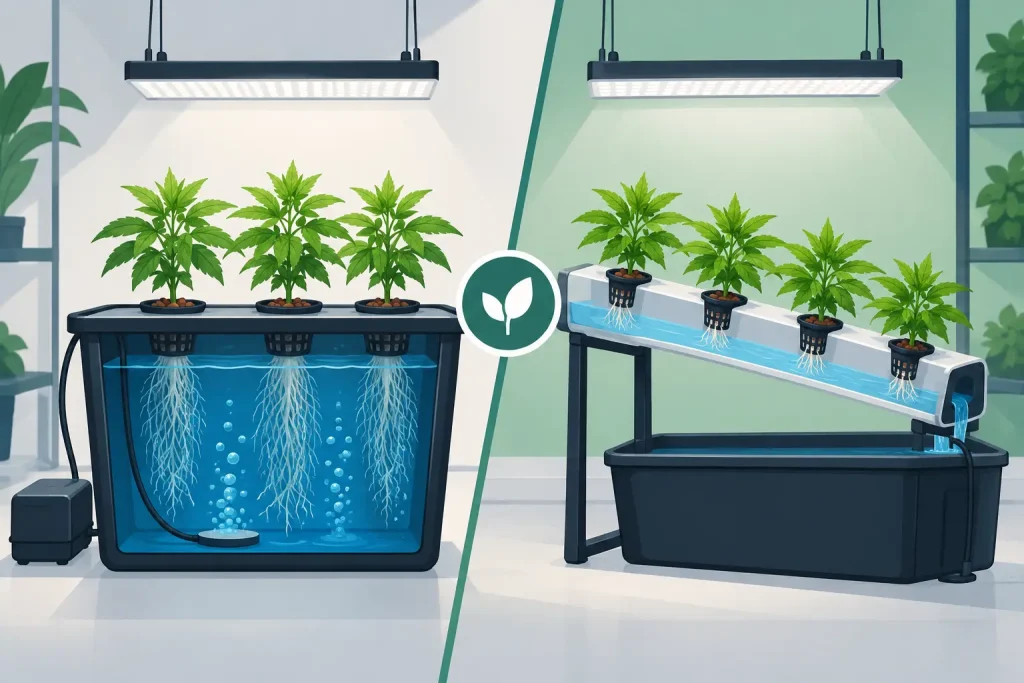
A recirculating system can save media, reduce hand-watering and deliver fast growth, but only when it suits the crop and the person running it. In the DWC vs NFT systems decision, the main difference is not just how water moves. It is how much room you have for error, how often you can check the system, and whether your plants need a large, stable root zone or a shallow, continually refreshed feed.
DWC vs NFT Systems: the core difference
Deep Water Culture, usually shortened to DWC, suspends plant roots in a highly aerated nutrient solution. Each plant normally sits in a net pot above a bucket, module or larger reservoir, with an air pump and air stone keeping dissolved oxygen available around the roots. In recirculating DWC, often called RDWC, a control reservoir and pipework circulate nutrient solution between multiple plant sites.
Nutrient Film Technique, or NFT, sends a thin film of nutrient solution along the bottom of a sloped channel. Plants sit in holes along the channel, usually in small net pots or collars, while roots spread through the enclosed channel. The solution drains back to a reservoir and is pumped round again.
DWC gives roots constant access to a larger volume of nutrient solution. NFT gives them a shallow, flowing stream, with much of the root mass exposed to humid air inside the channel. Both can perform well, but they behave very differently when temperature rises, a pump fails or a root system becomes oversized.
Root-zone conditions and plant performance
DWC is generally the more forgiving option for larger plants with substantial root systems. The reservoir volume buffers changes in EC, pH and water temperature better than a narrow NFT channel. A well-aerated DWC root zone can support rapid vegetative growth because roots have uninterrupted access to water and nutrients without becoming waterlogged.
The catch is that aeration is non-negotiable. Warm, stagnant solution loses oxygen quickly, and root disease can move fast through a shared recirculating system. Use a correctly sized air pump, good-quality air stones and opaque reservoirs that prevent light reaching the nutrient solution. Keep water temperatures controlled, particularly in a warm tent or insulated grow room.
NFT is particularly effective for fast, light crops such as lettuce, herbs and leafy greens. The shallow flow provides frequent nutrient contact while the channel design leaves plenty of air around the roots. It is efficient, clean and well suited to high plant counts where uniformity matters more than supporting a large individual plant.
For mature, heavy-feeding or long-cycle plants, NFT can become restrictive. Thick roots can block channels, disrupt flow and create dry spots downstream. That does not make NFT unsuitable, but it demands sensible plant spacing, correctly sized channels and disciplined crop timing.
What happens when the power goes off?
This is one of the most practical differences. In DWC, a short power interruption usually leaves plants with a reserve of solution around their roots. Oxygen levels will fall over time, but the root zone does not immediately dry out. The real risk depends on water temperature, plant size and how long the air supply is off.
NFT has less reserve. If the feed pump stops, roots in the channel can begin drying quickly, especially under strong lighting and warm conditions. A short interruption may be harmless in a cool room, but a longer failure can cause stress before you spot it. For NFT, a reliable pump, clean filter, secure pipework and a backup plan are sensible operational requirements rather than optional extras.
Space, layout and access
DWC works well where plants need individual spacing. Single-bucket systems are straightforward to position in a tent, and modular systems can be expanded as the growing area develops. Access is simple: you can inspect one plant, lift a lid and deal with an issue without dismantling an entire run.
The downside is floor space. Buckets, pipework and a control reservoir occupy room quickly, particularly once you allow clearance for checking levels, draining and cleaning. Large systems also become heavy when full, so plan the layout before filling them. A waterproof floor tray and accessible drain point can prevent a routine change-out becoming a difficult job.
NFT makes better use of horizontal and vertical footprint for compact crops. Channels can be arranged in rows or on a tiered frame, making NFT a practical choice for propagation areas, salad production and small commercial installations. However, every channel needs a consistent fall. Poor levelling causes pooling at one end and weak flow at another, which quickly shows up in uneven plant growth.
Nutrient management and daily workload
Neither system is maintenance-free. Both need regular checks of nutrient level, EC, pH and water temperature. The difference is how quickly small changes become significant.
A larger DWC reservoir is more stable, especially in a single-site system with modest plant numbers. Still, a healthy, fast-growing crop can drink heavily, concentrating the nutrient solution as water level falls. Top up with suitable water, measure before adjusting, and avoid chasing pH several times a day unless there is a clear problem. Large corrections can be more disruptive than a minor drift.
NFT reservoirs are often smaller relative to the number of plants they serve. This can make nutrient readings change faster, particularly under high-output LED lighting. The system needs consistent monitoring because plants at the start of the channel can sometimes receive a slightly different root-zone environment to those at the end.
Keep the reservoir covered in either setup. Light encourages algae, algae consumes oxygen and blocked lines or emitters are never far behind. Use a nutrient range appropriate for recirculating hydroponics, mix thoroughly, and do not assume a high-strength feed will compensate for weak environmental control. Root temperature, airflow and canopy conditions still determine how effectively plants use the feed.
Cleaning and biosecurity
DWC is simple to understand but not always quick to clean. Buckets, lids, net pots, air lines, air stones and connecting pipework all need cleaning between crops. In a recirculating build, biofilm can collect in return lines and fittings if the system is not properly flushed.
NFT channels have fewer submerged components, but their length creates its own cleaning work. Root fragments can lodge in gullies, and channels must be fully rinsed and sanitised between runs. Removable lids and accessible end caps make a major difference. If a system is awkward to clean, it will eventually be cleaned less thoroughly than it should be.
For both systems, start with clean equipment and inspect roots regularly. White or cream roots, depending on nutrient staining, are normally a good sign. A sour smell, slime, browning that progresses rapidly or a sudden loss of vigour needs action. Check water temperature, oxygenation, flow and hygiene before adding more additives to the reservoir.
Cost and equipment requirements
An entry-level DWC setup can be built with relatively few parts: an opaque reservoir, net pot, growing media, air pump, airline, air stone and nutrient solution. It is accessible for growers who want to learn hydroponic fundamentals without a complex plumbing layout.
RDWC raises the cost but offers centralised management. You will need suitable pipe sizes, reliable bulkhead fittings, a circulation pump, a control reservoir and a chiller or water-temperature strategy where conditions require it. The benefit is that you can manage several sites from one point, but a mistake in the reservoir affects every plant connected to it.
NFT usually needs a reservoir, feed pump, tubing, channels, returns and a frame or support system. It can be economical for many smaller plants, as one pump can serve multiple channels. Avoid treating it as the cheaper option by default. Well-made channels, stable supports and reliable fittings are worth the spend when leaks or uneven flow could damage an entire crop.
Which system should you choose?
Choose DWC if you are growing fewer, larger plants, want a generous root-zone buffer and have the floor space to work around reservoirs. It is also a sensible route for growers who want to understand pH, EC, water temperature and aeration clearly before moving into a more complex recirculating setup.
Choose NFT if your priority is efficient production of leafy crops, herbs or compact plants at higher density. It suits growers with a level site, a regular checking routine and confidence in maintaining uninterrupted flow. It is especially useful where bench space and fast turnover matter.
There are exceptions. A carefully designed NFT system can support more demanding crops, while a DWC layout can be highly productive for compact plants. The right choice comes down to crop type, plant count, room temperature, access to water and how much daily attention the system will receive.
Before buying equipment, map the grow area, measure the route to a drain, and decide how you will handle a pump fault or high reservoir temperature. The better system is the one you can inspect, clean and control properly every day.






