
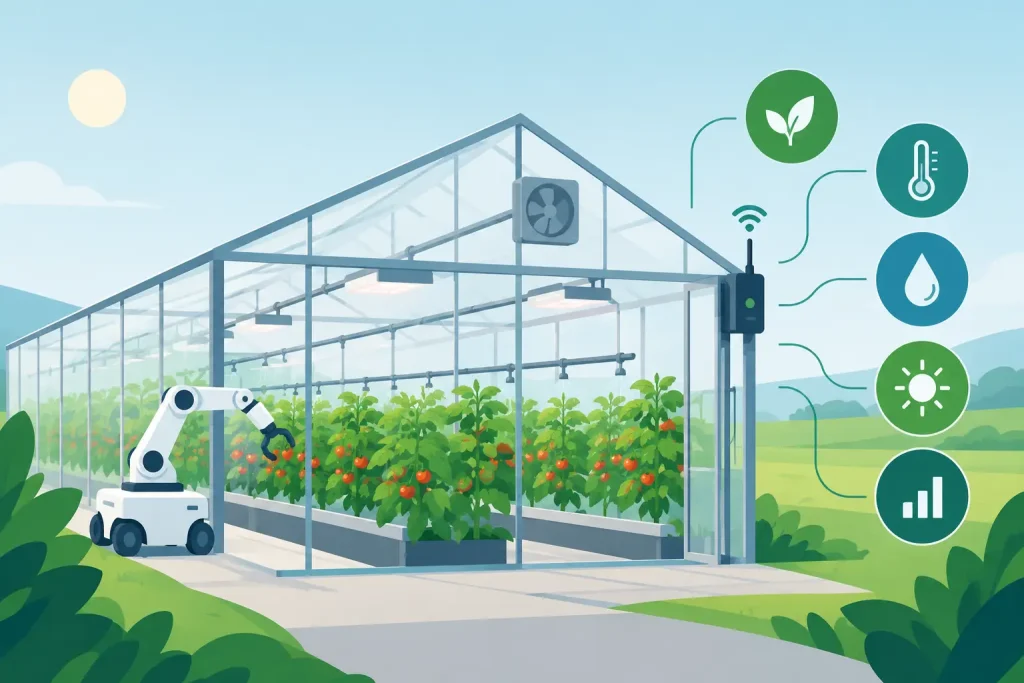
A greenhouse can look fully automated and still produce uneven crops. A controller, a few probes and a timer only improve a growing environment when they make reliable decisions from useful data. The greenhouse automation outcomes worth paying for are not flashing displays or remote access. They are steadier root-zone conditions, fewer missed irrigation events, tighter climate control and less time spent correcting preventable problems.
For serious growers, automation is a way to reduce variation. It does not replace crop checks, cleaning or sound cultivation practice. It gives you a repeatable baseline, so the time spent in the greenhouse can go into inspecting plants and making informed adjustments rather than manually switching pumps, fans and heaters.
Greenhouse automation outcomes to measure
The first measurable result should be environmental consistency. Temperature and humidity naturally move throughout the day, but large or prolonged swings slow growth and increase pressure from disease. A properly set climate controller can run extraction, circulation fans, heaters, vents, dehumidification or cooling equipment in response to the conditions you set. The target is not a perfectly flat graph. Plants can tolerate sensible day and night changes. The target is to keep the crop within its workable range without sharp peaks, cold spells or stale, humid periods.
Irrigation consistency is usually the next major gain. A timer-controlled feed schedule gives coco, rockwool, clay pebbles and other systems a more predictable wet-dry cycle than hand watering. Where a tank, pump, pipework and drippers are sized correctly, every plant should receive a similar volume at a similar time. This matters most in high-frequency irrigation, where one missed feed can stress a small root zone quickly.
Labour savings follow, but they should be viewed realistically. Automation removes repetitive tasks such as daily pump switching, routine fan control and top-up reminders. It does not remove the need to check emitters, inspect leaves, confirm drain and clean filters. A grower with an automated room should have more time for crop steering and maintenance, not a reason to leave the system unchecked for days.
Better records are another outcome that is often overlooked. If your controller logs temperature, humidity, CO2 or irrigation events, it becomes easier to link crop response to a real change in the environment. Instead of relying on memory, you can see whether humidity climbed after lights off, whether an extraction setting was too aggressive, or whether a warm spell pushed reservoir temperature beyond its normal range.
Start with the limiting factor
The right automation plan depends on what currently causes the most variation. In a small greenhouse with manual watering, irrigation is often the best first upgrade. A reliable digital timer, correctly sized pump, filter, distribution line and drippers can provide an immediate improvement. In a humid greenhouse, extraction, air movement and humidity management may deliver more value than adding another irrigation zone.
For growers running hydroponic systems, the root zone comes first. A recirculating system may benefit from automated top-up, water-temperature monitoring and alarms for low reservoir level. Run-to-waste setups commonly benefit from timed irrigation, pressure regulation and regular checks of feed and runoff EC and pH. Automation can deliver the solution consistently, but it cannot correct an unsuitable nutrient strength or an unbalanced pH.
Lighting is another common priority in controlled environments. A contactor or suitable controller can run lighting schedules accurately, while temperature-based fan speed control helps manage the heat load. Where supplemental lighting is used in a greenhouse, the equipment needs to be specified around the actual electrical load and site conditions. Do not use a lightweight timer to switch a system it is not rated to handle.
The equipment chain matters more than one controller
Automation works as a chain: sensor, controller, actuator and physical system. A high-quality controller cannot compensate for a humidity sensor positioned directly in an airflow, a blocked dripper or an undersized extractor.
Sensor placement is especially important. Measure canopy conditions around the crop rather than the temperature beside a heater or the humidity immediately outside the greenhouse. Keep sensors away from direct spray and strong light where possible. If a reading looks surprising, verify it with a second instrument before changing a setpoint. Calibration and periodic cleaning are basic maintenance, not optional extras.
Actuators need the same attention. Fans should move enough air for the space and be positioned to avoid dead spots. Solenoid valves must suit the pressure and water quality of the irrigation system. Pumps need enough flow and head height for the number of outlets. Filters protect drippers, but only if they are cleaned before debris restricts flow.
A simple system with dependable components is often more useful than an elaborate setup with too many failure points. For example, a timer, pump, filter and dripper manifold may be the correct solution for a modest growing area. Multi-zone controllers, dosing pumps and remote monitoring make more sense when the crop, greenhouse size or labour requirement justifies the added complexity.
Setpoints need a crop-specific purpose
Avoid setting a controller purely because a number sounds ideal. Temperature, humidity, airflow, light intensity and irrigation frequency interact. Lowering humidity with aggressive extraction can also strip heat from the greenhouse. More frequent feeds can improve oxygen availability in a well-managed coco crop, but excessive run-off wastes nutrient solution and can leave a medium too wet.
Use a clear reason for each setting. If lights-off humidity remains high, increase air exchange or add dehumidification capacity before pushing daytime extraction harder. If plants dry back too far between irrigations, adjust frequency or start times after checking dripper output and medium volume. Change one meaningful variable at a time, then watch the crop and records before making another adjustment.
Measure the result, not the purchase
Before installing equipment, record a short baseline. Note daily minimum and maximum temperature, humidity at lights off or overnight, irrigation times, reservoir level, nutrient use and the amount of time spent on routine tasks. You do not need laboratory-grade data for every greenhouse. You do need enough information to know whether the new equipment has solved the actual problem.
After installation, compare like for like over at least several growing days. Are irrigation events happening at the intended time? Is the greenhouse returning to its target temperature after lights come on? Has overnight humidity reduced without creating an unacceptable heating bill? Are plants more even from one end of the bench to the other?
Yield can be a useful long-term measure, but it is not the only one. A more uniform crop, lower water use, reduced nutrient waste and fewer stressed plants can justify automation even where the harvest weight changes only modestly. Equally, an automated system that saves a little labour but creates regular faults is not an upgrade.
Build in protection for failures
Automation changes the type of risk rather than removing risk altogether. A hand-watered crop can suffer when the grower is unavailable. An automated crop can suffer when a pump fails, a timer is programmed incorrectly, an emitter blocks or a sensor reports bad data. Plan for the likely faults before they happen.
Use overflow protection around reservoirs, secure all pipe connections and keep electrical equipment away from spills. Fit filters ahead of fine drippers, inspect them routinely and keep spare parts that would stop the system if they failed. For valuable crops, alarms for high temperature, low water level or power loss provide a useful layer of protection. A manual bypass or simple way to hand water is also worth retaining.
Power cuts deserve particular attention in the UK, especially where heating, ventilation or irrigation has little tolerance for downtime. Know what switches back on automatically, what needs resetting and how long the greenhouse can remain safe without power. The answer will differ between a lightly planted hobby greenhouse and a densely stocked hydroponic crop.
Upgrade in stages
The best route is normally to automate the most repetitive, high-impact task first, then prove it works. Add irrigation control before automated dosing if watering consistency is the weak point. Add climate control before remote monitoring if you are still manually managing fans. Remote access is useful for checking a system, but it is not a substitute for suitable hardware and regular site visits.
Hydroponic Centre customers building out a controlled growing space should specify each component as part of a working system: reservoir volume, pump capacity, pipe diameter, number of drippers, extraction rate, heater load and controller switching capacity all need to match. Buying individual parts without that plan is how simple jobs become troubleshooting sessions.
The useful outcome of greenhouse automation is confidence that routine conditions will be delivered as intended. Set the system around the crop, verify it with measurements and keep enough manual oversight to catch faults early. That is when automation earns its place in the greenhouse.






