
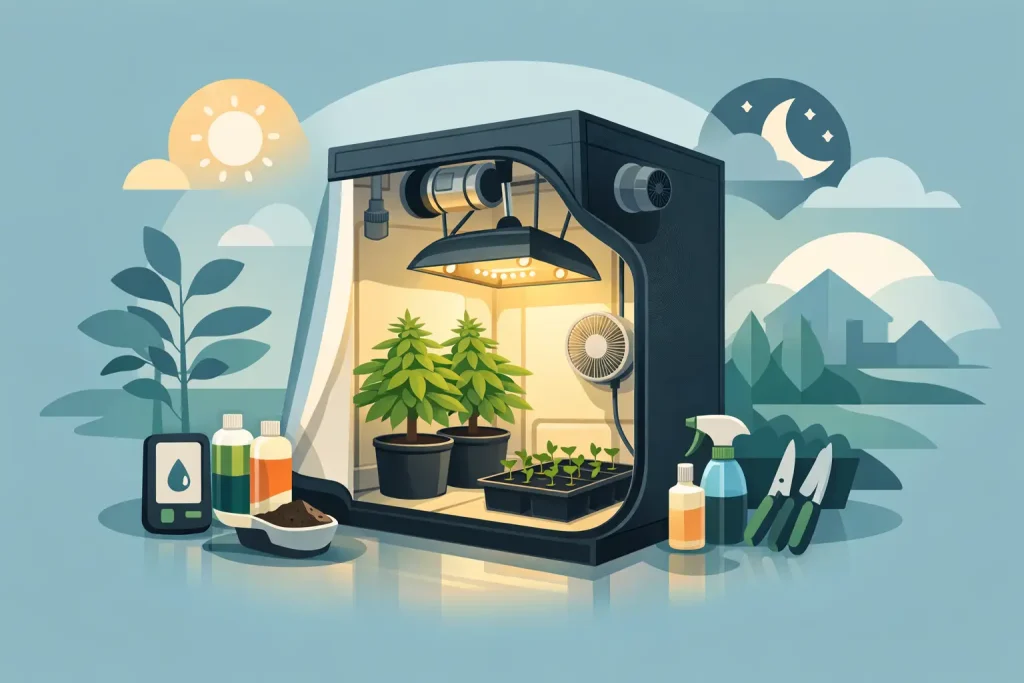
Buying your first tent is where most indoor setups either stay simple or get awkward fast. If you are looking for the best grow tent for beginners, the right choice is usually not the biggest tent or the cheapest kit on the page. It is the tent that fits your space, your extraction, your lighting plan and the number of plants you can realistically manage.
A beginner tent needs to do a few jobs well. It should be lightproof, easy to assemble, strong enough to carry your fan and filter, and practical to work in once the crop is actually inside. That sounds obvious, but many first-time buyers focus on footprint alone and ignore height, duct port placement, pole strength and access. Those details are what make a setup easy to run week after week.
What makes the best grow tent for beginners?
For a first indoor grow, reliability matters more than chasing the highest specification on paper. You want a tent with a decent fabric weight, a reflective inner lining that is properly finished, and zips that do not feel like they will fail after one cycle. Weak stitching, poor zip alignment and thin poles turn a budget purchase into a replacement job.
The best beginner tents also keep the layout straightforward. A simple rectangular tent with sensible door access is easier to light and ventilate than a niche shape that saves a few centimetres in one corner but creates problems everywhere else. If you are running an inline fan, carbon filter and LED fixture, a standard format gives you more flexibility with mounting and cable routing.
There is also a practical point around forgiveness. Beginners benefit from equipment that gives them margin for error. A tent with enough headroom for the light, the ratchets, the filter and the plant canopy is easier to manage than a low-profile tent where every adjustment becomes a compromise.
Size matters more than most beginners expect
The most common beginner mistake is buying by ambition rather than room dimensions. A tent can look compact online and still dominate a spare room, loft space or cupboard once extraction, ducting and access are factored in.
For many new growers, a 60 x 60 cm or 80 x 80 cm tent is the sensible starting point. These sizes are manageable, easier to ventilate and less expensive to light properly. They also make environmental control simpler. In a small footprint, it is easier to match fan size, carbon filtration and LED output without overspending.
A 100 x 100 cm tent can still work well for a beginner, but only if the room, budget and equipment plan support it. Once you step up in footprint, you usually step up in extraction requirements, lighting cost and irrigation demand as well. Bigger can mean better yield potential, but it also means more variables to control.
Height is just as important as floor area. A tent around 180 cm to 200 cm high gives more working room for hanging equipment and maintaining a safe gap between the LED and canopy. Short tents can work for propagation, mother plants or low-profile training, but they are less forgiving for a first full cycle.
Fabric, frame and finish
A tent is not just a cover over poles. Material quality affects light leaks, odour control and long-term durability. Thicker fabric generally performs better, especially if the outer shell is properly stitched and the corners are reinforced. You do not need to obsess over every quoted density figure, but very thin material often shows where corners have been cut.
The frame matters because even a small indoor setup puts weight on the roof bars. A carbon filter, inline fan and LED fixture can add up quickly. If the poles flex too much or the roof bars are poorly fixed, the whole installation becomes less secure. For beginners, that means more hassle during setup and less confidence once everything is hanging overhead.
Zip quality is another area that gets ignored until it becomes a problem. A smooth, heavy-duty zip saves time and reduces wear. If you are opening the tent daily to inspect irrigation, train plants or check runoff, that zip is part of the workflow.
Ventilation ports and access are not minor details
One of the easiest ways to make a first setup awkward is to buy a tent with the wrong port layout. Your extraction route should make sense before you assemble anything. If the duct ports force sharp bends or place the filter in an inconvenient position, efficiency drops and internal space gets wasted.
The best grow tent for beginners usually has enough duct and cable ports to give options without turning the tent into a patchwork of unused openings. You want clean routing for the fan, filter, power leads and any intake arrangement. Good port placement makes the whole setup neater and helps maintain negative pressure.
Door design is equally practical. A wide front opening makes plant work easier. Side access can be useful, but only if the tent is not pushed tight against a wall. In small rooms, a simple front-opening tent is often the better buy because it gives reliable access without requiring extra clearance.
Matching the tent to your lighting
A beginner tent should be sized around the light you can run properly, not the other way round. This is where many first purchases go wrong. An underpowered light in an oversized tent wastes the footprint. An overly aggressive fixture in a cramped tent can make heat and canopy management harder than necessary.
For a small starter tent, modern LED fixtures are usually the most practical option. They run more efficiently, simplify heat management compared with older HID setups and are easier to pair with compact extraction. That does not mean every LED is suitable. You still need sensible canopy coverage for the tent footprint and enough hanging height to maintain distance from the plants.
If you already own a fixture, buy the tent that matches its real flowering coverage rather than the marketing claim. If you are buying both together, treat them as one system. Tent size, light output, extraction rate and filter size should all support each other.
Should beginners buy a full grow tent kit?
Sometimes yes. Sometimes absolutely not.
A complete tent kit can be a good route for a first setup if the components are balanced and from known horticultural brands. It removes guesswork and speeds up the buying process. For growers who want one order, one delivery and a workable equipment package, a decent kit makes sense.
The trade-off is that some kits look competitive on price because one or two core components have been downgraded. Often it is the extraction, the light or the filter. That is where a cheap bundle becomes expensive later, because you end up replacing the part that controls environment or odour.
If you know you want specific equipment categories – for example a particular LED brand, a stronger inline fan, or a better carbon filter – building your own setup can be the better choice. This is often the smarter route for growers who prefer exact control over the specification from day one.
Best beginner tent sizes by use case
A 60 x 60 cm tent is a sensible entry point for growers with very limited space. It keeps equipment costs under control and is easier to dial in. The compromise is working room. Once the filter and light are installed, everything feels tighter.
An 80 x 80 cm tent is often the sweet spot for a first proper grow. It gives enough canopy area to make the setup worthwhile without pushing extraction and lighting costs too far. For many home growers, this is the most practical balance of footprint, yield potential and manageability.
A 100 x 100 cm tent suits beginners who have the room and are willing to invest in stronger supporting equipment. It offers better plant spacing and more flexibility, but poor environmental control becomes more obvious if the rest of the system is under-specced.
If discretion is a priority, remember that a smaller tent does not automatically mean a lower-profile setup. Noise from extraction and poor odour control are often more noticeable than the footprint itself. A well-matched fan and filter setup matters just as much as the tent dimensions.
What not to buy first time round
Avoid ultra-cheap tents with vague specifications, especially if they do not clearly state dimensions, frame details or material quality. If the product listing tells you almost nothing, that usually tells you enough.
Be cautious with oversized tents bought for future expansion. It is usually better to run a tent well now than pay for unused space you cannot light or ventilate correctly. Expansion is easier when the first cycle teaches you what your room and routine can actually support.
Also avoid treating the tent as a standalone purchase. A grow tent only performs as well as the extraction, lighting and environmental control around it. If the budget is fixed, it is often better to buy a slightly smaller, better-quality tent and leave room for a proper fan and filter.
So which tent is the right one?
For most first-time indoor growers, the best grow tent for beginners is an 80 x 80 cm or 100 x 100 cm model with solid frame bars, heavy-duty zips, reflective lining, sensible duct port placement and enough height for modern LED use. If space is tighter, a 60 x 60 cm tent still works, provided you accept the reduced working room and build the system carefully.
There is no single best tent without context. The right choice depends on available space, extraction route, lighting plan and how hands-on you want the setup to be. A beginner does not need the most expensive tent on the market. They need one that is structurally sound, easy to run and properly matched to the rest of the grow room.
If you buy with that in mind, your first tent will do what it should – stay out of the way, hold the environment steady and let you focus on the crop rather than the hardware.






