
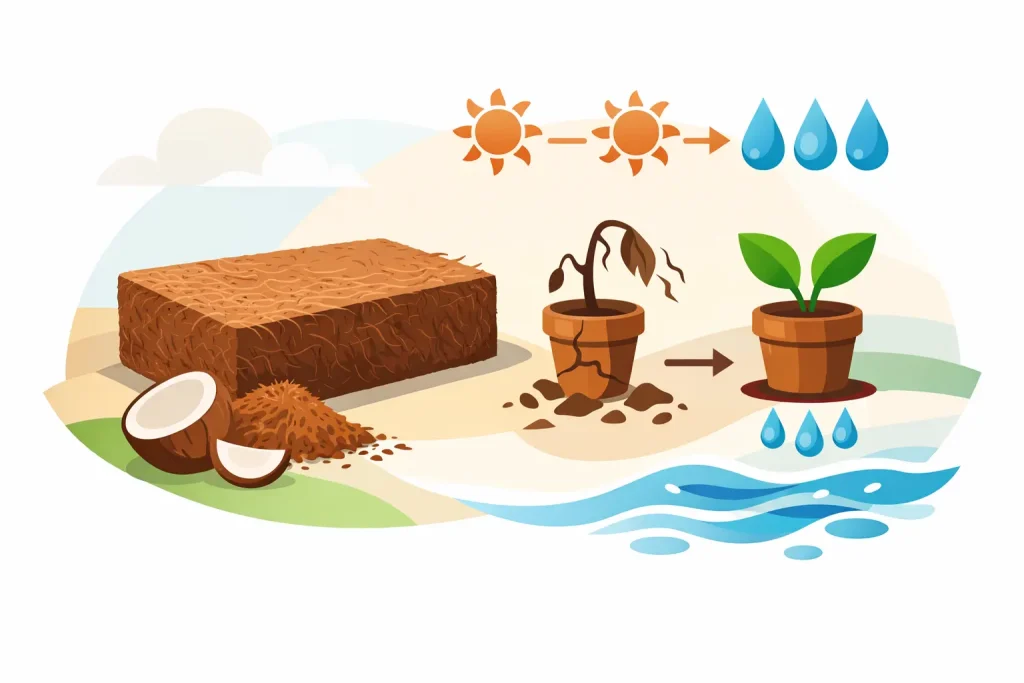
A coco pot can look dry on the surface while still holding useful moisture around the root zone. The real question is not simply, “can coco dry out?” It can – but allowing it to dry too far changes the EC in the root zone, makes rewetting harder and can slow plant growth. In a run-to-waste coco setup, consistent moisture is usually part of the system, not an optional extra.
Coco coir is often treated like soil by new growers because it comes in pots, bags and slabs. It does not behave like soil. Properly buffered coco holds air and water well, drains freely and works best with regular nutrient irrigation. It is closer to a hydroponic medium than a traditional compost-based growing medium.
Can Coco Dry Out Without Causing Problems?
Yes, coco can dry out physically, and a short period of reduced moisture will not automatically kill a healthy plant. A large, well-rooted plant in a correctly sized container has more resilience than a newly rooted cutting in a small pot. The risk comes from how dry the medium becomes, how long it remains dry and the strength of the feed left behind.
As coco dries, water leaves the root zone but dissolved mineral salts remain. This increases the concentration around the roots. If the medium is heavily dry and then fed at the usual nutrient strength, the plant may be exposed to a high root-zone EC before the media has fully stabilised. Leaf-edge burn, drooping, weak uptake and slow recovery can follow.
Dry coco can also become uneven to rewet. Water may run down the sides of a fabric pot or through channels in the medium rather than saturating the root ball. This is particularly common with small pots, very light mixes and plants that have been left without irrigation under high-intensity lighting.
The practical target is not permanently soaked coco. Roots still need oxygen. The target is an evenly moist medium with adequate air porosity, regular feed delivery and a sensible level of run-off where your system calls for it.
Why Coco Dries Faster Than Expected
Coco dries at different rates depending on pot size, root mass, room conditions and irrigation method. A small fabric pot beneath an efficient LED can move from correctly moist to too dry within a single light cycle once the plant is established. A larger plastic pot in a cooler room will hold moisture for much longer.
High temperatures, low relative humidity, strong extraction and direct fan movement all increase transpiration and evaporation. A pot positioned under an oscillating fan can dry notably faster than one elsewhere in the tent. This is why a feeding schedule that works in propagation may be inadequate once plants enter a high-demand stage.
Container choice matters too. Fabric pots offer excellent root-zone aeration but lose moisture through their sides. Air pots and highly perforated containers have a similar trade-off. They are useful options, but they often require more frequent irrigation than conventional plastic pots.
Coco quality and preparation also affect moisture behaviour. Low-grade or poorly buffered coco may contain fine material, excess salts or inconsistent texture. A quality coco coir product with a consistent particle structure gives a more predictable wet-dry pattern and makes irrigation adjustments easier.
Signs Your Coco Is Too Dry
Do not judge solely by the top 1-2 cm of the pot. Surface coco naturally dries first, particularly under grow-room airflow. Lift the container instead. Pot weight is one of the quickest and most reliable checks available to a hand-watered grower.
A pot that is substantially lighter than normal, coco pulling away from the pot edges and water immediately racing through are clear signs the medium has dried excessively. Plants may droop during the lit period, but this symptom needs context. Overwatering, high temperature, excessive light intensity and root disease can also cause drooping.
Check run-off where relevant. A run-off EC that is significantly higher than the input feed often indicates salts are concentrating in the root zone. If run-off volume is low or absent, the reading may not represent the whole pot, but it is still a useful warning that irrigation frequency or volume needs attention.
For growers using automated irrigation, dry pots can reveal a blocked dripper, a kinked feed line, an empty reservoir, an airlock or uneven pressure across the system. Check each dripper rather than assuming a timer setting guarantees equal delivery.
How to Rewet Over-Dry Coco Properly
If the coco has gone very dry, do not flood it once and assume the issue is solved. Start with a gentle, low-EC nutrient solution at the correct pH for coco, typically around pH 5.8 to 6.0. Apply enough solution to begin wetting the medium evenly, then allow a short pause before repeating. This gives the coco time to absorb moisture instead of channelling it away.
For a severely dry pot, several smaller applications are normally more effective than one large feed. Work until the pot has regained an appropriate weight and a modest amount of run-off is produced. Avoid using plain water as an automatic fix. Coco is generally managed as a fed medium, and repeated plain-water irrigation can disturb the nutrient balance, especially where calcium and magnesium demand is high.
If EC has climbed sharply, reduce feed strength temporarily and increase the volume or frequency of correctly balanced nutrient solution until run-off returns closer to the target range. The correct response depends on the crop, growth stage, input EC and how far the root-zone EC has drifted. Chasing an exact run-off number without considering plant condition can create further instability.
A plant may take a day or two to regain normal turgor after a hard dry-back. Resist the urge to overcorrect by keeping the pot saturated for days. Restore a controlled irrigation routine and watch new growth, leaf posture and pot weight.
Set Irrigation Frequency Around Plant Demand
Hand-watered coco can work well for smaller plants and early stages, but it becomes less precise as demand rises. Once plants are using water quickly, a drip irrigation system gives tighter control over feed timing, run-off and root-zone consistency.
Early on, a single daily feed may be sufficient if containers remain suitably moist. As roots fill the pot and the canopy develops, growers often move to multiple smaller feeds during the lit period. The exact number is not universal. It depends on pot volume, plant size, substrate blend, environmental conditions and the amount of dry-back you are aiming to achieve.
Start conservatively, then use observations rather than habit. If pots are becoming very light before the next irrigation, increase frequency, adjust shot volume or both. If the medium remains overly heavy and plants show signs of poor oxygenation, reduce volume or spacing. Good drainage is essential: pots should not sit in run-off, and waste water must be able to leave trays or guttering cleanly.
For automated systems, verify output with a measuring jug. A dripper rated for a certain flow rate may deliver less because of pressure loss, blocked filters or unequal line lengths. Timers should be checked regularly, particularly after power interruptions or reservoir changes.
Managing EC When Coco Dries Back
Coco naturally holds onto certain cations, particularly calcium and magnesium, which is why buffered coco and coco-specific nutrients are useful. When the medium dries too much, the concentration of remaining nutrients rises. This is one reason a plant can show nutrient stress even when the reservoir formula is correct.
Use an EC meter to compare input and run-off trends, not as a replacement for looking at the plant. A steadily rising run-off EC suggests the root zone is accumulating salts. In many cases, improving irrigation frequency and achieving suitable run-off will correct the issue more effectively than making repeated drastic changes to the nutrient recipe.
There is a trade-off with run-off. Too little can allow salts to build up; excessive run-off wastes water and nutrients and can make climate management harder in a compact grow space. Set a practical target for your system, collect run-off where possible and adjust based on measurable results.
A Simple Routine for Healthy Coco
The most reliable coco routine is consistent: use well-buffered media, feed with a suitable nutrient profile, keep pH in the correct range and avoid extreme dry-backs. Lift pots daily if hand watering. Inspect emitters if using drippers. Keep reservoir temperature, airflow and humidity within sensible limits so plant demand does not swing without warning.
Coco rewards precision, but it does not require guesswork or constant intervention. When the medium stays evenly moist, drainage is clean and feed delivery matches plant demand, the root zone remains easier to manage. Treat a pot that has dried too far as an irrigation signal, then correct the cause rather than repeatedly reacting to the symptom.






