
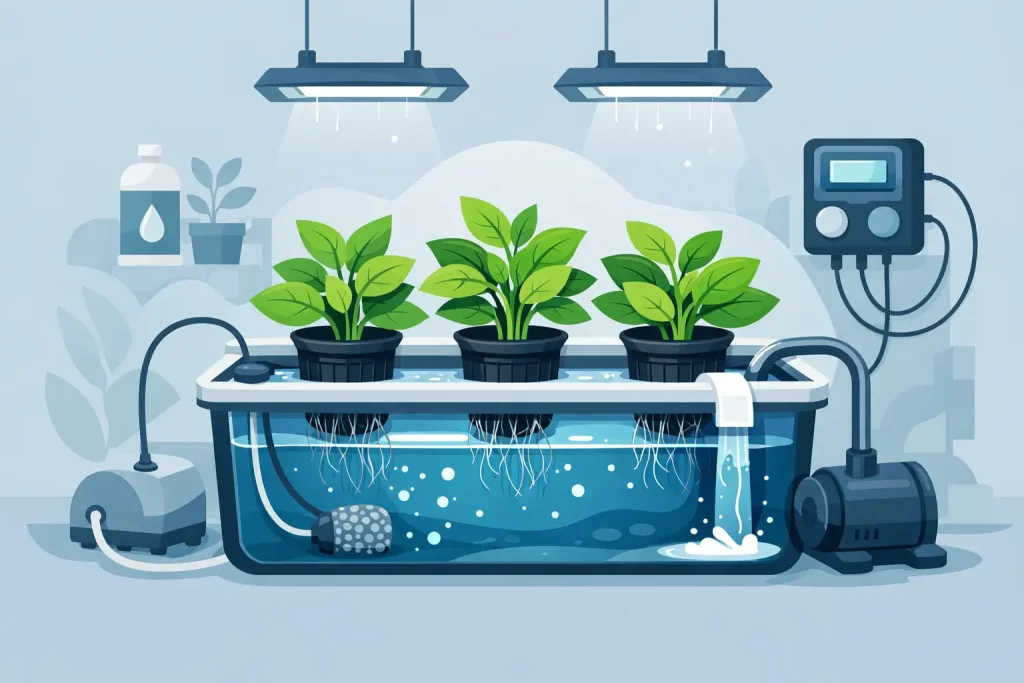
A deep water culture setup looks simple on paper – roots in nutrient solution, an air pump running constantly, and fast vegetative growth when conditions are right. In practice, the difference between a system that grows hard and a system that stalls usually comes down to build quality, oxygen delivery, water temperature and how well the rest of the room is controlled.
DWC rewards growers who pay attention to details early. If your reservoir runs warm, your air supply is weak, or your nutrient strength swings too much, plants tell you quickly. The upside is just as clear: when the setup is balanced, growth is aggressive, feeding is direct, and root development is easy to monitor.
What a deep water culture setup needs
At its core, a DWC system only needs a lightproof reservoir, a net pot, an air pump, airline, and an air stone. Add water, hydroponic nutrients and a suitable medium such as clay pebbles, and the system is functional. That said, functional is not the same as reliable.
For most growers, the reservoir or bucket is where reliability starts. It needs to be opaque, properly sealed against light leaks, and sized for the plant you expect to finish. Small buckets can work for short-cycle crops or smaller plants, but they demand tighter management because EC, pH and water level move faster. Larger reservoirs give more buffering and are generally easier to run, especially if the room gets warm.
Net pot size also matters more than many first-time growers expect. A small net pot is enough to anchor young plants, but larger plants benefit from a wider lid and more support around the stem base. Clay pebbles are still the standard choice here because they provide support without holding too much moisture around the crown.
Air supply is not the place to economise
If one component makes or breaks a deep water culture setup, it is the air system. DWC depends on dissolved oxygen. Weak pumps, restrictive airline runs and poor-quality stones all reduce root-zone performance.
A decent air pump should run continuously, quietly enough for the space, and have enough output for the volume of solution in each bucket or reservoir. Commercial-style pumps often make more sense than the smallest hobby models, particularly once you start running multiple sites. A larger pump with proper distribution is usually a better option than trying to push each bucket with a barely adequate single outlet.
Air stones are consumable items in real terms. They clog, output drops, and fine bubbles become less consistent over time. Replacing them before they become a problem is easier than chasing root issues later. If the roots are healthy but growth is underwhelming, poor aeration is one of the first things worth checking.
Choosing between single-bucket DWC and recirculating systems
A single-bucket DWC system is easier to learn on. Each plant is managed separately, faults are isolated, and cleaning between cycles is straightforward. For hobby growers or anyone testing a cultivar for the first time, that control is useful.
Recirculating DWC offers convenience once you know what you are doing. One central reservoir can feed multiple plant sites, making top-ups and nutrient changes more efficient. The trade-off is that one issue can affect the entire system. Root disease, pH drift or a blocked line becomes a system-wide problem rather than a single bucket problem.
There is no universal best choice here. If your priority is simplicity and fault isolation, start with standalone buckets. If your priority is scaling a uniform crop with less manual mixing, recirculating systems make sense, provided the rest of the room is up to standard.
Water quality sets the baseline
A DWC system exposes every weakness in your water source. Hard water, unstable source water, or high background EC all affect nutrient balance and make feeding harder to read. If you are working with inconsistent tap water, a reverse osmosis setup may be worth considering, especially for sensitive cultivars or tighter nutrient programmes.
Water temperature is just as important. Cool, oxygen-rich solution supports clean, active roots. Once temperatures drift too high, dissolved oxygen drops and the risk of root pathogens rises. In UK indoor rooms this can still become an issue under high-intensity lighting, in warm loft spaces, or during summer runs. If the room consistently runs hot, reservoir chilling or better environmental control may be more effective than trying to compensate with additives alone.
Keep the water line just below the bottom of the net pot when plants are established. In the early stage, roots need to find moisture easily, so the level can sit slightly higher or top feeding can be used temporarily. Once roots are hanging into the solution, avoid drowning the upper root zone unnecessarily. That gap helps with oxygen exchange.
Nutrients for DWC need a measured approach
Deep water culture is not the place for guesswork feeding. Plants respond fast because nutrients are delivered directly to the root zone, which is good when the mix is right and unforgiving when it is not.
Start lighter than you think, particularly with young plants. Overfeeding in DWC tends to show quickly and recovery can be slower than in media with more buffering capacity. A proper EC meter and pH meter are not optional if you want consistent results. Hand-feeding instincts do not translate well when roots are permanently suspended in solution.
Base nutrients designed for hydroponic use are the logical starting point. From there, additives should solve a clear need rather than clutter the tank. Root stimulants can help during establishment. Silica, calcium and magnesium products may be useful depending on water source and feed line. Heavy additive stacking often creates more problems than it fixes, especially if the reservoir is small.
pH management should be steady, not obsessive. Minor movement is normal as plants feed. Chasing every decimal point can create instability. What matters is keeping the solution within a sensible hydroponic range and watching the overall trend alongside EC and water consumption.
The room still matters as much as the bucket
One common mistake is treating DWC like a self-contained answer. It is not. A well-built bucket in a poorly controlled room still underperforms.
Temperature, humidity, airflow and extraction all shape how hard the plant transpires and how the root zone behaves. If the canopy is too hot, the reservoir often follows. If airflow is weak, the plant becomes less efficient and disease pressure increases. If humidity is badly out of step with growth stage, nutrient uptake can become erratic.
Lighting intensity deserves the same practical thinking. Strong lighting can push excellent growth in DWC, but only if the roots, nutrients and climate can support that demand. Turning the lights up before the root mass is established is an easy way to create stress. Match the system load to the plant’s stage rather than forcing performance too early.
Building for maintenance, not just first use
The best DWC systems are easy to clean, easy to inspect and easy to top up. That sounds obvious, but plenty of setups are awkward once plants are established.
Think about how you will access the reservoir for nutrient changes, whether airlines can be disconnected quickly, and how you will prevent light entering through pipework or lid gaps. If you are running more than one site, standardising components saves time. Matching buckets, lids, pumps and fittings makes spares easier to keep on hand and faults easier to diagnose.
Cleanliness is not just presentation. Salt build-up, biofilm and dead root matter all work against system stability. Between cycles, reservoirs, airlines, stones and fittings should be properly cleaned or replaced as needed. During a run, dead leaves and debris should not be left to sit around the lids or drop into the solution.
Common problems in a deep water culture setup
Slow growth at the start is often a root-establishment issue rather than a nutrient issue. If clones or seedlings are sitting too dry above the solution, or too wet in a poorly aerated zone, they hesitate. Temporary top feeding can bridge that gap.
Brown or slimy roots usually point to oxygen and temperature problems first. Additives may help in some programmes, but they do not replace cool solution and strong aeration. If the reservoir smells off, treat that as a system fault, not a cosmetic one.
Big pH swings can come from low water volume, overfeeding, unstable source water or root stress. When a reservoir is too small for the plant size, everything moves faster. Upsizing the water volume often solves more than another bottle on the shelf.
If one plant in a multi-site system is weaker than the others, check the simple mechanical issues before changing feed – blocked airlines, poor circulation, lid leaks, or root mass differences between sites.
Is DWC right for your grow?
DWC suits growers who want fast growth, direct control and a clean hydroponic method with minimal media. It is less forgiving than coco or hand-watered systems if your room is inconsistent or you do not check the reservoir regularly. That does not make it difficult by default. It just means accuracy matters.
For many growers, the best route is to build a simple, well-aerated system first and keep the rest of the environment disciplined. Once that is running predictably, scaling up is straightforward. Hydroponic Centre stocks the kind of category depth that makes that process easier, from air pumps and net pots to nutrients, meters, chillers and full-system components.
A deep water culture setup performs best when every part is chosen with the same mindset: stable, serviceable and fit for the room you are actually running, not the one you plan to have later.






