
If you’ve ever lost time hand-watering a tent full of plants, you already know where a drip irrigation hydroponic system earns its keep. Done properly, it gives you repeatable feed timing, tighter control over root-zone moisture, and a cleaner route to scaling from a few pots to a more serious room. Done badly, it gives you blocked drippers, uneven runoff, and plants that never quite match each other.
That is why this system suits growers who want control rather than guesswork. It is not the most glamorous hydro method, but it is one of the most practical. For indoor growers running coco, clay pebbles, rockwool or similar media, drip feeding is often the point where hand-fed growing starts to feel unnecessarily slow.
What a drip irrigation hydroponic system actually does
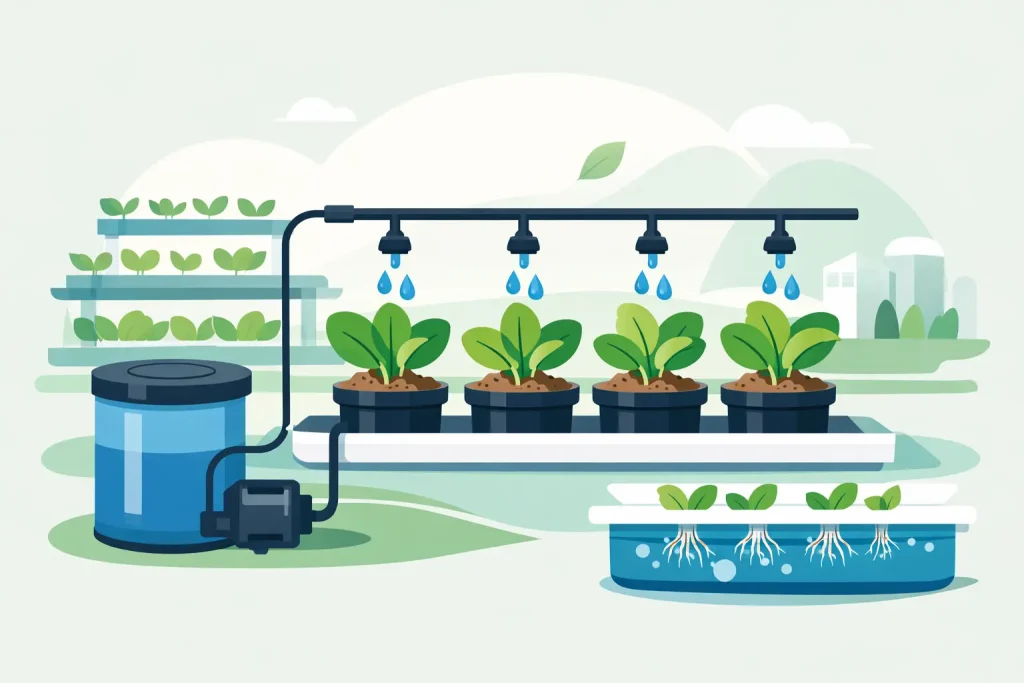
At its simplest, the system moves nutrient solution from a reservoir, through a pump and pipework, into drippers or feed stakes at each plant site. The solution is delivered in measured intervals rather than as a constant flood. Excess feed either drains away to waste or returns to the tank, depending on how the system is configured.
That basic layout matters because it lets you control three things with much more precision than hand watering – frequency, volume and consistency. Those are not small gains. In a controlled environment, small differences in feed timing quickly show up in growth rate, leaf posture and final yield.
Most growers will be choosing between run-to-waste and recirculating setups. Run-to-waste is simpler to manage nutritionally because each feed is fresh, and runoff carries away excess salts. Recirculating systems use less solution and can be more efficient, but they demand closer monitoring of EC, pH and tank hygiene. Neither is automatically better. It depends on crop type, medium, plant count and how much maintenance you are prepared to do.
Where drip systems fit best
Drip feeding works particularly well when the root zone is held in an inert or near-inert medium. Coco is a common choice because it buffers moisture well and responds strongly to frequent, controlled fertigation. Rockwool slabs and blocks also suit drip setups, especially where plants are grown in uniform numbers and spacing. Clay pebbles can work well too, although they tend to need more frequent irrigation because they hold less water.
If you are running a small hobby setup with just a couple of plants, hand feeding may still be perfectly reasonable. A drip system starts to make stronger sense when plant numbers rise, when feeds need to be frequent, or when you need the room to keep working the same way every day. Once you are dealing with multiple lights, different plant sizes or a tight schedule, automation is not a luxury. It is labour control.
The core components that matter
The shopping list is straightforward, but the specification matters more than many growers expect. You need a reservoir, a pump with enough head height and flow for the number of outlets, irrigation pipe, fittings, drippers or feed stakes, and a timer. In most rooms you will also want a filter, especially if you are using smaller drippers, because blocked emitters are one of the most common failure points.
Pump sizing is where a lot of systems go wrong. A pump that is too weak will feed unevenly, particularly across longer pipe runs or larger plant counts. A pump that is oversized can be managed with the right manifold or pressure control, but buying more power than the system can use cleanly is rarely efficient. Uniform delivery across every plant matters more than peak output on a spec sheet.
Reservoir choice affects maintenance as much as capacity. A tank that is awkward to access will be awkward to clean, and poor tank hygiene eventually becomes a root-zone problem. Opaque reservoirs help reduce light ingress and limit algae. A secure lid is not optional in a warm grow room.
Setting up for even irrigation
A good layout is usually simple and symmetrical. Keep pipe runs as even as possible, avoid unnecessary bends, and do not mix dripper types across the same line unless you know exactly what flow rate each one delivers. If one plant is receiving 30 per cent more solution than the next, you are not really running a controlled system.
Place the dripper where the medium actually wets out effectively. In a larger pot, one poorly positioned dripper can create a narrow wet channel while much of the root zone stays drier than intended. For bigger containers, two drippers per pot often gives better coverage and a safer margin if one outlet slows down.
Runoff management needs planning from the start. If the trays, gullies or saucers cannot clear solution quickly, standing runoff will create avoidable humidity and sanitation issues. In a run-to-waste room, drainage is part of the irrigation system, not an afterthought.
Feeding strategy and timing
The main advantage of a drip irrigation hydroponic system is that it allows short, repeatable feeds matched to plant demand. That does not mean more irrigation is always better. Overwatering in hydro media is still possible, especially early on when root mass is limited.
Young plants usually need smaller, less frequent feeds until the roots establish. As canopy size, transpiration and root density increase, feed frequency can rise. In coco, many growers move towards multiple irrigations per light period once the pots are fully rooted and the environment is dialled in. In rockwool, timing often becomes even more exact because the slabs respond quickly to changes in feed volume and interval.
The right schedule depends on medium, pot size, plant size, room temperature, VPD and stage of growth. That is the trade-off with drip systems. They offer more precision, but they also expose weak environmental control faster. If your room swings hard in temperature or humidity, irrigation timing alone will not fix it.
Common mistakes that cost performance
The most frequent issue is assuming all drippers are feeding equally without checking. Every system should be tested with plain water before plants go in. Measure output per site over a set time. If one line is underperforming, sort it then, not after the crop starts showing differences.
Another common mistake is letting nutrient residue build up in lines, drippers and tanks. Some additives, organics and heavier blends are simply more likely to leave deposits. If you want a low-maintenance drip setup, that should influence your nutrient choice. A feeding programme that performs well in hand watering is not always the cleanest option for a pump-fed line.
Timer choice matters too. Basic segment timers can be enough for broad scheduling, but finer control is often useful once plants are feeding several times a day. If your irrigation windows are too coarse, you end up adjusting duration when what you really need is more precise frequency.
Maintenance is the real difference between a good system and a bad one
Drip systems are not difficult to run, but they do punish neglect. Check filters, inspect lines, clean the tank and confirm dripper output regularly. In a busy room, these checks are easy to skip because the system appears to be working. By the time uneven growth is visible, the problem has usually been there for days.
It also pays to watch what the plants are telling you. If one side of the room is drying faster, that may not be an irrigation fault at all. It could be airflow, radiant heat from lighting, or a difference in plant size. The system should be part of the diagnostic process, not the first thing blamed.
For growers building or upgrading a room, this is where buying proper irrigation components rather than piecing together unsuitable parts tends to save time. Pumps, fittings, drippers, tanks and timers are not glamorous purchases, but mismatched hardware causes more avoidable downtime than most growers care to admit.
Is a drip system the right choice?
If you want fast automation, scalable feeding and precise control over media moisture, yes, it is often one of the most sensible hydro routes. If you want a system you can ignore for long stretches, probably not. It rewards growers who are already paying attention to feed strength, root-zone conditions and environmental consistency.
For many indoor setups, especially coco-based rooms, it is the point where efficiency and control start to line up properly. It reduces labour, supports consistency and makes it easier to repeat a successful crop cycle. That is usually the real goal – not a more complicated room, just one that behaves the same way every day.
If you are choosing components, think less about the headline system type and more about how the room will actually run on a Tuesday afternoon when you are busy. The best setup is the one that feeds evenly, drains properly, cleans up without a fight, and keeps your plants on schedule.






