
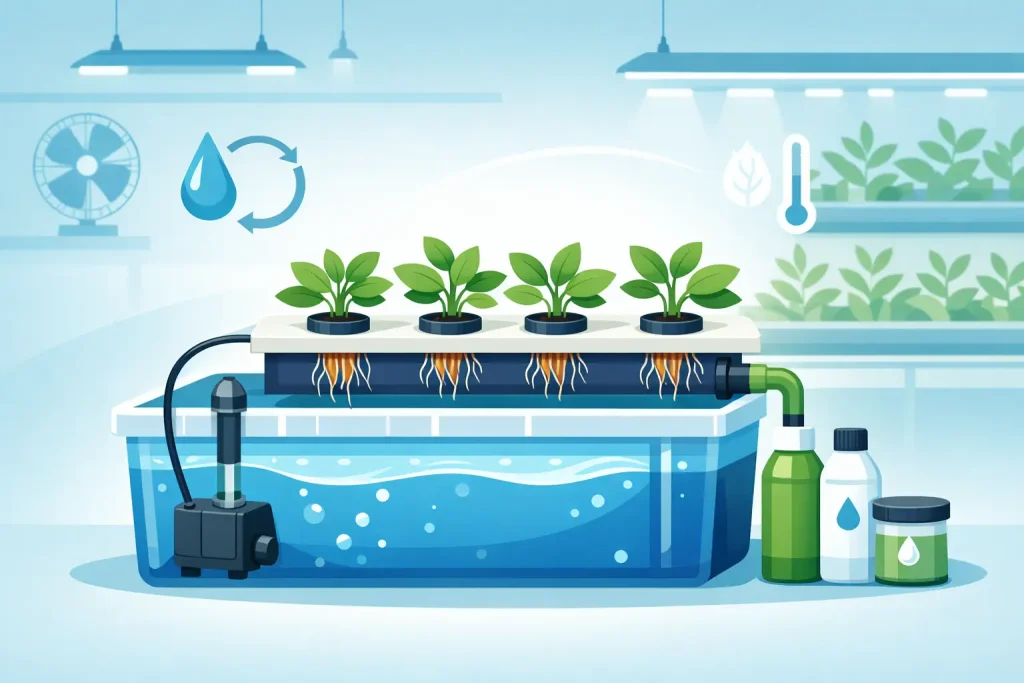
A reservoir is not just a water tank at the side of the tent. It is the working nutrient supply for the entire crop. Get its volume, temperature or plumbing wrong and even a well-built irrigation system becomes difficult to manage. This guide to hydroponic reservoirs covers the decisions that affect plant health, day-to-day labour and the consistency of your feed.
What a hydroponic reservoir needs to do
In recirculating hydroponic systems, the reservoir holds the nutrient solution before it is pumped to the root zone and, in many systems, returned for reuse. It must provide enough solution to keep EC, pH and temperature stable between checks. It also needs to work with the pump, pipework, filter, irrigation layout and available space in the grow area.
The correct setup depends on the system. A DWC reservoir is also the root chamber, so aeration and light exclusion are priorities. In flood-and-drain, the reservoir must hold enough solution to fill the tray without running the pump dry. In a recirculating drip system, it needs to cover daily plant demand while allowing enough spare capacity for return flow. Run-to-waste systems can use a reservoir too, but the feed is not returned, so its main job is supplying accurately mixed nutrient solution.
A small reservoir may look convenient, but it changes quickly. Plants drink water faster than minerals, which can push EC upwards. Warm conditions reduce dissolved oxygen, while a low solution level can expose a pump intake or make it run hotter. More volume gives the crop a larger buffer. The trade-off is that larger tanks take up floor space, use more nutrient when filled and need more solution to be discarded when a full change is due.
Choosing reservoir size for your system
There is no useful one-size-fits-all litre figure. Start with the number of plants, their stage of growth, the irrigation method and the number of days you want between full top-ups. A young crop in small pots may use very little. A mature, heavily lit crop in coco can consume several litres per plant each day.
For a recirculating system, aim for a volume that does not need constant correction after every feed cycle. As a practical starting point, allow enough solution for at least several days of expected water use, plus capacity for return water and a safe pump operating level. If plants are in peak flower and the room is warm, build in more headroom rather than relying on a minimal tank.
Flood-and-drain needs a simple volume check before installation. Fill the tray with plain water, let it drain fully back to the reservoir, then mark the normal operating level. The tank must still retain sufficient water above the pump intake when the tray is filled. Never estimate this from tray dimensions alone, as media, pots and fittings displace a substantial amount of water.
For gravity-fed or run-to-waste drippers, calculate daily run-off and feed volume rather than assuming a larger tank always improves results. Holding nutrient solution for too long can be counterproductive if temperatures are high or the mix is prone to pH drift. A correctly sized reservoir that is mixed fresh regularly is often easier to control than an oversized tank left unattended.
Allow room for mixing and return flow
Do not fill a reservoir to the brim. Leave space for nutrient additions, circulation and solution returning from dripper lines or tables. This prevents spills when the pump stops and helps avoid concentrated nutrients splashing onto equipment.
A marked fill line is worth adding from the start. It gives you a reliable reference for daily top-ups and makes unexplained water loss easier to spot. If the level drops far faster than expected, inspect for leaks, blocked drippers, excessive run-off or unusually high plant demand.
Reservoir material, colour and location
Use a purpose-made, food-safe plastic reservoir where possible. It should be strong enough not to bow when full and fitted with a secure lid. Opaque black plastic is the standard choice because it blocks light. Light entering nutrient solution encourages algae, which can block filters and emitters, alter pH readings and compete with roots for oxygen.
Translucent tanks, clear pipework and loose-fitting lids create avoidable maintenance. If a reservoir is exposed to light, cover it properly rather than relying on a thin sheet that leaves gaps around the edges. Also keep unused holes sealed. A clean, dark reservoir is easier to run than one treated repeatedly for algae.
Location matters as much as tank choice. Keep the reservoir away from direct lamp heat, heaters and uninsulated hot surfaces. A tank inside the tent may be convenient for short pipe runs, but it is more exposed to heat and can reduce usable plant space. Placing it outside the grow area can improve temperature control and make mixing easier, provided pipework is routed safely and any joins are accessible.
Set the tank on a level, load-bearing surface. Water weighs roughly one kilogram per litre, so a 100-litre reservoir becomes a serious load once you include the tank, lid, pump and pipework. Raise it only when there is a clear plumbing reason to do so, and make sure the base is fully supported.
Setting up pumps, returns and aeration
Match the pump to the job, not just the reservoir size. A drip system needs enough flow and pressure to supply all open drippers evenly after accounting for lift height, pipe length and filters. An oversized pump can cause excessive run-off, leaks or uneven distribution unless it is controlled with a valve or bypass. A pump that is too small leaves distant drippers underfed.
Fit a filter before fine irrigation components, particularly with recirculating feeds. Root debris, media particles and biofilm can clog small dripper passages quickly. Make the filter and pump easy to remove for cleaning. If maintenance requires dismantling half the system, it will be delayed when the grow room is busy.
Return lines should flow freely back to the tank without kinks, dips or restrictions. In recirculating systems, ensure the return cannot overflow if a line partially blocks. A screened return point helps catch larger debris before it reaches the pump.
Aeration is essential for DWC and beneficial in many warm recirculating setups. Use an appropriately rated air pump, air stone and check valve, with the air pump positioned above the water line or protected against back-siphoning. Aeration adds dissolved oxygen and agitation, but it does not solve a reservoir running too warm. If solution temperatures remain high, address room temperature, tank location, insulation or cooling capacity.
Daily reservoir management: EC, pH and temperature
A reservoir performs best when checked at a consistent time each day. Measure solution temperature first, then EC and pH. Record the readings alongside water level. The pattern is more useful than any single number.
If water level falls and EC rises, plants are taking up more water than nutrient. Top up with water, then recheck before making large adjustments. If water level falls and EC drops, plants are feeding strongly and may need a slightly stronger mix. If both EC and pH move sharply or unpredictably, inspect root health, solution temperature, calibration of meters and the condition of the reservoir.
Most hydroponic crops perform well with nutrient solution in the high teens to low twenties Celsius, though the best target depends on the crop and system. Warmer water holds less oxygen and creates better conditions for pathogens. Colder solution slows root activity. Consistency is usually more valuable than chasing an exact reading while the room swings between day and night.
Always add nutrients in the manufacturer’s recommended order and dilute each component into the reservoir separately before adding the next. Never combine concentrated mineral nutrients together in a measuring jug. This can cause precipitation, leaving unavailable salts in the tank and an inaccurate final feed.
Cleaning and changing the solution
Top-ups do not replace proper reservoir changes. Over time, unused salts, additives and organic residue can accumulate, especially in recirculating systems. How often to change the reservoir depends on volume, crop demand, water quality, nutrient range and how stable the readings remain. A small tank with a fast-growing crop may need frequent changes, while a larger, clean and stable system can run longer with careful monitoring.
When changing solution, drain the tank completely, remove the pump and filter, then clean all surfaces with a suitable system cleaner. Flush pipework where practical and rinse thoroughly before remixing. Pay attention to lids, corners, taps, return fittings and pump housings, where slime can build up out of sight.
Do not mix fresh feed into a dirty reservoir simply because the old solution looks clear. Clear water can still contain residue and microbial build-up. Regular cleaning protects drippers, pumps and roots, and it makes EC and pH management far more predictable.
A reservoir should make the crop easier to control, not add another daily problem. Choose enough volume, keep the solution dark and cool, build the plumbing for cleaning access, and use your readings to respond to what the plants are actually taking up.






