
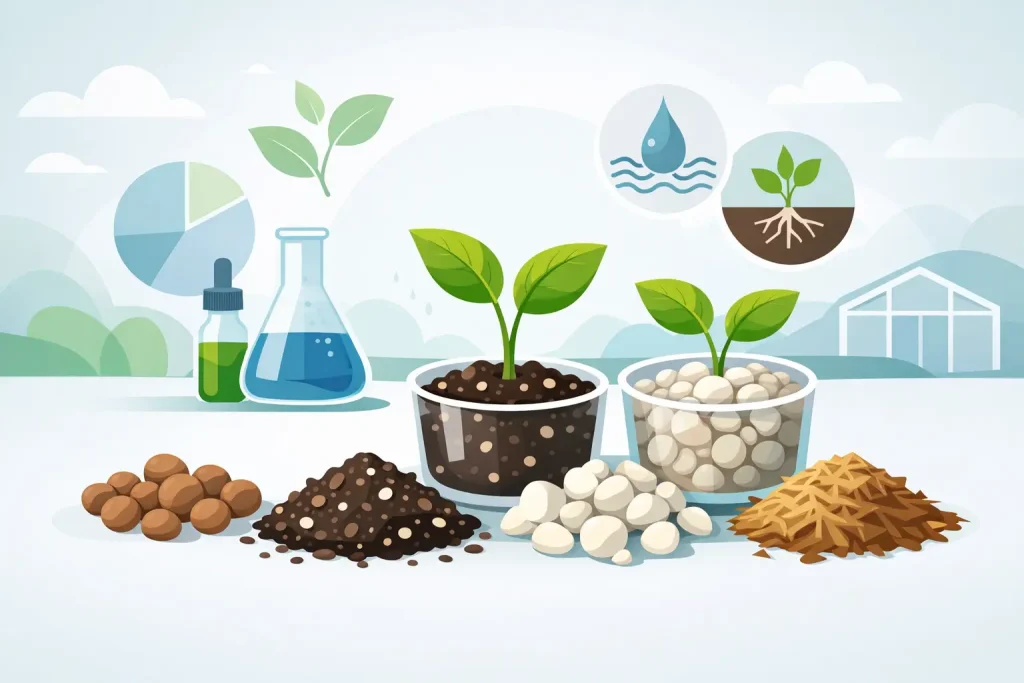
Pick the wrong medium and you end up compensating for it all the way through the cycle – overwatering in one setup, dry pockets in another, poor root oxygen, unstable EC, or plants that never really get moving. If you are working out how to choose grow media, the key is not which option is “best” in general. It is which medium matches your system, irrigation style, crop speed and how hands-on you want to be.
Grow media does four jobs. It supports the root zone, holds water, retains some air, and influences how nutrients move through the pot, slab or system. Once you look at it that way, the choice gets simpler. You are not buying a bag of substrate. You are choosing how the root zone behaves between irrigations.
How to choose grow media by system type
The fastest way to narrow it down is to start with the system, not the product. A medium that performs well in hand-watered pots can be a poor fit in recirculating hydro, and a substrate built for frequent feeds may punish a grower who only wants to water every few days.
If you are running deep water culture, nutrient film technique or aeroponics, you usually need very little media. The medium is there mainly for plant support during propagation and early establishment. Clay pebbles are common here because they drain fast, hold plenty of air and do not stay waterlogged. They work well in net pots and flood-and-drain systems, but they dry quickly. That is an advantage if irrigation is frequent and reliable, and a drawback if feed intervals are inconsistent.
If your setup is run-to-waste in pots, coco is often the most forgiving hydro-style option. It gives a good balance of water retention and oxygen, supports aggressive feeding schedules, and suits automated drip irrigation as well as careful hand-watering. Coco also gives you more margin for error than pure clay pebbles, especially in warm rooms where pots dry back quickly.
If you are growing in a more traditional container setup and want longer intervals between watering, soil or a richer potting mix may suit better. That is especially true for growers who prefer a slower, less technical workflow. The trade-off is reduced control compared with an inert medium. Soil can buffer mistakes, but it can also hide them until root issues or nutrient lockout become obvious.
What matters most when choosing grow media
When people ask how to choose grow media, they often compare brands first. Brand quality matters, but the physical behaviour of the medium matters more. Focus on water retention, aeration, stability and how much control you want over feeding.
Water retention versus air-filled porosity
Roots need moisture, but they also need oxygen. Media that hold too much water for your irrigation habits can slow growth and increase the risk of root disease. Media that drain too fast can leave you chasing moisture levels all day.
Rockwool holds water evenly and can produce very strong results in drip-fed systems, slabs and blocks. It is widely used because it is predictable once dialled in. The downside is that it can be unforgiving if you mismanage irrigation timing or initial conditioning. It tends to suit growers who monitor dry-backs, feed frequency and runoff rather than those who prefer a looser routine.
Coco sits in the middle. It retains enough moisture to reduce stress between feeds, but still offers good air content when the product is well buffered and structured. That balance is why it works across so many indoor systems. For many growers, it is the practical answer when they want hydroponic performance without the sharper edge of rockwool.
Clay pebbles are at the opposite end. Excellent oxygen availability, fast drainage, and minimal water holding. They suit flood-and-drain, recirculating systems and situations where the irrigation schedule is doing most of the work.
Inert or active medium
An inert medium gives you tighter control over feeding because it contributes very little nutritionally. Rockwool and clay pebbles are the obvious examples. You decide what goes in, when it goes in, and at what strength. That is useful if you are chasing consistency and want the nutrient programme to be highly repeatable.
A more active medium, such as a fertilised soil blend, changes the equation. It can supply nutrition and buffer pH swings, which reduces workload early on. But it also makes feeding less exact. If you are trying to run a precise nutrient schedule, especially with fast-growing crops under strong lighting, an active medium can become harder to read.
Stability over the full crop cycle
Some media break down faster than others. Fine, compressed substrates can lose structure over time, reducing oxygen in the root zone. That matters more on longer veg periods or bigger plants. A medium that starts airy but compacts heavily after repeated irrigation will not perform the same at week eight as it did at transplant.
This is where product quality shows up. Better coco tends to have a more consistent particle size, proper buffering and less excess salt. Better clay pebbles are more uniform and cleaner. Better rockwool products are more consistent in density and water distribution. Cheap media often create expensive problems later.
The main grow media options and where they fit
Soil is still the simplest route for many growers. It suits hand-watering, allows longer dry-back windows and can be easier for smaller plant counts. It is less dependent on pumps, timers and frequent irrigation. The compromise is slower correction if something drifts out of range.
Coco is the all-rounder for indoor cultivation. It is well suited to pots, drip systems and high-frequency feeding, and it responds quickly when you adjust nutrients. If you want strong growth, good root oxygen and a medium that fits both manual and automated workflows, coco is often the safest place to start.
Rockwool is geared towards controlled hydroponic production. It is clean, uniform and scalable, particularly for propagation, blocks and slabs. It tends to reward growers who measure runoff EC, manage saturation carefully and keep irrigation tight.
Clay pebbles are best viewed as a structural, high-air medium for recirculating hydro systems. They are reusable if cleaned properly, which appeals to some growers, but they are not forgiving of missed feeds.
There are also blended media, such as coco with added perlite. These mixes can improve drainage and root aeration in pot systems. They make sense when standard coco feels a bit too wet for your environment, pot size or irrigation frequency.
Match the medium to your workload
A common mistake is choosing a medium based on what top-end growers use, without asking whether the day-to-day routine matches. Media choice has to fit the amount of attention your room gets.
If you are in the grow room every day, checking moisture levels, runoff and environmental conditions, you can run more responsive media and push feeding harder. If you need a bit more flexibility because of work, travel or a larger number of plants, a medium with more buffering and water retention may be the better operational choice.
This is also where pot size matters. A fast-draining medium in a small pot under high-intensity lighting will dry much faster than the same medium in a larger container. If you have had problems before, the issue may not have been the substrate alone. It may have been the combination of medium, container volume and irrigation timing.
How to choose grow media for propagation and transplanting
Propagation media is a separate decision from finishing media. Young plants need consistency, gentle moisture retention and enough air around the early root zone. Starter plugs, small rockwool cubes and light propagation mixes are built for that stage.
The handover from propagation to the main medium matters. If you start in rockwool cubes and move into clay pebbles, irrigation has to adapt quickly because the surrounding root environment changes fast. If you transplant into coco, the transition is usually smoother because moisture remains more stable around the plug.
Keep the whole workflow in mind. The best propagation method is the one that transfers cleanly into your final system without slowing root expansion.
Avoid the usual selection mistakes
The biggest mistake is choosing by trend instead of by system. The second is underestimating irrigation frequency. The third is buying low-grade media to save a small amount upfront.
Another common problem is mixing media properties without understanding the result. Adding perlite to improve drainage makes sense. Mixing several substrates at random usually does not. Every change affects wetting behaviour, feed timing and root oxygen.
It is also worth checking whether the medium needs preparation. Some coco products need proper buffering and rinsing. Clay pebbles often need washing before use. Rockwool needs conditioning. If you skip setup steps, you are not testing the medium fairly.
For most indoor growers, the practical decision is straightforward. Choose soil if you want a slower, simpler hand-watered routine. Choose coco if you want strong growth, flexibility and hydro-style feeding in pots. Choose rockwool if you want precision and you are ready to manage irrigation properly. Choose clay pebbles if your system is built around frequent recirculating feeds and maximum root-zone oxygen.
The right grow media should make the rest of the room easier to run, not harder. If your medium matches your system and your working routine, everything downstream – irrigation, nutrient control, root health and plant response – becomes easier to read.






