
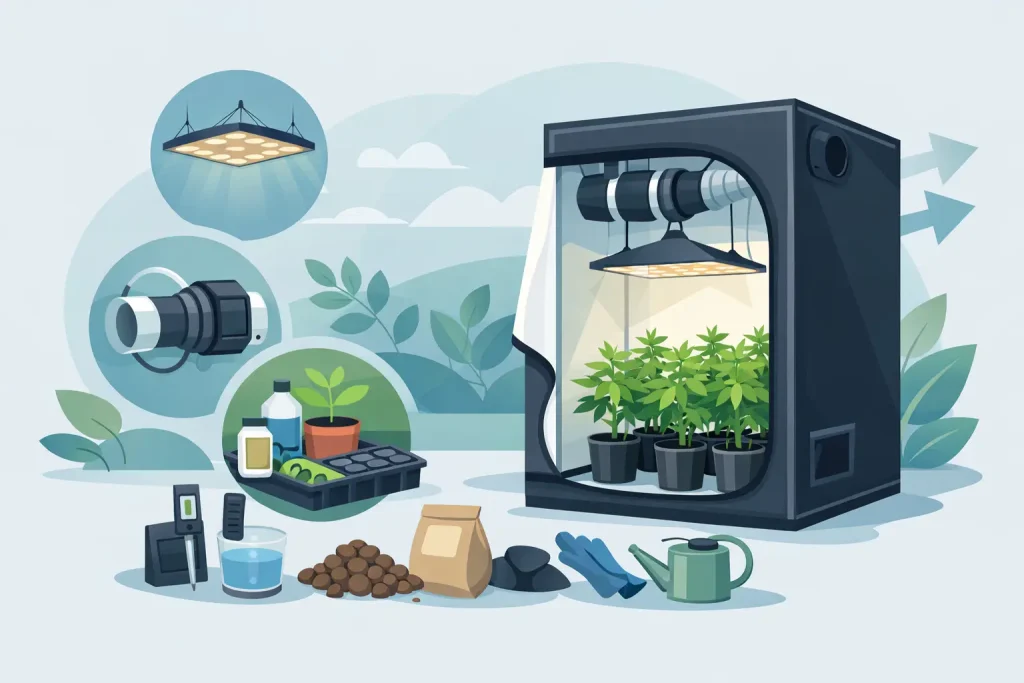
A grow tent kit that looks good on paper can still be wrong for the room, the crop cycle, or the way you actually grow. If you are working out how to choose grow tent kit options, the right starting point is not the brand name or the headline wattage. It is the combination of floor space, plant count, extraction requirements, and how much control you want over the environment.
A lot of first-time buyers make the same mistake. They buy around a single spec, usually the light, and then spend the next few weeks correcting weak airflow, poor headroom, noisy extraction, or a tent footprint that does not fit the available space properly. A good kit should reduce that friction. It should give you a workable base that matches your cultivation method from day one.
How to choose grow tent kit size first
Tent size decides almost everything else. Once the footprint is fixed, you can choose a sensible light output, extraction rate, and plant layout. If you get the tent wrong, every other component becomes a compromise.
For small spaces, a compact tent can make sense if you are running a modest plant count, keeping veg times shorter, or using lower-profile systems such as fabric pots, coco and hand-watering. A larger tent gives more flexibility, but it also increases the demand on lighting, airflow, and climate control. Bigger is not automatically better if the room around it is already warm or restricted.
Height matters as much as footprint. Many growers focus on length and width, then forget the vertical stack. You need room for the pot or system, the plant canopy, the light fixture, and the safe gap between the light and the tops. LED fixtures usually reduce heat load compared with older HID setups, but they still need hanging room and sensible clearance. If the tent is too short, training becomes less optional and temperature management gets tighter.
Before buying, measure the room properly. Account for doors, loft access, radiators, sloping ceilings, and the space needed to reach the rear corners of the tent. There is no point buying a kit that technically fits if routine maintenance becomes awkward.
Match the kit to your grow style
The best answer to how to choose grow tent kit packages depends on whether you want simple hand-watered cultivation or a more system-led setup. Growers using soil or coco in pots can usually start with a more straightforward kit. You still need good lighting and extraction, but the irrigation side is less demanding.
If you plan to run DWC, flood-and-drain, aeroponics, or a dripper system, the tent needs to support more equipment. That means extra floor space for reservoirs, pumps, pipework, air pumps, or manifolds. It also means more attention to access. A hydro system squeezed into a tent with no room to service it is a poor buy, even if the component list looks strong.
The same applies to crop strategy. If you are running a quick turnover with smaller plants, your canopy shape and spacing will differ from a grower vegging longer and filling a tent with fewer, larger plants. The kit should support the style you already intend to use, not force you into a different method because the dimensions are wrong.
Lighting is not just about wattage
Lighting is often the first thing people compare, but the right fixture is about coverage and efficiency, not just power draw. A light should match the usable canopy area of the tent. Too little output and yields suffer. Too much output in the wrong space creates unnecessary heat, wasted electricity, and harder environmental control.
For many growers, modern LED grow tent kits are the most practical option. They generally offer better efficiency, lower heat output than HID, and simpler operation for small to medium tent setups. They also tend to make life easier in warmer rooms or during summer conditions. That said, not all LED fixtures are equal. Look at actual coverage, dimming options, fixture design, and how evenly the light spreads across the canopy.
HID still has a place for some growers, especially those familiar with the setup and replacement cycle, but it places more demand on extraction and often on noise tolerance as well. If you want a straightforward indoor setup with less heat management, LED is usually the more forgiving choice.
A dimmable light is useful if you are still learning. It gives you room to adjust intensity as plants develop and helps when the environment is not yet fully dialled in.
Extraction, filters and airflow decide how usable the kit really is
If the tent is the shell and the light drives growth, extraction is what makes the space workable. A kit with weak extraction will struggle with heat, humidity, and stale air. If odour control matters, the carbon filter also needs to be correctly matched rather than treated as an afterthought.
Check the fan size, extraction rate, and whether the kit includes ducting and clamps that are actually fit for purpose. A tent in a cool spare room has different demands from one in a warmer box room with poor ambient airflow. If the room already runs warm, do not choose a kit with marginal extraction just to save a bit up front.
Internal air movement matters too. Clip fans or oscillating fans help prevent stagnant zones and support stronger plant structure. They are not a substitute for extraction, but they are part of a stable environment. A kit that ignores circulation usually needs upgrading quickly.
Noise can also be a deciding factor. More powerful fans are useful, but if discretion matters, it may be worth choosing a setup with a fan controller or planning for a quieter mixed-flow or EC fan upgrade later.
Do not ignore tent build quality
The tent itself is not just fabric and zips. Frame strength, stitching, reflective lining, vent placement, and door access all affect day-to-day use. A weak frame becomes more of an issue once you hang a filter, fan, and light from the roof bars. Cheap zips and poor seals turn into ongoing irritation.
Good port placement makes cable routing, ducting runs, and intake management much easier. Access points on the wrong side for your room layout can turn basic jobs into a hassle. This is one reason complete kits should always be judged as a system, not just as a list of parts.
Budget properly or you will buy twice
A low-cost kit can be fine if the core components are correctly matched and you understand what you may need to upgrade later. Problems start when the ticket price is low because the extraction is undersized, the light coverage is optimistic, or the accessories are weak enough to need immediate replacement.
It is usually better to buy a modest-sized kit with competent lighting and ventilation than a larger tent with compromised hardware. Performance comes from balance. There is little value in extra square footage if the environment is unstable.
Also factor in the parts not always emphasised in entry-level bundles. You may still need timers, pH and EC meters, nutrients, media, pots, ducting accessories, hygrometers, shears, drying equipment, and pest control. The real spend is the working grow setup, not the tent kit alone.
A quick checklist for choosing the right kit
If you want a clean buying process, assess the kit in this order: available room space, intended plant count, cultivation method, lighting coverage, extraction capacity, odour control, then upgrade headroom. That sequence usually prevents the most expensive mistakes.
It also helps to think one cycle ahead. If you already know you will move from hand-watered coco into automated irrigation, or from a basic LED board into a higher-output fixture, buy a tent size and extraction setup that can support that move.
When a complete kit makes sense and when it does not
A complete grow tent kit is the right buy when you want a matched starting point without building every component line by line. For many growers, that saves time and avoids obvious compatibility mistakes. It is especially useful if you want to get operational quickly and source the main hardware in one order.
If you already know the exact fan, filter, light, or hydro system you want, a custom build may be the better route. Experienced growers often outgrow generic bundles because they need tighter control over specification. There is no issue with that. The goal is not to buy the biggest bundle. The goal is to buy the right working setup.
The best kit is the one that fits the room, supports the method, and stays manageable once the canopy fills out. Buy for the environment you can control consistently, not the one you hope to manage later.






