
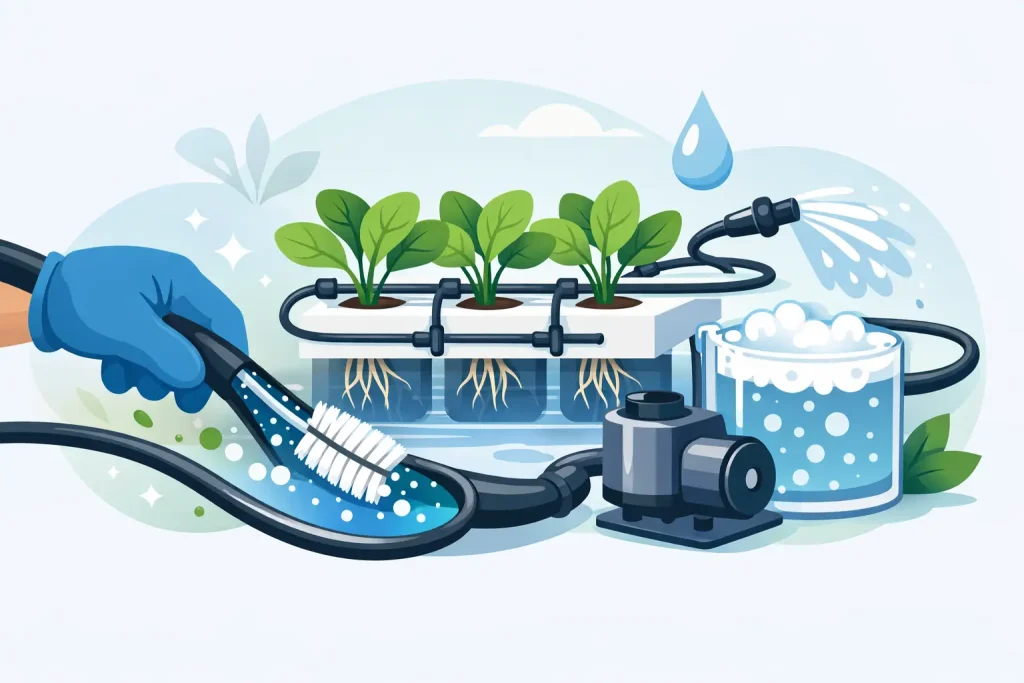
A dripper that starts delivering half its normal flow rarely fails without warning. Uneven pot weight, a dry patch in the root zone, rising pump noise or one plant falling behind are usually signs that deposits are already building inside the system. Knowing how to clean irrigation lines properly protects feed uniformity, prevents blocked emitters and keeps a small maintenance issue from becoming a crop-wide problem.
For recirculating and run-to-waste systems alike, line cleaning should be planned around the nutrient programme rather than left until a blockage appears. Salts, organic additives, sediment and biofilm do not all respond to the same treatment, so the right approach depends on what is in your reservoir and what type of pipework and drippers you are running.
What blocks hydroponic irrigation lines?
Most irrigation restrictions begin with mineral scale. Hard water, concentrated nutrient solution and pH drift can leave calcium, magnesium and phosphate deposits on the inside of pipework, manifolds and dripper labyrinths. These deposits gradually reduce internal diameter and can make individual emitters inconsistent long before they block completely.
Biofilm is the other common issue. This is a slippery layer of microorganisms and organic residue that forms in warm, wet lines, particularly where beneficial microbes, root-zone inoculants, carbohydrate products or other organic additives are used. Biofilm catches fine particles and gives mineral deposits something to adhere to, making the restriction harder to remove.
A third cause is physical debris. Perlite, coco fibres, clay dust, root fragments and particles from an unfiltered reservoir can lodge in filters and drippers. Cleaning chemicals will not reliably shift larger debris, which is why flushing and filtration matter just as much as the cleaner itself.
When should you clean irrigation lines?
Inspect filters and dripper output every week. A quick check catches problems early: compare emitter flow, look for drippers that continue to drip after an irrigation event, and check whether pots at the end of each run receive the same volume as those nearest the pump.
A light flush between nutrient changes is sensible for most systems. A full clean is normally best carried out between crop cycles, before installing new plants, or whenever flow rates become inconsistent. High-EC feeds, hard water and organic-heavy regimes require more frequent attention than a clean mineral feed with reverse-osmosis water.
Do not wait for a line to block completely. Once a dripper is fully obstructed, it can be quicker and more reliable to replace it than to rely on a chemical soak. This is particularly true for inexpensive button drippers and narrow-bore spaghetti tube.
How to clean irrigation lines: the working method
Start by emptying the reservoir and removing plants from the irrigation circuit where possible. If the system cannot be isolated from rooted plants, use only products explicitly suitable for use around living plants and follow the manufacturer dilution rate. A stronger cleaning treatment should be reserved for an empty system between runs.
First, remove and rinse any filters. Take out screen filters, disc filters and inline strainers, then wash off loose debris with clean water. A blocked filter restricts flow and may release trapped particles back into the system during a high-pressure flush.
Next, fill the reservoir with clean water and run the system briefly. This initial rinse removes loose nutrient solution and prevents the cleaning product being immediately diluted by old feed. Open flush valves or disconnect end caps on main runs where the layout allows. The aim is to give dislodged material somewhere to leave the pipework instead of pushing it into the final drippers.
Add the chosen line-cleaning product at the label rate, circulate it through every zone and leave it for the stated contact time. Run enough irrigation cycles to ensure the solution reaches all branches, including low-use lines and dead-end sections. If your system has a manifold with individual taps, check each outlet rather than assuming the pump has treated every run equally.
After the contact period, drain the system completely. Refill with clean water and flush until there is no remaining cleaner in the reservoir, pipework or emitters. Two fresh-water flushes are often worthwhile after a stronger treatment. Finish by refitting clean filters, checking each dripper and running a measured test cycle before plants are connected again.
Choosing between acid and peroxide cleaners
Acid-based cleaners are generally the right choice for mineral scale and stubborn salt deposits. They are particularly useful where hard water is used or where calcium-heavy nutrient regimes have left a chalky residue. Their limitation is that they are not the best standalone option for heavy biological slime, and overly strong solutions can be harsh on some metals, seals and fittings.
Hydrogen peroxide-based products are better suited to breaking down organic residue and reducing biofilm. They can help keep reservoirs and lines cleaner where biological additives are not part of the intended root-zone strategy. However, peroxide can harm beneficial microbial populations and may oxidise roots if used incorrectly in a live system.
Some commercial irrigation cleaners combine descaling and sanitising action, but label directions still matter. Never mix acids, peroxide products, chlorine-based cleaners or nutrient concentrates together. Mixing cleaning chemicals can create dangerous reactions, damage equipment and leave residues that are unsuitable for plants.
Use gloves and eye protection when handling concentrates, work in a ventilated area and keep cleaners clearly separated from nutrient stock bottles. It is a basic operational step, but misidentifying a concentrate in a busy grow room can cause expensive damage.
Pay attention to drippers, pumps and pipe size
Irrigation lines are not all equally easy to clean. Wide-bore pipework and open flood-and-drain fittings tolerate flushing well, while capillary tube, pressure-compensating drippers and fine spray jets have much smaller internal pathways. A system that uses small emitters needs better preventative maintenance because a small amount of scale is enough to alter output.
Remove drippers and soak them separately if several are restricted. While they are off the system, flush the bare lines at full flow. This prevents loosened deposits from collecting inside the emitters during the cleaning cycle. Replace any dripper that remains inconsistent after cleaning. The cost of a new emitter is minor compared with uneven root-zone moisture across a crop.
Check the pump impeller and pump intake at the same time. Slime or fine root debris around the intake lowers pressure, which can look like a line blockage. Clean the impeller chamber according to the pump instructions and make sure the pump is not pulling sediment from the base of the reservoir.
Prevent deposits from returning
The best line-cleaning programme starts with the reservoir. Mix nutrients in the correct order, allow each part to disperse before adding the next, then set EC and pH only after the solution is fully mixed. Poor mixing can create precipitates before the feed even reaches the pipework.
Use an appropriate inline filter after the pump, and select a mesh rating that matches the emitter size. Clean it routinely rather than only when pressure drops. Keep the reservoir covered to reduce dust, algae and airborne debris, and avoid letting feed sit warm and stagnant for long periods.
If you use organic additives or beneficial biology, accept that the system needs a different maintenance routine. These products can be valuable in the root zone, but they increase the likelihood of biofilm in fine irrigation hardware. Regular plain-water flushing, larger-bore distribution lines and replaceable drippers may be a better operational choice than trying to run a heavily biological feed through very narrow emitters.
For growers running multiple zones, record flow checks, filter cleaning and full system cleans in the same log as nutrient changes and reservoir maintenance. It makes recurring restrictions easier to trace, whether the cause is water quality, a particular additive or a section of pipework that receives little flow.
Clean lines are not simply about keeping water moving. They ensure each plant receives the feed volume and nutrient strength you intended, which is exactly what a controlled irrigation system is there to deliver.






