
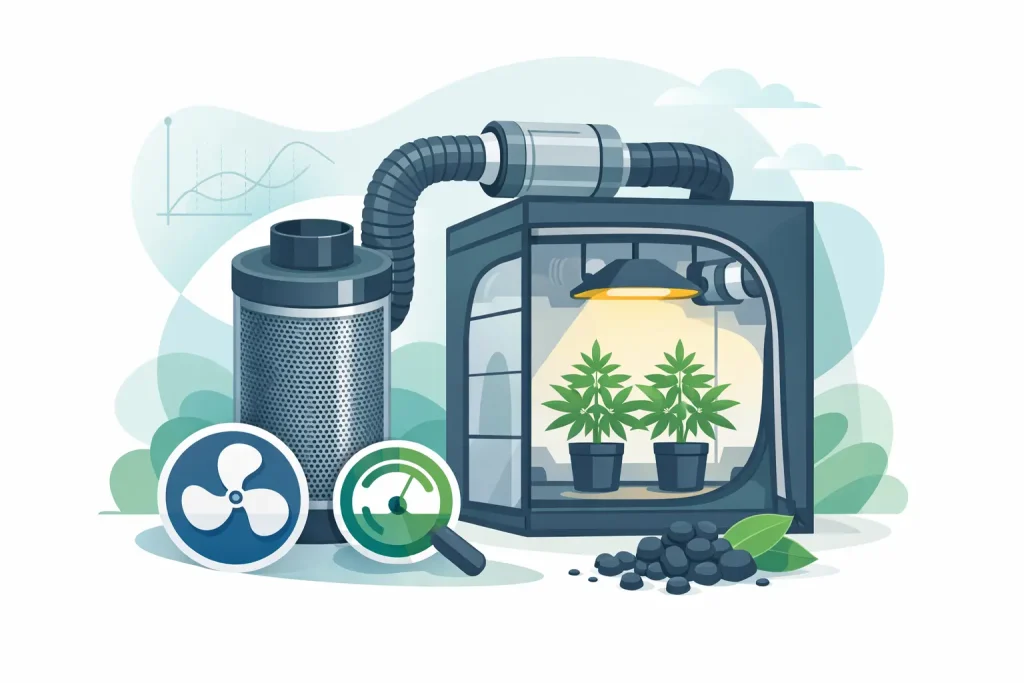
A carbon filter that looks right on paper can still leave a grow room smelling if it is matched to the fan’s free-air rating rather than its real working airflow. Knowing how to size carbon filter equipment properly means allowing for the tent volume, heat load, ducting resistance and the way you intend to run the extraction fan. Get those four things right and the system will maintain negative pressure and reliable odour control through flowering.
Start with grow tent volume
Measure the internal length, width and height of the tent in metres, then multiply them to find the volume in cubic metres. For example, a 1.2 m x 1.2 m x 2.0 m tent has a volume of 2.88 m³.
The basic extraction calculation is:
Tent volume (m³) x air changes per minute x 60 = required airflow in m³/h
For a normally lit indoor tent, aim to replace the full air volume at least once per minute. The 2.88 m³ example therefore needs a theoretical minimum of around 173 m³/h.
That is the starting point, not the fan size to buy. A filter, ducting and bends all reduce delivered airflow. High-output LEDs, HID lamps, warm loft spaces and long duct runs raise the requirement further. In practice, a tent of this size will commonly need an extraction setup with considerably more capacity than 173 m³/h, especially if heat management matters as much as smell control.
How to size carbon filter capacity to the fan
Choose a carbon filter with an airflow rating equal to or higher than the fan’s expected operating airflow. Do not select a filter below the fan rating and assume a controller will solve it. Running too much air through an undersized carbon bed shortens contact time, allowing odour molecules to pass through rather than be adsorbed.
As a practical rule, match the filter to the fan’s maximum rated airflow, or give the filter a modest capacity margin above it. A fan rated at 600 m³/h should normally be paired with a filter rated for at least 600 m³/h. A 700 m³/h or 800 m³/h filter gives more headroom if the fan has to work hard in summer or if odour levels increase late in flower.
A larger filter is not automatically better in every setup. It costs more, weighs more and can be awkward in a compact tent. However, extra carbon volume generally improves dwell time and can extend useful filter life when the fan is run below maximum speed. For growers using fan speed controllers, this is often the sensible trade-off: use a correctly sized or slightly oversized filter, then run the extraction fan at the lowest speed that holds temperature, humidity and negative pressure where they need to be.
Do not use the fan’s free-air figure in isolation
Inline fan specifications are generally measured with little or no resistance. Once you add a carbon filter, ducting, reducers, acoustic ducting and external vents, the airflow drops. The exact reduction depends on the equipment, but it can be significant.
If you are choosing between two fan sizes, consider the whole extraction path rather than the tent volume alone. A short, straight 150 mm duct run through a nearby wall vent places far less load on a fan than several metres of ducting with multiple bends, a silencer and a roof outlet. The latter installation needs more fan pressure and usually benefits from a larger diameter system.
Allow for heat, humidity and the room outside the tent
A carbon filter deals with odour. The extraction system also removes heat and moisture, which is why the basic one-minute air exchange is only a baseline.
LED fixtures produce less radiant heat than equivalent HID lighting, but they still put their electrical load into the grow space. A powerful LED in a small tent, especially during warm weather, may need the fan to run hard for temperature control. If the filter has no spare capacity, odour performance can suffer at exactly the point the plants are producing more scent.
Humidity changes the picture too. Carbon filters work best with reasonably dry intake air. Very high relative humidity can reduce adsorption efficiency and places more demand on the environmental system. If late-flower humidity is regularly high, address airflow, dehumidification and room conditions rather than relying on a bigger filter alone.
The temperature of the lung room also matters. Extracting tent air into the same small, warm room only recirculates the heat. Wherever possible, draw fresh air from a clean, cooler source and exhaust warm air away from the intake. This reduces the extraction rate required to maintain the canopy environment.
Match duct diameter from end to end
The filter flange, fan inlet and main ducting should use the same diameter wherever possible. Common grow-room sizes include 100 mm, 125 mm, 150 mm, 200 mm and 250 mm. A reducer may be unavoidable at an outlet, but reducing the system immediately after a high-capacity fan restricts airflow and raises noise.
A 150 mm fan and filter system is usually quieter and more efficient than forcing the same airflow through 125 mm ducting. Larger duct moves a given volume of air at a lower velocity, which lowers resistance. This matters when selecting equipment for a larger tent or a high-heat setup.
Keep ducting runs short, supported and as straight as practical. Each sharp bend reduces airflow. Flexible ducting is convenient, but tightly compressed or kinked lengths perform poorly. Acoustic ducting and silencers reduce noise effectively, though they add resistance that must be included in the fan choice.
Check that the tent holds negative pressure
A correctly sized filter cannot contain odour if air is leaking from unfiltered gaps. With the extraction fan running, the tent sides should pull in slightly. This is negative pressure: air enters through the passive vents or controlled intake, then leaves only through the carbon filter and extraction fan.
If the tent is ballooning outwards, either the intake is too powerful, the exhaust is restricted, or the fan arrangement is wrong. Reduce active intake, check ducting for obstructions and confirm that the filter is installed on the extraction side of the system. For most tents, the filter sits inside at the top, connected to the fan so air is pulled through the carbon and exhausted outside the tent.
There are exceptions. In a hot room, mounting the filter and fan outside the tent can recover headroom inside. The duct section between tent and filter must then remain airtight, otherwise unfiltered odour can escape. Internal mounting is usually the simplest option for dependable odour control.
Choose filter quality and carbon depth, not just the printed rating
Two filters carrying the same m³/h rating may not perform equally. Carbon type, bed depth, fill weight, construction quality and the pre-filter all affect working life. Heavier filters with a deeper, well-packed carbon bed tend to offer more contact time, although they require secure hanging straps and sensible handling.
The fabric pre-filter is not cosmetic. It captures dust and fibres before they reach the carbon, helping the filter maintain airflow. Clean or replace it when it is visibly loaded. Do not run the filter without one, and do not wash the carbon canister itself.
A filter that has stopped controlling odour should be replaced rather than masked with sprays or ozone equipment. Odour neutralisers can be useful outside a grow space, but they do not replace properly filtered extraction. Ozone can also be hazardous and is not a substitute for correct ventilation design.
A practical sizing example
Take a 1.2 m x 2.4 m x 2.0 m tent. Its volume is 5.76 m³. At one full air exchange per minute, the baseline is 346 m³/h.
Now account for a flowering crop, two efficient LED fixtures, a warm room, a carbon filter, several metres of ducting and a couple of bends. A 400 m³/h fan may keep air moving, but it leaves little control margin. A fan in the 600 m³/h range, paired with a 600 m³/h or higher-rated filter and 150 mm ducting, is usually a more workable starting point. The fan can then be speed-controlled during cooler periods instead of being permanently flat out.
For a small 60 cm x 60 cm x 160 cm tent, the calculated volume is only 0.576 m³, but do not choose an extremely small filter purely from that figure. Compact tents still need to manage lighting heat and often use 100 mm or 125 mm extraction equipment. The best choice depends on the light wattage, room temperature and available duct route.
Buy the filter and extraction fan as a matched system, install the widest practical ducting, and leave enough capacity to deal with the hottest, most fragrant part of the crop. That margin is what keeps a grow room controlled when conditions stop being ideal.






