
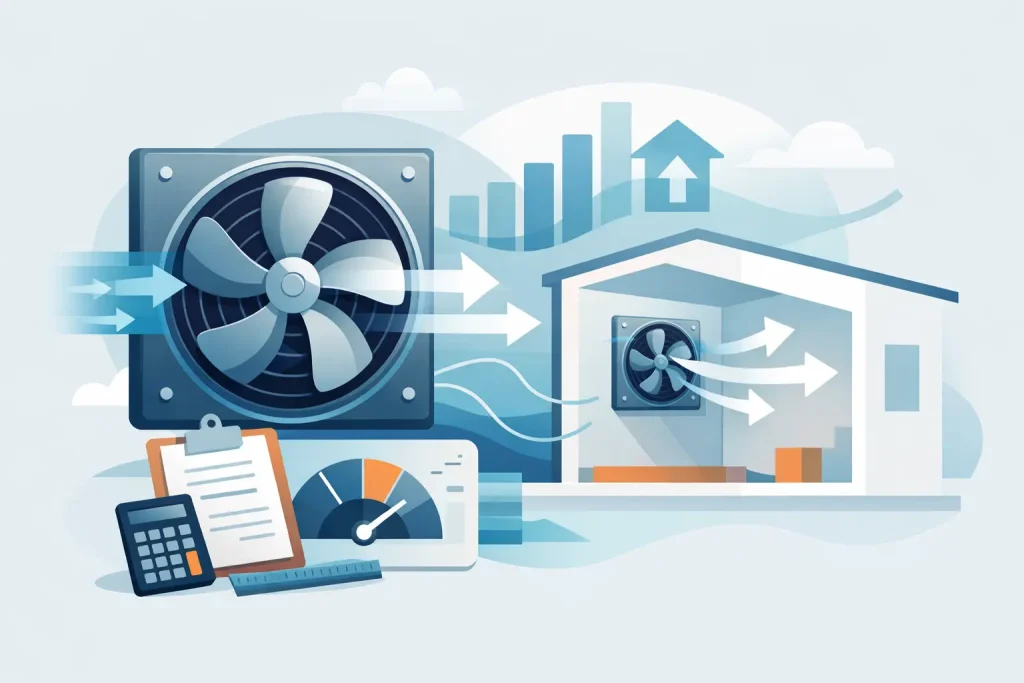
A fan that looks right on paper can still leave a tent too hot, too humid, or under negative pressure once the filter and ducting go in. That is the real issue behind how to size extraction fan equipment for an indoor grow – not just matching a room volume, but accounting for the resistance and heat your system actually creates.
For growers running HID, powerful LED fixtures, carbon filters and long duct runs, fan sizing is part airflow maths and part system planning. Get it right and your environment is easier to control. Get it wrong and you end up chasing temperature spikes, weak odour control, and plants that never quite sit in the right VPD range.
How to size extraction fan for a grow space
The starting point is simple. Work out the volume of the space in cubic metres by multiplying length x width x height. If your tent is 1.2m x 1.2m x 2m, the volume is 2.88m3.
A basic rule is to replace the full air volume once every 1 to 3 minutes, depending on heat load and how tightly controlled you need the environment. In a cooler, lower-intensity setup, one complete air exchange every 2 to 3 minutes may be enough. In a hotter tent with higher light intensity, most growers are closer to one air change per minute.
That means a 2.88m3 tent needs a bare minimum airflow of around 3m3/min for a full exchange every minute. Multiply by 60 to convert to hourly rating, which gives 172.8m3/h. That is only the baseline. It is not the final fan size you should buy.
Why the baseline figure is rarely enough
Manufacturers rate extraction fans in ideal conditions. Once you add a carbon filter, bends in the ducting, reducers, silencers or long runs, actual airflow drops. This is where growers often undersize the fan.
A good working approach is to calculate the room volume first, then add capacity for system losses. For most tent and room setups, that means increasing the required fan output by 25 to 50 per cent. In more demanding systems with longer duct runs or heavily loaded filters, you may need more.
Using the same 1.2m tent example, if the baseline need is roughly 173m3/h, a more realistic target may be 220 to 260m3/h. If you are running a carbon filter, warm lighting and a couple of bends in the ducting, it often makes sense to step up again rather than buy right on the edge.
Oversizing slightly is usually safer than undersizing, provided you control the fan speed properly. An extraction fan running below maximum has headroom for summer conditions and tends to be easier to work with than one running flat out all the time.
Account for the carbon filter first
If your extraction system includes odour control, the filter is not optional in the sizing calculation. Carbon filters add static pressure and reduce airflow. A fan rated at 300m3/h in free air will not deliver that once connected to a filter.
This is why matched fan and filter combinations matter. If the fan is too weak for the filter, airflow drops off sharply. If the fan is too strong for the filter without control, contact time through the carbon can suffer and noise can increase. For most growers, pairing an inline fan and filter with similar recommended airflow ranges is the practical route.
Ducting length and bends matter more than people think
Straight, short ducting performs better. Every unnecessary metre and every bend adds resistance. Two tight 90-degree bends can make a noticeable difference, especially on smaller systems.
If your fan has to push or pull through long duct runs, through an air-cooled hood, or out to a difficult extraction point, build in extra capacity from the start. It is often worth improving the layout rather than just buying a larger fan. A cleaner duct route gives better airflow and lower noise.
Heat load changes the answer
Room volume gives you a starting figure. Heat load tells you whether that figure is enough.
If you are running cooler modern LED bars in a tent in a mild part of the house, the extraction requirement may stay fairly close to the volume-based estimate. If you are using HID lighting, compact high-output LEDs, dehumidifiers or pumps in a small sealed area, the fan may need to move much more air just to keep leaf temperature and ambient temperature within range.
This is why two growers with the same tent size can need very different extraction rates. The hotter setup needs faster air exchange. The room the tent sits in also matters. If the lung room is already warm, the extraction system has less temperature advantage to work with.
As a practical guide, small to mid-size tents under modest LED loads can often run well with mixed-flow inline fans in the 150mm range, while hotter or larger spaces may need 200mm or higher-capacity EC fans. That is not a fixed rule, but it reflects how quickly real-world resistance and heat push growers beyond the basic maths.
Intake airflow and negative pressure
Sizing extraction properly is not only about removing air. You also need enough passive or active intake to let fresh air replace what is being extracted.
Most grow tents are run with negative pressure so air is drawn in through vents and odours stay contained. If the tent walls are sucking in hard, that is normal to a point. If they are collapsing dramatically, intake area may be too restricted or the fan may be pulling harder than the system can comfortably supply.
As a rule, passive intake openings should be larger than the extraction duct diameter. If they are not, airflow is choked and the fan works harder for less result. In bigger rooms or more restrictive layouts, an intake fan may make sense, but it should usually be slightly weaker than the extraction side to maintain negative pressure.
Choosing between AC and EC fans
When working out how to size extraction fan equipment, fan type affects how forgiving the system will be.
Standard AC inline fans are common, effective and often good value. They suit straightforward tent setups, especially where the duct run is short and the filter is properly matched. Their control options are usually more limited, and some models do not like being heavily speed-controlled unless they are designed for it.
EC fans cost more, but they are easier to dial in accurately, typically quieter at part load, and more efficient. In setups where climate swings matter, or where you want to oversize the fan and run it back, EC models are often the cleaner solution.
For serious growers, the logic is simple. If environmental control is central to yield and consistency, fan controllability matters almost as much as fan size.
A simple sizing example
Take a grow tent measuring 2.4m x 1.2m x 2m. The volume is 5.76m3. One full air exchange per minute gives a baseline of 5.76m3/min, or 345.6m3/h.
Now add a carbon filter, 4 to 5 metres of ducting, and two bends. A realistic uplift is at least 30 to 40 per cent, taking the requirement to roughly 450 to 485m3/h. If the tent is running warm lighting or sits in a hot room, moving up again may be justified.
That is why many growers in this size tent do not stop at the baseline figure. They choose a fan with enough reserve capacity to handle summer temperatures, filter loading over time, and future equipment upgrades.
Common mistakes when sizing extraction
The most common mistake is buying to room volume alone and ignoring resistance. The second is choosing a fan and filter that are technically compatible on paper but poorly matched in practice once ducting is installed.
Another common issue is trying to solve everything with extraction when the room outside the tent is already too warm. Extraction cannot cool below the temperature of the incoming air. If the lung room is hot, you may need to address intake air, lighting schedule, or broader climate control rather than just increasing fan size.
Noise is another trade-off. A more powerful fan gives headroom, but if the system is poorly mounted or badly ducted it can create unnecessary noise. Sometimes the better answer is a larger, slower-running fan with a silencer and cleaner duct routing, not a smaller fan pushed to maximum.
What to aim for in practice
For most indoor growers, the right approach is to calculate the room volume, target roughly one air exchange per minute as a working baseline, then add capacity for filters, ducting and heat. After that, choose a fan you can actually control.
If you are between sizes, going up one step is often the safer decision, especially for filtered systems. A fan with spare capacity gives you options as seasons change, filters age, and plant mass increases through the cycle. That matters far more than chasing the smallest unit that just about fits the calculation.
A well-sized extraction setup does not just move air. It stabilises the whole room, keeps odour control working properly, and gives every other part of the grow a better chance to perform as intended. If you build with headroom rather than hope, the environment is usually much easier to manage.






