
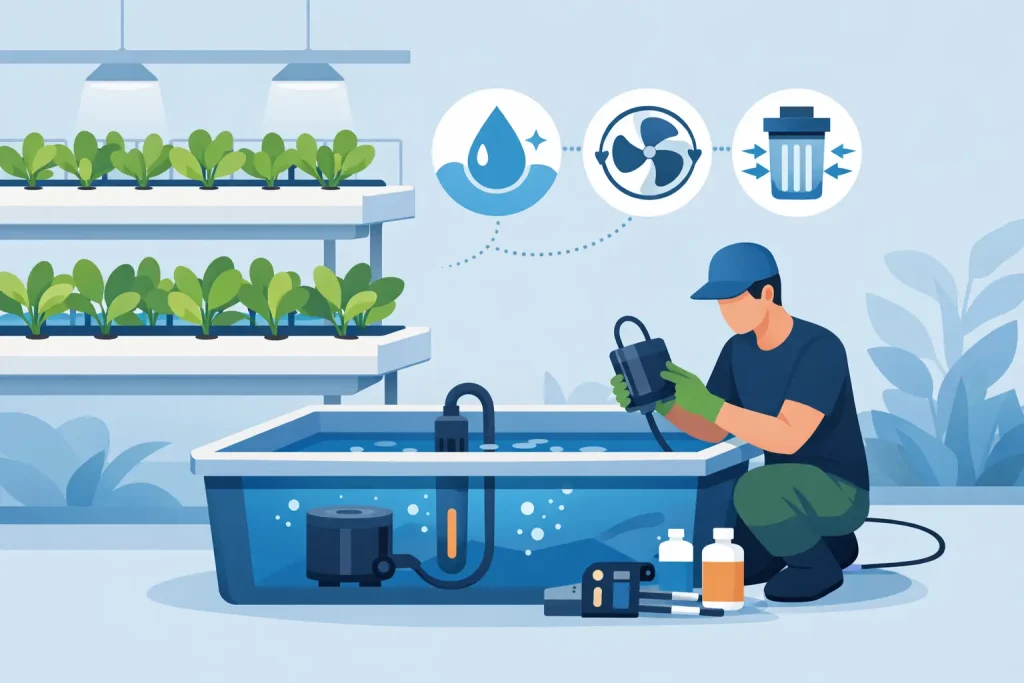
A reservoir can look clean while the root zone is already under pressure. Rising water temperature, a drifting pH, settled salts or a thin layer of biofilm inside pipework can all reduce nutrient uptake before plants show obvious symptoms. Proper hydroponic reservoir maintenance is therefore not a once-a-week clean-out. It is a routine of measuring, topping up, inspecting and resetting the system before small errors become lost growth.
For indoor growers, the reservoir is the working heart of a recirculating system. If its solution is stable, irrigation is predictable and roots can access water, nutrients and oxygen as intended. If it is unstable, adjusting bottles and additives at random rarely fixes the underlying cause.
Set the reservoir up for stable operation
Start with a reservoir that is light-proof, correctly sized and easy to access. Light entering the nutrient solution encourages algae, while a tank that is too small changes temperature, EC and pH far too quickly. A larger volume gives more buffering capacity, although it also uses more nutrient solution at each full change.
Keep the lid fitted whenever possible and route cables and airline tubing so they do not leave gaps for light, dust or pests. In a warm grow room, insulate the reservoir or position it away from lamps, heaters and warm return lines. A chiller may be justified on larger or high-value systems, but good placement and airflow often solve the first part of the problem.
For most hydroponic crops, a nutrient solution temperature around 18-22°C is a sensible operating range. Warmer water holds less dissolved oxygen and creates better conditions for root pathogens. Colder water can slow root activity and nutrient uptake. The best target depends on the crop, room conditions and system design, but temperature swings are usually more damaging than being slightly above or below an ideal figure.
Check pH, EC and temperature on a schedule
A reliable routine beats occasional heavy correction. In active recirculating systems, check pH, EC and water temperature daily. Record the readings at roughly the same time so trends are clear. This is particularly useful after a nutrient change, a major environmental adjustment, or a move into a faster growth stage.
pH determines whether key elements remain available to the plant. Most hydroponic nutrient programmes work well in a mildly acidic range, commonly around pH 5.5-6.2, but follow the nutrient manufacturer’s guidance and avoid chasing tiny changes. Letting pH move modestly within the accepted range can be normal. Repeated, large corrections point to a reservoir issue, incorrect mixing, poor source water or an undersized tank.
EC tells you the total concentration of dissolved salts, not whether the nutrient balance is correct. A rising EC while the water level falls generally means plants are taking up more water than nutrients. A falling EC can indicate stronger nutrient uptake than water uptake. Neither reading is a command to make an immediate large adjustment. Consider plant stage, root health, temperature and recent top-ups before changing the feed.
Calibrate pH and EC meters regularly with fresh buffer and calibration solutions. Rinse probes in clean water after use and store pH probes according to the meter manufacturer’s instructions. A poorly maintained meter can send a grower in the wrong direction for days.
Use the water level to interpret the numbers
Record the reservoir level alongside EC and pH. This gives the readings context. If the level drops quickly but EC increases, top up with water first and reassess after the solution has circulated. If water level and EC both fall, a light nutrient top-up may be appropriate. Always make changes gradually, allow the system to mix, then test again.
Avoid topping up by eye alone. Mark volume levels on the reservoir or use a measuring jug when preparing smaller systems. Consistency makes it far easier to spot a leak, blocked dripper, excessive evaporation or unexpectedly high plant demand.
Mix nutrients in the correct order
Use clean, preferably cool source water and establish the starting EC before adding nutrients. Hard water can already contain a meaningful mineral load, while very soft or filtered water may need a specific base nutrient or calcium-magnesium strategy. Match the nutrient range to your source water and cultivation method rather than copying a feed chart without adjustment.
Add base nutrients one part at a time, stirring thoroughly between each addition. Never combine concentrated Part A and Part B directly, as they can react and form insoluble salts. Add supplements, boosters or beneficial products only after the base feed is fully diluted. Check EC first, then adjust pH last.
Do not assume more additives mean better results. Every product changes the solution chemistry, and some organic or biological inputs are less suitable for fine drippers, spray nozzles or systems with limited filtration. If using them in a recirculating system, monitor filters, emitters and reservoir cleanliness more closely.
Clean the system before contamination builds
A full reservoir change is the point to clean more than the tank. Drain the system completely, then inspect the reservoir walls, lid, pump housing, air stones, filters, pipework and irrigation lines. Brown residue, slime, root fragments and mineral scale all deserve attention.
The frequency of a full change depends on reservoir size, plant demand, water quality and system type. A small DWC reservoir may need changing every 7-10 days in heavy growth. A well-managed larger recirculating system can often run longer if daily readings are stable and the solution remains clean. Run-to-waste systems have different maintenance demands because unused feed is not returned to the tank.
After draining, remove loose debris first. Clean surfaces with a suitable system cleaner or diluted peroxide-based product approved for horticultural equipment, following label directions and safety guidance. Flush thoroughly with clean water afterwards. Residues from cleaning products can harm roots just as surely as old nutrient salts.
Pay special attention to pumps and filters. A pump clogged with root matter or sediment may still run but deliver reduced flow, leading to uneven irrigation. Wash reusable filters during every reservoir change and replace damaged screens, tired air stones and brittle tubing before they fail in service.
Biofilm is a warning, not just a cosmetic issue
A slippery film on the reservoir wall, airlines or fittings is often a sign that microbes and organic material are accumulating. It can restrict flow, consume oxygen and shelter pathogens. Do not simply wipe the visible section and refill. Clean the complete wetted path, including return lines and fittings where deposits can remain out of sight.
Choose one root-zone approach and manage it consistently. Sterile systems rely on clean equipment and compatible sanitising products. Biological systems use beneficial microbes and should avoid products that destroy them. Switching between the two without a proper clean-out can create poor results from both approaches.
Maintain oxygen and flow
Healthy roots need more than the correct EC. In DWC and other water-culture systems, use adequate aeration for the reservoir volume and check that air pumps, non-return valves and air stones are operating evenly. Replace air stones when their output becomes weak or uneven rather than waiting for complete failure.
In drip, flood-and-drain and recirculating systems, inspect every feed point. A blocked dripper, kinked line or uneven manifold can leave one plant dry while another is overwatered. Check pump flow after cleaning, and make sure return lines drain freely without standing water or leaks.
Keep the reservoir lid secure and remove dead roots or plant material promptly. Organic debris raises the biological load in the solution and can quickly turn a manageable temperature issue into a root-zone problem.
Respond to warning signs early
Cloudy solution, unusual odour, foam that persists, rapid pH movement, falling water flow or discoloured roots all justify an immediate inspection. Do not keep adding pH adjuster or nutrients to mask the symptoms. Check temperature, aeration, pump performance, source water, root condition and visible contamination first.
If the cause is unclear, a full change and clean is often faster than trying to rescue an exhausted solution. Refill with correctly mixed feed, verify the system is circulating, then monitor readings closely for the next 24-48 hours. This gives you a clean baseline instead of a reservoir full of competing corrections.
A written maintenance log may feel excessive on a small tent system, but it is one of the quickest ways to improve consistency. Record dates, reservoir volume, EC, pH, temperature, top-ups, cleaning and any changes to feed or equipment. When a problem develops, the answer is usually in the trend rather than a single reading.
Treat reservoir work as part of the daily grow-room check, not a job saved for when plants look unhappy. Clean water, accurate measurements and unobstructed flow give every other part of the system a fair chance to perform.






