
A poor hydroponics setup usually does not fail because the method is flawed. It fails because one part of the room is out of step with the rest – feed strength too high for root mass, weak drainage in the medium, too much heat under the light, not enough air movement around the canopy, or an irrigation schedule copied from someone else’s system. For growers who want consistency rather than guesswork, that is where hydroponics earns its place.
What hydroponics actually means in practice
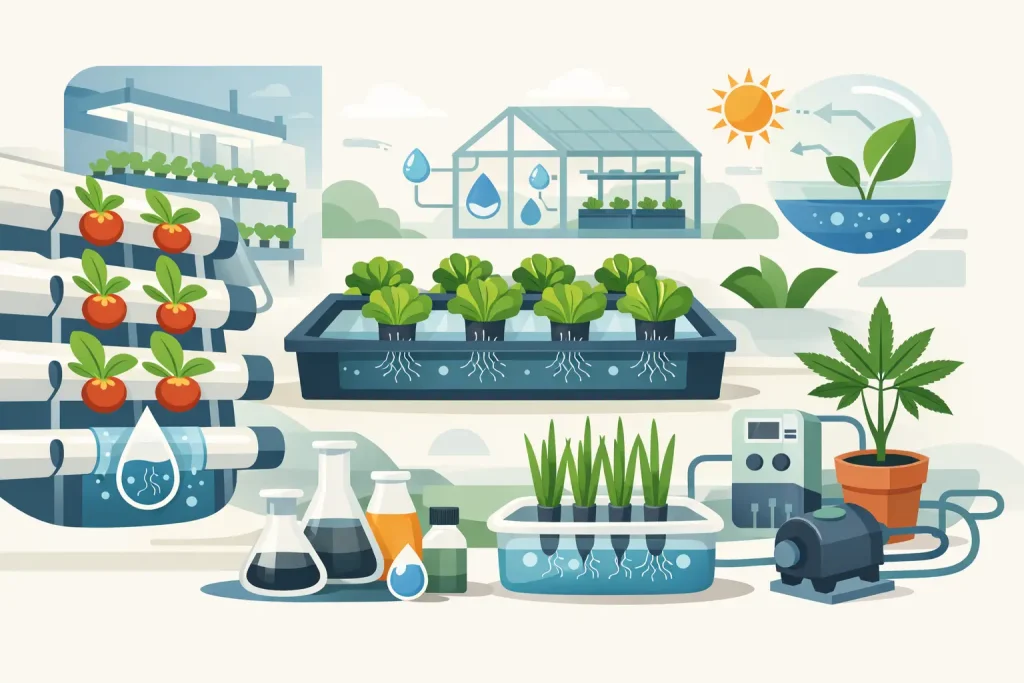
At a basic level, hydroponics is plant cultivation without soil, using a nutrient solution delivered through water and a controlled root environment. In practice, that covers a wide range of setups. A hand-watered coco run-to-waste system sits under the same umbrella as deep water culture, NFT, flood-and-drain and high-pressure aeroponics.
That matters because growers often talk about hydroponics as if it were one method. It is not. The common thread is control. You are managing feed, oxygen availability, moisture levels and drainage more directly than in conventional compost or soil-based growing. The trade-off is obvious – more control usually means less buffer for mistakes.
For indoor growers, that control is the main advantage. If your room is driven by artificial lighting, extraction, fans, filters, timers and irrigation, a hydro setup fits the same logic. Each input can be adjusted with intent, and each problem can usually be traced to a component, a setting or a routine.
Why hydroponics appeals to indoor growers
The attraction is not just faster growth. Good hydroponics gives you a cleaner chain of cause and effect. If plants are underperforming, you can look at EC, pH, reservoir temperature, irrigation frequency, dissolved oxygen, root condition, air exchange and light intensity in a structured way.
That is useful in tents, dedicated grow rooms and small commercial spaces where square metre performance matters. A well-matched hydro system can reduce wasted medium, improve feed accuracy and make repeat runs more predictable. For growers managing multiple plants under controlled conditions, predictability is often more valuable than chasing peak growth rates on paper.
There are practical benefits as well. Media such as clay pebbles, rockwool and coco are easy to pair with automated irrigation. Reservoirs, pumps, drippers, air stones and pipework can be scaled up or down. If you know the plant count, the container size and the irrigation strategy, you can build a system around the workflow rather than forcing the room to adapt.
The main hydroponic systems and where they fit
Run-to-waste and coco systems
For many growers, this is the most sensible entry point. Coco coir paired with a mineral nutrient line behaves like a forgiving bridge between soil habits and fully recirculating hydroponics. You still irrigate frequently, monitor runoff and feed with precision, but the medium provides some buffering.
Run-to-waste is simple to troubleshoot. Fresh nutrient solution goes in, excess drains out, and you read runoff to see how the root zone is behaving. The downside is more waste nutrient and more attention to drainage and collection. If runoff sits in trays or saucers, root-zone problems build quickly.
Deep water culture
DWC can produce rapid growth when oxygenation, water temperature and feed strength are kept in line. Roots sit directly in aerated nutrient solution, so uptake is efficient and response is fast.
The same directness makes it less forgiving. Warm reservoirs, poor hygiene or pump failures can turn into root issues very quickly. For experienced growers with tight environmental control, DWC is effective. For anyone struggling to stabilise room temperature, it can become more maintenance-heavy than expected.
Flood-and-drain
Flood-and-drain systems remain popular because they are straightforward and scalable. Plants sit in pots or trays filled with an inert medium, and the system periodically floods the root zone before draining back to the reservoir.
Done properly, it provides a good balance of moisture, feed and oxygen. Done badly, it leads to overwatering, salt build-up or uneven feed across the tray. Tray level, flood height, medium choice and cycle timing all matter more than many first-time users realise.
NFT and aeroponics
These systems appeal to growers who want highly oxygenated roots and fast development, but they demand tighter control. NFT relies on a shallow film of nutrient solution moving past roots. Aeroponics suspends roots and feeds them via mist or fine spray.
Both methods can perform well, but both are vulnerable to interruptions. A blocked line, failed pump or unstable temperature can cause stress faster than in buffered media systems. They suit growers who already have reliable routines and want to refine performance, not those still building basic room stability.
Equipment decisions that make or break hydroponics
Hydroponics rewards correct system matching more than expensive impulse buying. The first question is not which branded nutrient or booster to add. It is whether the root-zone method matches the room, the cultivar, the plant count and the level of attention available.
Lighting has to be considered alongside irrigation. Higher light intensity drives higher transpiration and nutrient demand, but only if CO2, temperature, humidity and root health support it. Pushing feed under strong LEDs in a hot room with poor extraction is not a nutrient problem. It is a systems problem.
Ventilation and climate control are just as central as reservoirs and pumps. Roots may sit in water or inert media, but the crop still lives in air. Extraction fans, carbon filters, oscillating fans, ducting and environmental controllers are not add-ons. They are part of the hydroponic process because they determine how efficiently the plant can use what the roots are supplied with.
Water quality is another separating line between average and reliable results. Hard water, soft water and variable source water all change how nutrients behave. In some setups, a base nutrient designed for hard water will be enough. In others, filtration or RO water makes the feed programme more stable. There is no universal answer. It depends on the starting water and the nutrient line being used.
Nutrients, pH and the problem with overfeeding
A lot of hydro mistakes come from trying to improve a decent feed regime with too many extras. Base nutrients matter most. Additives should solve a clear problem or support a defined stage, not pad out the tank because the label sounds promising.
Plants in hydroponics typically react quickly to both good and bad decisions. That means pH drift, overfeeding and imbalanced ratios show up faster than in heavier organic media. Monitoring EC and pH is not optional if you want repeatable results. It is part of routine system management.
More feed does not equal more yield. If roots are healthy, irrigation timing is correct and the environment is stable, plants usually perform better on a feed level they can use consistently than on a stronger mix that stresses uptake. The same goes for boosters. Used at the right stage, they can support flower or fruit development. Used too early or too heavily, they often create more correction work than benefit.
Maintenance is not glamorous, but it is the job
Reservoir checks, line cleaning, pump inspection, media management and basic hygiene are what keep hydroponics productive. Growers looking for a low-attention method are often better off with a simpler medium and hand-watering routine.
That is not a criticism of hydro. It is just the reality of a controlled system. The more hardware you rely on, the more routine inspection matters. Salt residues, biofilm, blocked drippers and failing air pumps rarely appear without warning if the room is being checked properly.
For that reason, the best hydro setup is often not the most advanced one. It is the one you can run cleanly, monitor properly and repeat without cutting corners. A basic dripper system in coco with reliable runoff management will usually outperform a complex recirculating system that is only half understood.
Is hydroponics the right choice?
If your priority is precision, automation and tighter control over plant performance, hydroponics makes sense. If you want a wider buffer for irregular watering, inconsistent temperatures or less frequent monitoring, another method may suit you better.
Most growers do not need every possible upgrade from day one. They need a system that fits their room and working routine, with dependable irrigation, stable nutrients, adequate lighting and proper environmental control. That is where specialist suppliers such as Hydroponic Centre are useful – not because every grow needs more kit, but because the right components save time, reduce faults and make the whole room easier to run.
The useful way to think about hydroponics is not as a shortcut to bigger yields. It is a method that rewards discipline. If you build the system around how you actually grow, it gives you fewer surprises and better control where it counts.






