
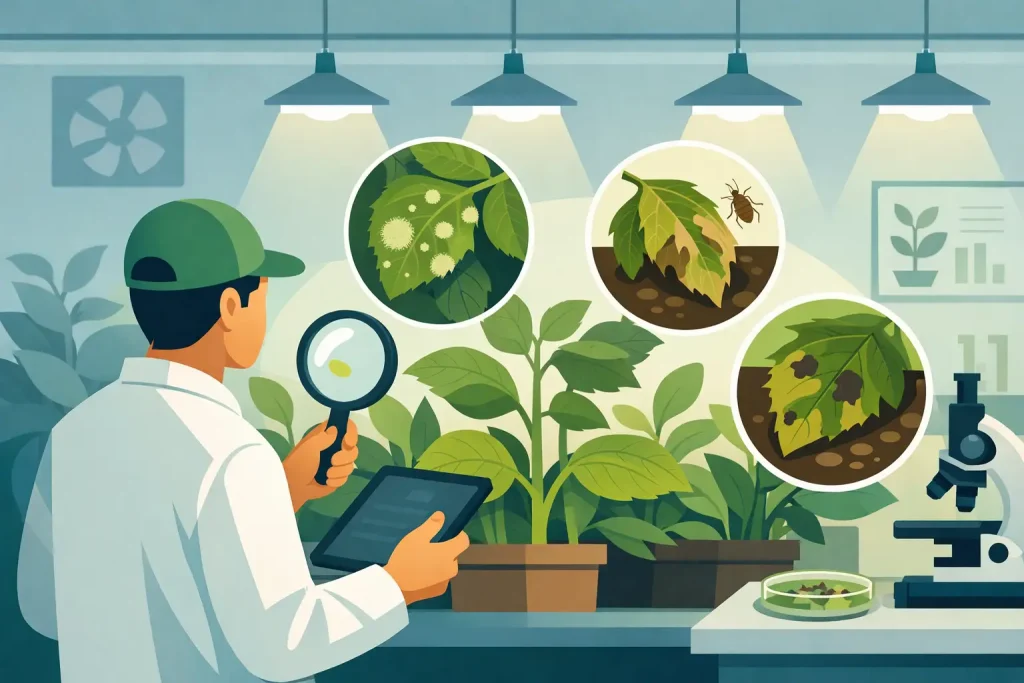
A pale leaf, a brown spot or a drooping plant does not automatically mean disease. In a controlled grow room, the same visible symptom can be caused by poor root-zone oxygen, a feed imbalance, excessive light, erratic irrigation, pests or a pathogen. Accurate indoor disease identification starts by treating symptoms as evidence, not as a diagnosis.
The cost of guessing is usually higher than the cost of a short inspection. Applying a fungicide to a calcium issue wastes time. Raising feed strength to correct a root problem can make it worse. Before changing products or settings, establish what has changed in the room and where the issue began.
Start with the pattern, not the damaged leaf
Check whether the problem is isolated or spreading. A single damaged leaf near an intake may be mechanical damage, a pest feeding site or a local cold spot. Similar marks appearing on multiple plants, particularly those sharing an irrigation line, tray or reservoir, point towards a wider environmental or root-zone issue.
Look at the age and position of affected growth. Deficiencies that start on older leaves often relate to mobile nutrients or root uptake. Problems concentrated in fresh growth can indicate calcium availability, micronutrient lockout, heat stress or pest damage. Disease symptoms are more likely to expand in recognisable patches, form spores or affect stems, roots and neighbouring plants over time.
Take clear photographs before removing leaves or spraying anything. Record the date, cultivar, room temperature, relative humidity, nutrient EC, pH, reservoir temperature and irrigation frequency. Also note recent changes: a new nutrient, a stronger light setting, altered extraction, a missed feed, a new batch of cuttings or plants moved between rooms. These details often identify the cause faster than the leaf itself.
Check the root zone before treating foliage
Many indoor crop problems begin below the media surface. Healthy roots are generally firm and light coloured, though staining can occur with organic nutrients and some additives. More useful indicators are texture, smell and growth. Roots that are soft, slimy, easily stripped or sour-smelling need immediate attention, particularly in DWC, recirculating systems and overwatered media.
Root disease and root stress can look similar above ground: slow growth, wilting when the medium is wet, leaf curl, weak colour and reduced uptake. Pythium-type root rot is commonly associated with low dissolved oxygen, warm nutrient solution, poor hygiene or organic debris in a system. But a plant can show the same symptoms simply because irrigation is too frequent, drainage is restricted or the reservoir has drifted outside its working range.
Inspect emitters, drippers, run-off and reservoir return lines. Uneven flow can leave one group of plants too dry while another remains saturated. In coco, compare pot weight between healthy and affected plants. In hydro systems, check water temperature, aeration, pump operation and biofilm around fittings. Correcting the physical cause is more valuable than adding a treatment to an unstable system.
Reading common indoor disease symptoms
Powdery mildew usually appears as white or grey powdery patches on leaf surfaces, stems or petioles. Early marks can resemble dried spray residue, so inspect both sides of the leaf and watch whether the patch enlarges. It is encouraged by crowded canopies, weak air movement and humidity conditions that allow surface moisture around susceptible tissue. Remove heavily affected material carefully, improve airflow through the canopy and avoid spreading spores during routine handling.
Botrytis, often called grey mould, requires a faster response. It may begin as soft brown tissue, dead flowers or grey fuzzy growth in dense, humid areas. Inspect inside large flowers and around damaged stems rather than relying on the outer canopy alone. Remove infected material with clean tools, bag it before moving it through the grow area and clean contact points afterwards. Trying to save badly colonised material can spread spores through fans, hands and trimming equipment.
Leaf spot diseases tend to produce distinct lesions that enlarge or develop darker margins, sometimes with yellow halos. However, nutrient splash, foliar sprays, high EC and pest damage can also create spotting. If marks occur only where spray has pooled, or on leaves closest to a light, investigate application practice and environmental stress first.
Fusarium and other vascular diseases can cause one-sided wilting, stunting and internal stem discolouration. These problems are difficult to confirm by appearance alone and can be carried through contaminated media, water or propagation material. Isolate suspect plants rather than placing them back among healthy stock. If symptoms persist despite stable irrigation and root-zone conditions, professional testing may be the sensible next step.
Indoor disease identification needs environmental data
Pathogens do not operate separately from the room conditions that favour them. A humidity reading at one wall is not enough if the canopy is dense, lights are off and airflow is weak beneath the foliage. Measure where the plants are growing. Check that fans move air through, not merely above, the canopy, and confirm that extraction and intake are matched to the heat and moisture load.
High humidity is not automatically a problem, especially during early growth, but prolonged leaf wetness and poor air exchange increase risk. The target depends on plant stage, room temperature, cultivar, canopy density and whether the crop is in a tent, sealed room or larger cultivation space. The practical aim is consistency. Big temperature drops at lights-off can push moisture onto leaf surfaces even when daytime figures look acceptable.
Nutrient conditions matter as well. An incorrect pH can mimic deficiency because nutrients become less available. Excessive EC can burn root tips and reduce water uptake, creating leaf-edge damage that is sometimes mistaken for infection. Check calibration on pH and EC meters before making major adjustments. A faulty meter can send a perfectly healthy crop down the wrong corrective path.
Separate disease from pests and deficiencies
Pests often create patterns that look like disease. Spider mites can produce pale stippling that progresses to bronzing and webbing. Thrips leave silvery feeding scars, small black frass marks and distorted young growth. Fungus gnats indicate wet media and can contribute to root problems, particularly in young plants. Use a loupe and inspect leaf undersides, growing tips, media surfaces and sticky traps before deciding the issue is fungal.
Deficiencies usually follow a more consistent nutritional pattern than a pathogen. Magnesium issues commonly show interveinal chlorosis on older leaves, while calcium problems tend to affect new growth and may be linked to unstable transpiration or root-zone pH. Still, feeding more nutrient is not a default fix. If roots are stressed, the plant may be unable to use what is already present.
When symptoms are unclear, use a controlled approach. Keep the climate stable, correct obvious irrigation faults, avoid stacking multiple additives and monitor new growth rather than expecting existing damaged leaves to recover. Old lesions are records of past stress. The useful question is whether fresh growth is emerging cleanly.
A practical response sequence for suspect disease
Use the same sequence every time so that urgent work does not become random work:
- Isolate affected plants or at least create a clear working boundary around them. Handle healthy plants first and suspect plants last.
- Inspect roots, leaf undersides, stems, media and irrigation hardware. Check for pests before choosing a disease treatment.
- Record room and root-zone conditions, including temperature, humidity, pH, EC, water temperature and irrigation timing.
- Remove seriously infected plant material with sanitised tools, then clean trays, reservoirs, scissors and touch points between tasks.
- Correct the environmental trigger before applying any approved crop-protection product. Follow the label precisely and do not exceed application rates or intervals.
Avoid spraying under high-intensity lighting or when the canopy is already heat stressed. Foliar applications can cause their own spotting, especially where droplets sit on leaves. If a treatment is necessary, test it on a small area first where practical, and ensure suitable ventilation and personal protective equipment are in place.
Prevention is mainly a workflow issue
The most reliable disease control is built into daily operations. Start clean with washed trays, disinfected propagation tools and reliable water. Keep plant waste out of reservoirs and away from intake areas. Do not bring unchecked plant material directly into a main room, and avoid moving from a problem area to a clean area in the same gloves or clothing.
Canopy management matters once plants fill the available space. Remove dead leaves, maintain sensible spacing and ensure there is airflow through lower growth. Good circulation is not a substitute for extraction, but it reduces stagnant pockets where humidity and spores can build. In recirculating systems, clean filters, lines and tanks on schedule rather than waiting for visible slime or blocked drippers.
Most successful growers do not diagnose every issue perfectly at first sight. They maintain enough records, hygiene and environmental control to narrow the possibilities quickly. When the root zone is stable and the room is operating consistently, indoor disease identification becomes less about chasing symptoms and more about making a confident, timely decision.






