
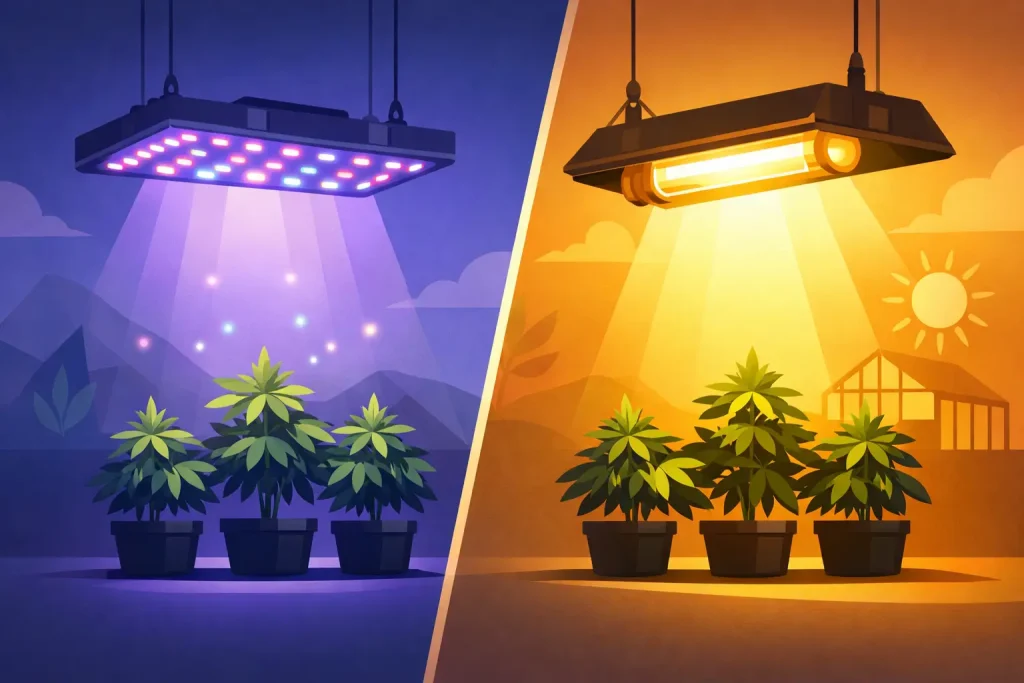
When a grow room is underperforming, lighting is usually the first place to look. The LED vs HPS lighting question matters because it affects far more than wattage on a box. It changes canopy temperature, feed demand, extraction requirements, plant structure, and what you spend every month to keep the room running.
For some growers, HPS still does the job well and keeps the setup simple. For others, modern LED fixtures make more sense because they cut heat, reduce power draw, and give tighter environmental control. The right choice depends on your space, crop style, budget, and how much control you want over the full system.
LED vs HPS lighting in real grow rooms
On paper, the comparison looks straightforward. LED is more efficient, HPS is cheaper to buy, and both can produce strong results. In practice, the differences show up in the room itself.
An HPS lamp throws a lot of radiant heat. That can be useful in colder spaces or during winter cycles, especially if your intake air is cool and your room struggles to maintain leaf surface temperature. It can also become a problem fast in smaller tents, loft spaces, or sealed rooms where extraction and air-cooled reflector performance become limiting factors.
LED fixtures generally run cooler at canopy level, even though they still produce heat at the driver and heatsink. That lower radiant heat load gives growers more headroom with climate control. You can often manage the room with less aggressive extraction, and in some setups you can place fixtures closer to the canopy without the same burn risk you get from an HPS bulb.
That does not mean LED is automatically easier. When you remove the extra heat from HPS, the room may need more support from heaters, dehumidifiers, or environmental controllers to stay in range. Growers switching from sodium often find that the whole room balance changes, not just the light source.
Upfront cost versus operating cost
If you are building on a tight budget, HPS still has one clear advantage. A lamp, reflector, ballast and bulb package is usually cheaper than a quality horticultural LED fixture with comparable output.
That lower entry cost keeps HPS relevant for budget-conscious growers, temporary rooms, and straightforward flower-only spaces. Replacement lamps are easy to source, and most growers already understand how to run them.
The longer-term maths often swings towards LED. Good LED units use less electricity for similar or better usable light output, and they usually reduce strain on extraction and cooling equipment. Over multiple cycles, that lower power demand can offset the higher purchase price. In the UK, where electricity costs remain a serious consideration for indoor growers, running cost is not a minor detail.
There is a maintenance angle as well. HPS bulbs degrade over time and need replacing to maintain output and consistency. LED fixtures also lose output gradually, but quality units tend to hold performance for far longer before replacement becomes necessary. If you are running repeat cycles and care about fixture stability, that matters.
Light intensity, penetration and canopy response
HPS earned its reputation for a reason. A strong sodium lamp can push heavy flowering performance, particularly in well-managed rooms with even canopies and good environmental support. Many growers still like the way HPS drives stretch early in bloom and bulks flowers later in the cycle.
LED performance has moved on significantly. Modern full-spectrum fixtures are no longer a compromise option. Good units can deliver high PPFD levels, strong uniformity across the footprint, and better photon efficiency than HPS. That usually translates into more light per watt and less wasted energy.
Penetration is often discussed as if HPS always wins. It is not that simple. Penetration comes from total photon density, fixture design, canopy structure and plant management, not just lamp type. A badly designed LED fixture can underperform. A high-quality bar-style LED with even spread can outperform a single-point HPS source in real canopy coverage, especially over wider footprints.
If your grow style relies on deep, uneven canopies and minimal training, HPS may still feel more forgiving. If you run flat, well-trained canopies with controlled spacing, LED often shows its strengths more clearly.
Spectrum and plant behaviour
HPS has a red-heavy spectrum that supports flowering well, but it is limited compared with modern full-spectrum LED. LED fixtures can provide a broader spectral output, which can influence internodal spacing, leaf development, resin production and overall morphology.
That does not mean spectrum alone guarantees better crops. Environment, feed, irrigation timing and genetics still decide a lot. But broader-spectrum LED gives growers a more balanced tool, particularly if one fixture is being used from veg through flower.
For mixed-stage rooms or growers who want one lighting platform across the full cycle, LED is often the cleaner option.
Heat management and equipment knock-on effects
Lighting decisions affect the rest of the shopping list. If you choose HPS, you are often also choosing stronger extraction, more airflow management, and in many cases a greater focus on ducting, reflectors and heat removal.
In a larger room with proper ventilation, that may not be a problem. In fact, HPS can work very well where the infrastructure already supports it. But in compact tents or rooms with limited airflow, heat quickly becomes the bottleneck rather than raw light output.
LED tends to reduce that pressure. You may still need solid extraction, oscillating fans and environmental monitoring, but the room is generally easier to keep stable. That can simplify your setup and reduce the need for reactive adjustments across the cycle.
Humidity can shift as well. Because LED often lowers canopy heat, plants may transpire differently and the room can hold moisture more readily. Some growers upgrading to LED find they need better dehumidification during flower than they did under HPS. Again, the point is that lighting changes the whole room.
Yield, quality and consistency
Most serious growers are not asking which light looks better on a spec sheet. They want to know what fills the drying rack.
Both systems can produce strong yields when the room is dialled in. HPS remains capable of excellent flower production, especially in experienced hands. LED, however, has become the stronger all-round option for growers who want high output with better efficiency and tighter environmental control.
Quality is where opinions vary. Some growers still prefer the crop response they know under sodium, particularly with cultivars they have run for years. Others report better terpene retention, tighter node spacing and more uniform development under quality LEDs. Those outcomes depend heavily on genetics and climate control, so blanket claims are not useful.
Consistency is the more practical metric. A stable LED fixture with uniform spread and predictable output can make it easier to repeat results across cycles. For growers managing multiple tents, perpetual harvests or small commercial rooms, repeatability has real value.
Which setup makes sense for your space?
If you are running a basic flower room on a limited budget and you already have extraction sorted, HPS can still be a sensible buy. It is proven, available, and easy to understand. In colder parts of the year, the extra lamp heat may actually help keep conditions in range.
If power consumption, heat build-up and long-term running cost are the bigger concerns, LED usually comes out ahead. It is particularly well suited to smaller tents, insulated rooms, multi-stage grows, and setups where environmental precision matters.
The better question is not whether LED or HPS is universally better. It is whether your room benefits more from the lower purchase cost and added heat of HPS, or the efficiency and control of LED.
When HPS still makes sense
HPS remains a practical option for flower-focused growers who want low upfront cost, straightforward replacement parts and proven performance. It also suits rooms where the extra radiant heat is useful rather than problematic.
When LED is the stronger option
LED is usually the better fit for growers looking to reduce electricity use, manage heat more effectively, and run one lighting platform across veg and flower. It also suits growers investing in a more efficient room over the long term.
If you are comparing fixtures, do not stop at wattage. Check the actual coverage area, photon efficiency, dimming options, thermal design, and how the light will sit alongside your extraction, circulation and climate-control equipment. That is where the real decision gets made.
A lighting upgrade works best when it matches the room, not just the crop. Get that part right and every other piece of the system becomes easier to manage.






