
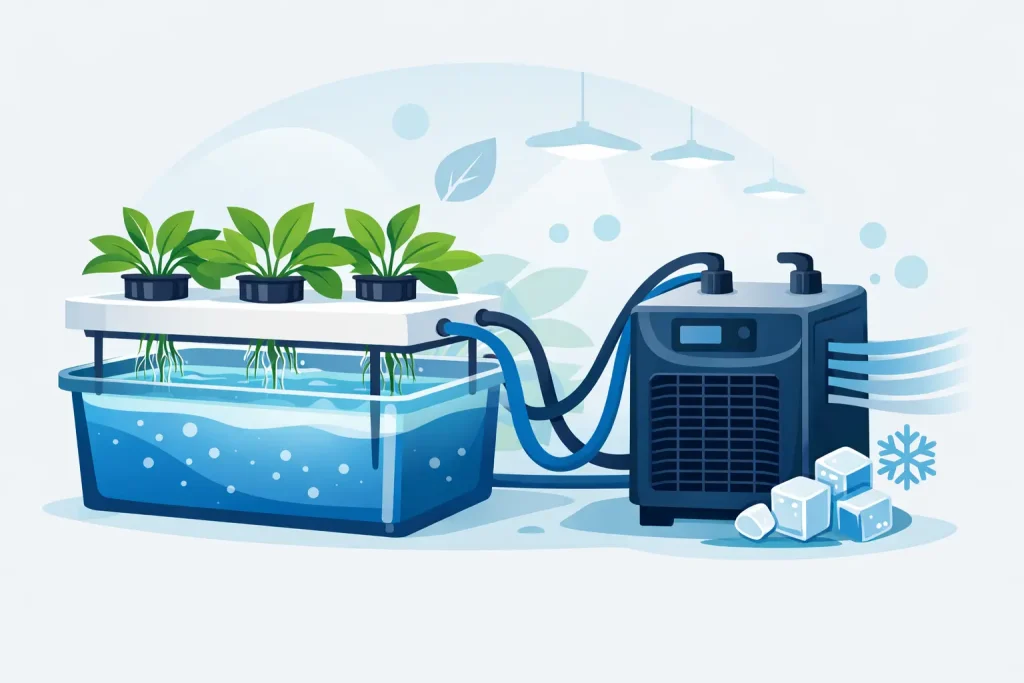
A nutrient tank sitting at 24°C may not look like the source of a poor run, but roots will often show it first. Dissolved oxygen falls as solution temperature rises, while pathogens become more comfortable and hungry plants can lose their usual pace. The main reservoir chiller benefits are consistency at the root zone, better oxygen retention and a wider safety margin when lighting, pumps and warm weather push solution temperatures upwards.
For growers running DWC, RDWC, aeroponics or recirculating systems, a chiller is not a decorative upgrade. It is a piece of climate-control equipment that protects the part of the system plants cannot do without: healthy, oxygenated nutrient solution. Whether it earns its place depends on reservoir size, room temperatures, water movement and how tightly the rest of the grow is managed.
Why nutrient solution temperature matters
Most hydroponic crops are comfortable with a nutrient solution around 18-21°C. The exact target varies by cultivar, system design and grower preference, but this range is a sound operational starting point. Below it, uptake and growth can slow. Above it, the water holds less dissolved oxygen and the roots have to work in a less forgiving environment.
That matters most in systems where roots are continuously submerged or regularly sprayed. Warm solution combined with organic build-up, light leaks, weak circulation or a dirty tank can turn a minor temperature issue into slimy roots, poor uptake and an unstable reservoir quickly. A chiller does not correct those underlying faults, but it removes one major source of pressure.
The key reservoir chiller benefits
More dissolved oxygen around the roots
Cooler water can retain more oxygen than warmer water. Air stones, venturi returns and waterfalls still have a role, but they work more effectively when the solution is not already warm. This is especially useful in DWC and RDWC, where the root mass depends heavily on an oxygen-rich reservoir.
The practical result is usually firmer, cleaner-looking roots and a system that is less likely to struggle after a hot day. It is not a licence to under-size air pumps or neglect cleaning. It is an extra layer of control that lets the aeration equipment do its job properly.
Reduced root-zone stress under high-intensity lighting
Modern LED fixtures produce less radiant heat than older lamp types, but a powerful, well-filled tent still generates heat. Pumps add warmth directly to the nutrient solution, while external temperatures can climb sharply during a UK summer spell. In a sealed or busy grow room, the reservoir may heat up even when the air temperature appears acceptable.
A correctly sized chiller holds the solution near its set point rather than letting it climb for hours. This steadier root zone can make feeding behaviour easier to read. If EC, pH or water consumption changes, you are less likely to be chasing a temperature swing at the same time.
Better protection against root disease conditions
Warm, poorly oxygenated nutrient solution creates favourable conditions for root pathogens. A reservoir chiller reduces one of the conditions that can encourage those problems, particularly in recirculating systems with a large root mass and frequent solution movement.
It should be viewed as prevention, not a cure. If a system already has biofilm, brown roots, blocked pipework or a contamination issue, chilling alone will not clean it up. Proper reservoir hygiene, light-proof lids, adequate filtration where appropriate and regular checks remain essential. Still, keeping the nutrient solution cool gives pathogens fewer advantages and healthy roots a better chance of recovering from minor stress.
More predictable nutrient uptake
Root uptake is influenced by temperature, oxygen, EC, pH, humidity, irrigation frequency and plant demand. There is no fixed rule that a chiller automatically increases yield. What it can do is remove a variable that causes erratic uptake, especially when the reservoir would otherwise move from cool nights to hot afternoons.
That consistency is valuable when tuning a feed schedule. Plants that drink more predictably are easier to manage, and a stable tank makes it simpler to spot a genuine nutrient imbalance, blocked dripper or root issue before it develops further.
A more reliable system in warm periods
The strongest case for a chiller often arrives when ambient conditions are least cooperative. A reservoir can be stable for much of the year, then climb beyond target during a heatwave, after a ventilation fault or when a larger light is added. For growers who cannot attend the room several times a day, a chiller offers useful protection against those spikes.
This is also relevant to small commercial rooms and multi-site systems, where a reservoir failure can affect far more than one plant. Consistent water temperature supports repeatable crop management and reduces the need for reactive interventions.
Which hydroponic systems benefit most?
DWC and RDWC are usually the clearest candidates because roots sit directly in nutrient solution. The larger the root mass, the more quickly oxygen demand becomes a limiting factor when temperatures rise. Recirculating systems may also collect heat from multiple buckets, pumps and long pipe runs, so monitoring temperature in the main reservoir alone is not always enough.
Aeroponic and high-pressure systems can benefit as well, particularly where the return reservoir warms throughout the light cycle. In flood-and-drain systems, the need depends on how long solution sits in the tray, the size of the reservoir and the room climate. Run-to-waste growers may need a chiller less often, since fresh feed can be mixed and delivered at a controlled temperature, but a warm mixing tank can still cause problems in a large automated installation.
For a small hand-watered coco setup, improving extraction, moving the reservoir away from the tent or mixing smaller volumes may be more cost-effective than buying a chiller. The equipment should solve a measured problem, not simply add complexity.
Selecting the right chiller capacity
Choose capacity based on the heat load, not just the number of litres in the tank. Reservoir volume matters, but so do pump wattage, room temperature, water movement, insulation, light-cycle length and whether the chiller is working against a warm, enclosed space. An undersized unit may run constantly and still fail to bring the solution down to the set point.
As a working approach, measure the reservoir temperature at several points through the light cycle for a few days. Note the peak temperature, the room temperature and how quickly the solution warms. This gives a clearer picture than selecting a chiller from tank volume alone.
Allow headroom where possible. A unit that cycles on and off is generally preferable to one operating flat out every day. Oversizing has trade-offs too: higher purchase cost, more electricity use and the risk of cooling a small reservoir too quickly if the controller is poorly set. Use a dependable digital thermometer independently of the chiller display, especially after installation.
Installation details that affect performance
Place the chiller outside the tent or grow room where possible. It removes heat from the nutrient solution and releases that heat into the surrounding air. Putting it inside the same enclosed space can make extraction work harder and reduce the net benefit.
Use suitably sized tubing, keep runs short and avoid tight bends that restrict flow. Most chillers need a compatible water pump with enough flow to move solution through the heat exchanger, but excessive flow can also fall outside the manufacturer’s recommended range. Check the specification for both the chiller and pump rather than assuming any spare circulation pump will suit.
Insulating a reservoir and keeping it off a warm floor can reduce the workload considerably. Use an opaque, well-fitting lid to prevent light reaching the solution, and route pipework away from hot drivers, radiators and direct airflow from dehumidifiers. These basic measures may mean a smaller chiller can maintain target temperature more efficiently.
Operating and maintaining a chiller
Set the target conservatively. Many growers aim for roughly 19-20°C, then allow a small controller differential so the unit is not switching on for every minor fluctuation. Avoid chasing a very low number without a reason. Nutrient solution that is too cold can slow root activity and reduce the benefit you intended to gain.
Keep the condenser vents clean and leave clearance around the unit for air movement. Dust-clogged coils reduce cooling efficiency and increase power use. Inspect hose connections for drips, check flow regularly and clean the chiller loop between crops according to the equipment guidance. Scale, nutrient residue and biofilm can restrict performance over time.
A chiller also adds another electrical load and another possible point of failure. Use safe, dry positioning, protect plugs from splashes and avoid overloading extension leads. A high and low temperature alarm is worthwhile in valuable crops, because a failed pump, blocked line or warm room can undo the benefit before the next routine check.
When a chiller is not the first fix
If solution temperatures are only slightly high, start with the obvious heat sources. Improve extraction, move ballasts or drivers out of the grow area, reduce unnecessary pump heat, insulate the tank and keep the reservoir out of direct light. Increasing aeration helps oxygen levels, although it will not physically lower water temperature.
Frozen bottles are sometimes used as a short-term emergency measure, but they create swings and demand frequent attention. They are not a reliable replacement for controlled cooling in a recirculating system. Conversely, if the reservoir stays within range without intervention, a chiller may add cost and maintenance without delivering a meaningful return.
Treat solution temperature as part of the same control plan as lighting, airflow, humidity, irrigation and reservoir hygiene. Once the root zone is stable, the rest of the system becomes easier to assess – and plants get the consistent conditions they need to keep moving forward.






