
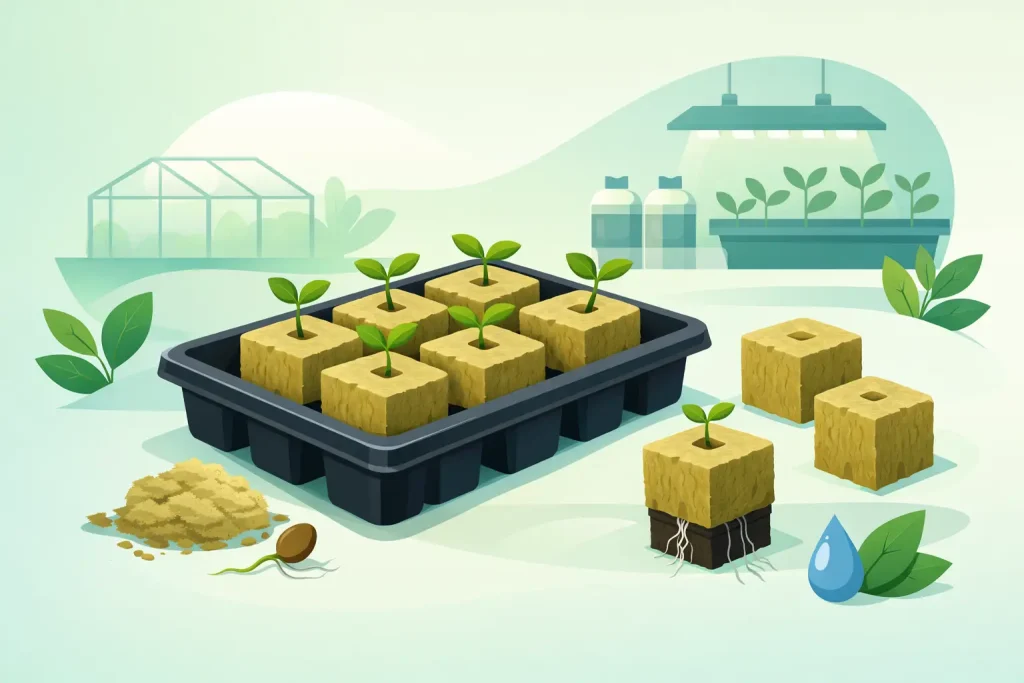
If your seedlings stall before they ever reach the system, the problem usually starts in propagation. A good rockwool starter cubes guide is less about theory and more about getting moisture, pH and handling right from day one. When cubes are prepped properly, they give you a clean, uniform starting point for seeds and cuttings across hydro, coco and even hand-watered runs.
Why growers use rockwool starter cubes
Rockwool remains a standard propagation medium because it is consistent. Every cube is broadly the same size, density and water-holding profile, which matters when you are trying to keep a tray of seedlings or cuttings on the same timeline. Compared with loose media, it is easier to control irrigation and easier to assess what is happening in the root zone.
The main advantage is the balance between moisture retention and air space. Young roots need constant access to water, but they also need oxygen. Rockwool holds enough moisture to support germination and rooting while still leaving pore space for air, provided you do not keep it waterlogged. That makes it a practical option for propagation domes, heated mats, NFT starts, dripper systems and transplanting into larger rockwool blocks.
There are trade-offs. Rockwool starts with an alkaline pH, so prep matters. It can also stay too wet in inexperienced hands, especially under a humidity dome where evaporation is limited. If you treat it like compost and keep soaking it, you slow root development instead of helping it.
How to prepare rockwool starter cubes properly
This is the step people rush, and it is where a lot of early issues begin. Fresh rockwool cubes should be soaked in pH-adjusted water before use. For most propagation work, aiming around pH 5.5 is standard. That brings the medium into a more suitable range for early root activity.
The cubes do not need aggressive handling. Soak them, let them absorb evenly, then allow excess water to drain away naturally. Do not squeeze them. Squeezing crushes the fibre structure and reduces air pockets, which works directly against healthy rooting. You want the cube moist throughout, not dripping and compacted.
Some growers add a very light nutrient solution or a rooting product at this stage. That can work, but strength matters. Seeds need very little feed at the start, and fresh cuttings are not ready for a heavy EC. If you are using additives, keep it mild and avoid stacking products too early. A clean, correctly pH’d soak is often enough.
Moisture level matters more than most beginners think
A properly prepared cube should feel damp, not saturated. If water runs out when you pick it up, it is too wet. In a covered propagator, that excess moisture lingers and pushes the cube towards poor oxygen availability. The result is slow germination, weak stems or cuttings that sit in place without throwing roots.
This is why experienced growers often irrigate less than beginners expect. In propagation, over-attention causes more damage than slight restraint.
Seeds or cuttings – the handling is slightly different
For seeds, place one seed into the pre-formed hole and keep handling to a minimum. You want contact with the moist cube, but you do not want to bury the seed too deeply or flood the hole. If the opening is too large for the seed, pinch it lightly closed without compressing the whole cube.
For cuttings, the focus is on stem contact and sanitation. Use a clean cutting, prepared correctly, and insert it so the stem sits firmly in the cube without wobble. A loose fit slows rooting because the stem is not in reliable contact with the moist medium. At the same time, forcing a thick stem into a small hole can damage tissue and create another problem. Match cube size and hole size to the material you are propagating.
Environment makes the cubes work
Even the best-prepared cube will underperform in the wrong conditions. Temperature, humidity and light intensity all affect propagation speed. For most seedlings and cuttings, warm root-zone conditions help. A heated propagator or heat mat is useful if your grow area runs cool, particularly in colder UK periods when room temperatures drop overnight.
Humidity should support the plant without encouraging stagnation. Cuttings generally prefer higher humidity early on because they are not yet taking up water through a rooted system. Seedlings can also benefit from a dome at first, but once they emerge, stale, over-humid air becomes less helpful. Vents should be adjusted as plants establish, and domes should not stay shut indefinitely.
Light needs to be gentle. Strong HID or an overpowered LED at close range is unnecessary at this stage and often counterproductive. Propagation lighting should keep seedlings compact and support rooting without driving excess transpiration. It is a low-intensity job.
Rockwool starter cubes guide for watering and feeding
Once seeds have germinated or cuttings are set, the next job is not constant watering. It is maintaining an even moisture level. The cubes should stay moist enough to support root development, but they should not sit in standing water for long periods. A propagator tray can collect runoff, but cubes left soaking at the base invite problems.
For seeds, feed is usually minimal until the first true leaves appear and roots begin to move through the cube. For cuttings, a low-strength rooting solution is often enough until visible roots show. Piling in base nutrients too early does not speed the process up. In many cases it just increases stress.
If you are running a precise hydroponic workflow, monitor EC and pH from the start. That matters more when you are propagating at scale or trying to keep multiple cultivars aligned in one environment. For a small tray, the principle is simpler: low strength, correct pH, consistent moisture.
When to transplant from starter cubes
The right transplant point is usually when roots are visible around the outside of the cube, but before they become overextended and exposed. Move too early and the plant has not established enough. Leave it too long and you create unnecessary stress during transfer.
One reason rockwool works well in hydroponics is the clean handoff into the next stage. Starter cubes can go into larger rockwool blocks, net pots with clay pebbles, coco pots or other compatible systems with minimal root disturbance. That continuity helps reduce transplant shock if the receiving medium and irrigation strategy are set up properly.
It does depend on the crop and the system. Fast-rooting cuttings might be ready quickly. Slower seedlings, or plants held in cooler conditions, take longer. Root visibility matters more than sticking rigidly to a timetable.
Common mistakes with rockwool cubes
Most failures come back to a short list of avoidable errors. The first is not conditioning the cubes to the correct pH. The second is overwatering. The third is poor environmental control, usually too cold, too wet, or too much light.
Another common issue is excessive handling. Squeezing cubes, pulling seedlings to check roots, or moving cuttings around repeatedly all slow progress. Propagation rewards consistency more than intervention.
There is also the temptation to overcomplicate the feed programme. Growers with a full shelf of nutrients sometimes try to use all of them from the first day. Propagation is not the stage for a heavy additive schedule. Get the basics right first – pH, moisture, warmth and clean handling – then build from there.
Choosing the right cube size
Small starter cubes are ideal for germination trays, cloning stations and short propagation windows. Larger cubes can buy you more time before transplanting, but they also hold more water, which can be a disadvantage if your environment already runs humid.
For most growers, cube choice should match the workflow rather than just the plant size. If you are transferring quickly into a larger block or system, a standard starter cube keeps things simple. If you need a slightly longer holding period, a larger format may make sense, provided your irrigation discipline is good.
Hydroponic Centre stocks propagation formats because growers need compatibility as much as they need media quality. The cleaner your handoff from cube to block, pot or hydro system, the easier the rest of the run becomes.
Is rockwool the best option?
That depends on your setup. Rockwool is excellent for uniformity, clean system integration and repeatable results. If you want a medium that works neatly with trays, blocks and hydroponic transplanting, it is hard to argue against.
But it is not foolproof. Growers who prefer a more forgiving, soil-like feel sometimes get on better with plugs or light starter mixes because they are less likely to keep them overly wet. If your watering habits are heavy-handed, rockwool can expose that quickly.
Used correctly, though, it stays one of the most efficient propagation media in controlled environments. Get the prep right, keep the cubes just moist, and let the roots do the work. Most propagation problems are not caused by the cube itself – they come from trying to improve on a process that already works.






