
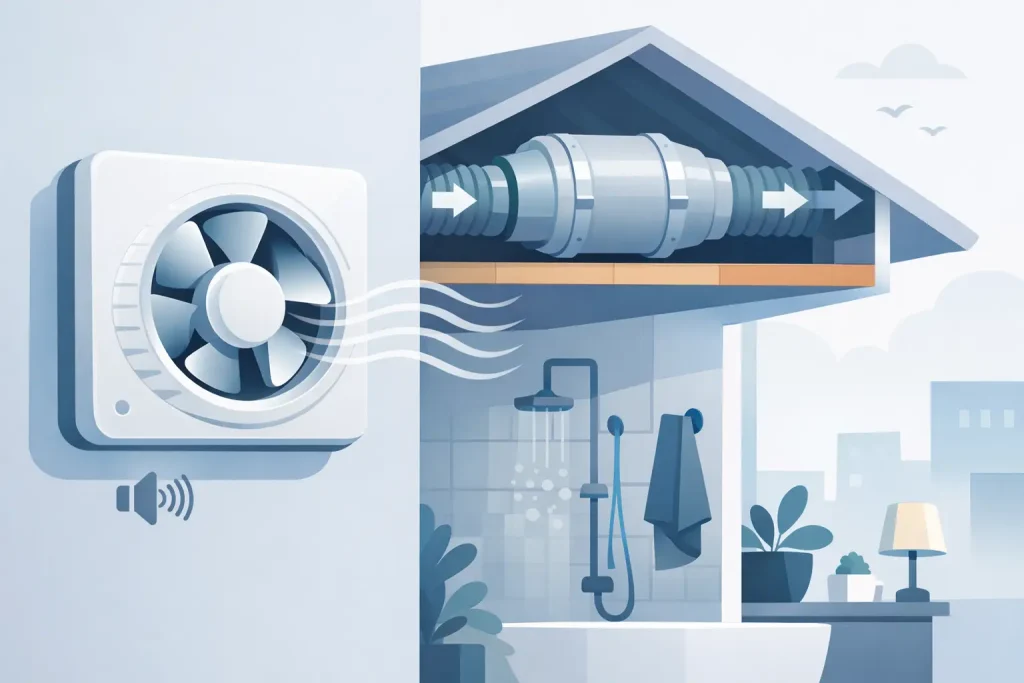
The loudest part of many grow rooms is not the light or the pump. It is the extraction line rattling through thin ducting, the fan body humming against a tent pole, or the air velocity whining through a filter that is too small for the job. A proper silent extractor fan setup fixes that at source. It does not mean choking airflow or undersizing the system. It means moving the right volume of air, with less vibration, less turbulence and fewer obvious noise points.
For growers running tents, cupboards or sealed-off rooms, that matters for more than comfort. Noise usually points to inefficiency somewhere in the ventilation chain. If the fan is working too hard, the duct run is badly planned, or the filter is creating excess resistance, you get more sound and poorer environmental control at the same time.
What a silent extractor fan setup really depends on
The basic rule is simple: quiet systems are usually oversized systems run sensibly. A small fan pushed near its limit is often louder than a larger EC or mixed-flow fan running at reduced speed. That is why a silent setup starts with airflow requirement, not with the word silent printed on a box.
In a grow tent, extraction has to deal with lamp heat, humidity spikes, stale air and odour control. Once you add a carbon filter, bends in the ducting and any long run to an outlet, the real resistance climbs quickly. If you only match the fan to the tent volume on paper, the unit often ends up running too hard. Noise follows.
A better approach is to calculate the airflow you need, then give yourself headroom. That extra capacity lets you run a controller, step down the speed and keep negative pressure without turning the extractor into the loudest bit of kit in the room.
Sizing the fan and filter properly
A silent extractor fan setup is easier to achieve when the fan and filter are matched as a pair. If the fan outperforms the filter too aggressively, air velocity through the filter can rise and add noise. If the filter is too restrictive for the fan, the motor works harder and the whole line becomes less efficient.
For most hobby and intermediate tent grows, the target is steady extraction with enough margin for seasonal changes. Summer is where bad sizing shows up. What seems acceptable in winter can become noisy and underpowered once room temperatures rise and the fan spends all day at high output.
EC fans generally make more sense where noise is a concern. They offer finer speed control and tend to stay more stable across different load conditions. AC fans can still do the job, particularly on simpler or tighter budgets, but not every controller and fan combination behaves quietly. Some AC fans hum or chatter when slowed incorrectly, so compatibility matters.
If discretion is a priority, it often pays to buy one size up and run it lower. That costs more upfront, but it is usually the cleanest fix for noise without compromising plant health.
Why oversizing often makes sense
Oversizing has limits. Too much fan for a very small tent can create excessive negative pressure, pull walls inward and make passive intakes work against you. But a moderate step up in capacity is usually beneficial because it gives control range.
That control range is what separates a merely functional extraction system from a genuinely quiet one. You are not relying on maximum RPM just to maintain acceptable temperatures and humidity.
Ducting is where most noise starts
A lot of growers focus on the fan body and ignore the duct line. In practice, poor ducting creates a large share of the noise. Thin flexible duct can flap, crinkle and amplify air movement, especially when runs are long or sharply bent.
Keep the duct route as short and straight as the space allows. Every unnecessary bend adds resistance and turbulence. A hard 90-degree turn is worse than a broad curve, and multiple bends stack the problem.
Insulated acoustic ducting is usually worth it if quiet running matters. It helps dampen the sound of moving air and reduces the metallic or papery resonance you get from basic flexible duct. It will not make a bad system silent on its own, but it can take the edge off a setup that is already correctly sized.
The same goes for duct diameter. Necking down to a smaller size just because a fitting is available is an easy way to add hiss and back pressure. Keep diameters consistent across the run wherever possible.
Keep the run clean and supported
Sagging duct creates pockets and awkward bends that disturb airflow. Support the run properly so the air path stays smooth. Pull flexible duct reasonably taut, but do not stretch it to the point where connections are strained or likely to work loose.
Leaks also matter. Small air leaks around joints can whistle, especially at higher fan speeds. Proper clamps and secure connections are basic, but they are often the difference between a tidy system and one that sounds rough.
Mounting and vibration control
Even a good fan becomes noisy when it is hard-mounted badly. If the unit is fixed directly to a tent frame, timber panel or wall bracket without isolation, vibration transfers into the structure and gets amplified.
For a quieter silent extractor fan setup, suspend the fan where possible using straps, rope hangers or dedicated anti-vibration mounts. The goal is to stop motor vibration travelling into rigid surfaces. This is one of the cheapest upgrades with the biggest real-world effect.
Carbon filters also need secure support. A filter knocking lightly against poles or boards can create more perceived noise than the fan itself. The same applies to ducting touching walls, shelves or reflective sheeting.
If the fan is housed in a box or enclosure, do not block airflow in the name of noise reduction. Restricting intake or exhaust just pushes the fan harder and usually makes the problem worse. Quieting the system should never come at the cost of proper extraction.
Positioning inside or outside the tent
There is no single correct layout. It depends on headroom, heat load, access and how tidy you need the run to be. Fan and filter inside the tent is common because it keeps the extraction chain compact and maintains straightforward odour control. The trade-off is that the motor noise stays closer to the canopy space.
Mounting part of the system outside the tent can reduce internal clutter and sometimes makes servicing easier. It can also move the main noise source away from the immediate grow area. But if the external mounting surface is rigid, poor isolation can make the room outside the tent noisier than before.
The quietest layout is usually the one with the shortest, straightest run and the best vibration isolation. Not the one that looks neatest on paper.
Controllers, speed settings and pressure balance
A fan controller is not just a convenience. In a quiet setup, it is central to how the system behaves day to day. You want enough extraction to maintain temperature, humidity and negative pressure, but not so much that the fan races unnecessarily.
For odour-controlled tents, negative pressure must remain stable. If you reduce fan speed too far in pursuit of silence, smells can escape and environmental consistency drops away. That is the trade-off. Quieter is good, but only if the room still performs properly.
Temperature and humidity controllers help because they stop the system being set blindly. Instead of running one fixed speed year-round, you can tune the baseline and let the controller respond when the space actually needs more extraction.
Passive intake area matters here as well. If the intake is too restricted, the extractor strains against the lack of incoming air and noise increases. Sometimes the answer is not changing the fan at all, but improving intake flow so the system breathes more freely.
Common mistakes that make extraction louder
Undersized filters, long duct runs, crushed flexible duct and bad mounting are the usual offenders. Another one is trying to solve every issue with a silencer while ignoring the underlying airflow problem. Silencers can help on certain systems, especially larger or higher-output lines, but they work best when the core setup is already sound.
Cheap mixed components can also cause issues. A decent fan paired with poor ducting and an over-restrictive filter will still be noisy. Ventilation works as a chain, and the weakest part tends to show up in both sound and performance.
There is also the simple issue of expectation. Silent does not mean inaudible. In most active grow rooms, you are aiming for low, unobtrusive background sound rather than total absence of noise. If the system is moving enough air to handle heat and humidity, some sound will remain. The objective is controlled airflow without obvious drone, rattle or hiss.
When it is worth upgrading the whole extraction line
If you have already added acoustic duct, remounted the fan and cleaned up the duct route but the setup is still too loud, the real answer may be a full extraction upgrade. An EC fan, matched carbon filter, proper controller and insulated ducting package often outperforms a patched-together system by a wide margin.
That is especially true for growers stepping up from a basic tent kit to higher-intensity lighting, denser canopies or more frequent year-round runs. As environmental demand rises, weak extraction becomes more obvious. At that point, buying quieter components is not cosmetic. It is part of getting the room under control.
Hydroponic Centre customers usually know when a system is merely running and when it is actually dialled in. Extraction sits firmly in that second category. If the setup is right, you notice it less – and the crop benefits more.
The useful way to think about noise is as a symptom. Sort the airflow path, size the fan with headroom, isolate vibration and keep the pressure balance sensible. Do that, and a silent extractor fan setup stops being a marketing phrase and starts behaving like proper grow-room ventilation.






