
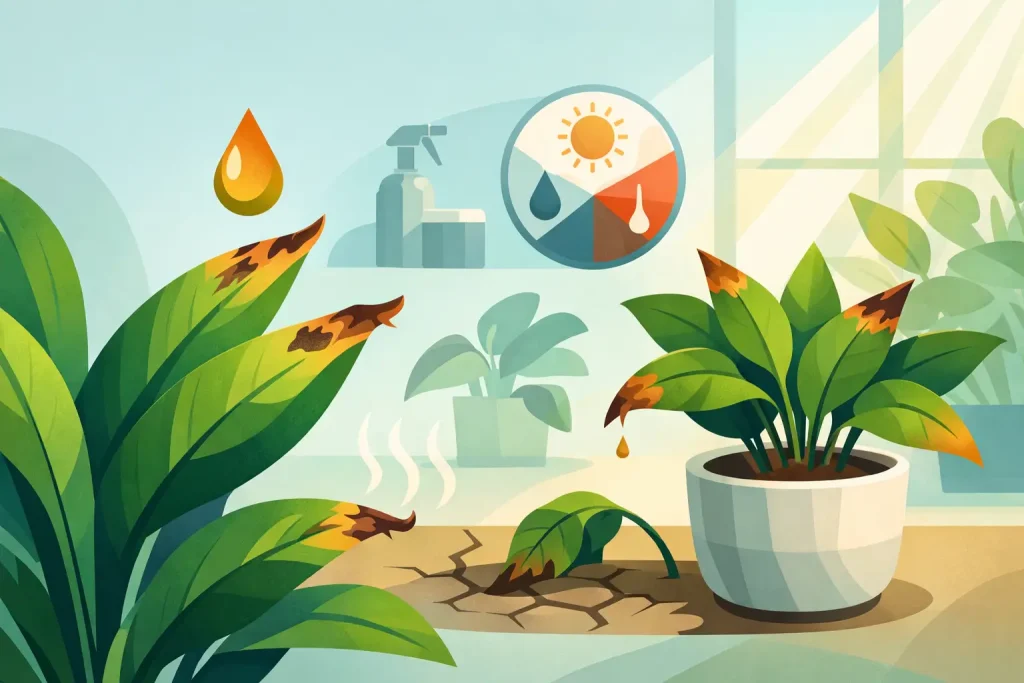
A plant can look strong overall and still start telling you something is off at the margins. If you are asking why are leaf tips burning, the answer is usually not a mystery disease. In most indoor grows, burnt tips point to stress from feed strength, root zone conditions, environment, or a combination of all three.
Tip burn is one of the more common warning signs in hydroponics and controlled environments because plants respond quickly to small mistakes. That speed is useful if you catch it early. The key is reading the pattern properly before you start changing multiple variables at once.
Why are leaf tips burning in hydro and indoor grows?
Leaf tips burn when the plant is taking up more salts than it can process, or when the root zone and environment stop it from moving water and nutrients efficiently. The damaged area usually starts at the very end of the leaf, turns pale or yellow, then progresses to brown and crispy tissue.
That does not always mean you have simply overfed. In a recirculating system, for example, high EC might be the trigger, but pH drift, warm nutrient solution, low dissolved oxygen, or a weak dry-back cycle can all produce similar symptoms. In coco or run-to-waste, accumulated salts in the media can make a moderate feed behave like an aggressive one. Under high-intensity LED fixtures, leaf tips can also burn because transpiration demand has gone up faster than the root zone can keep pace.
This is where growers go wrong. They see burnt tips and immediately slash nutrients, when the real issue might be poor irrigation timing or climate control. The plant then gets stressed twice.
Start with feed strength and EC
If the tips are only just singed and the rest of the plant looks healthy, slightly high EC is the first thing to check. Mild tip burn often shows up when plants are being pushed near the upper end of their feeding range. Some growers accept a very small amount of tip burn in heavy-feeding cultivars because it can indicate they are close to maximum uptake. That can be workable, but only if growth remains vigorous and the damage does not travel further back into the leaf.
If the burn is spreading, leaves are clawing, or the canopy is dark and heavy, you are past that line. In hydro systems, test the reservoir EC rather than relying on what went in originally. In media-based systems, measure runoff EC if your method allows it. A root zone packed with residual salts can keep burning tips even after you have mixed a lighter feed.
The fix is usually modest, not extreme. Reduce EC in sensible steps, check whether the base nutrient already contains enough calcium and magnesium for your water source, and avoid stacking boosters unnecessarily. Additives can look harmless because they are sold separately, but several together can push the total load beyond what the plant wants at that stage.
pH problems can mimic overfeeding
Plants do not read the label on the bottle. They respond to what is available in solution. If pH drifts out of range, nutrient uptake becomes uneven, and leaf tips are often one of the first places where stress appears.
In hydro, an unstable reservoir pH can create a stop-start feeding pattern where some elements remain available and others do not. In coco, poor pH management can lead to lockout symptoms that look like deficiency in one area and toxicity in another. The result is a plant that appears overfed and underfed at the same time.
For most hydroponic systems, keep pH in the appropriate working range for the crop and method, and monitor drift over time rather than looking at a single reading in isolation. A stable pH trend matters more than chasing the number every few hours. If you are constantly correcting, look at water temperature, reservoir hygiene, root health, and nutrient compatibility.
Root zone stress is often the real cause
When roots are unhappy, leaf tips are quick to show it. Warm nutrient solution, poor aeration, overwatered media, compacted substrate, or inconsistent irrigation cycles all reduce the plant’s ability to move water properly. Once that happens, salts concentrate at the leaf edges and tips, and burn becomes more likely.
Deep water culture systems need strong dissolved oxygen and sensible solution temperatures. Flood-and-drain setups need enough air exchange between irrigations. Coco needs a feed schedule that keeps the media buffered and oxygenated without leaving it waterlogged. Soil blends indoors can also cause issues if pots are too large for the root mass and stay wet for too long.
A useful distinction is this: if the reservoir or feed numbers look fine but the plant still has burnt tips, slow growth, and a dull overall appearance, inspect the root zone before altering the nutrient programme again. Healthy roots should be vigorous, fresh-looking, and free of sour smells. Once roots are compromised, tip burn is a symptom, not the main problem.
Light intensity and climate can push tips over the edge
Strong lighting increases photosynthetic demand, but only if everything else keeps up. Raise PPFD without matching irrigation frequency, feed balance, air movement, and humidity, and the plant can start burning at the tips even on a familiar nutrient regime.
This is common after a lighting upgrade. A fixture with more output or better canopy penetration changes transpiration rates quickly. If leaf tips are burning on the upper canopy first, especially alongside slight bleaching or canoeing, look at fixture distance, dimmer settings, and leaf surface temperature. The issue may not be nutrient strength alone.
Dry air makes this worse. When vapour pressure deficit runs too high, plants lose water faster, and mineral concentration in leaf tissue rises. The tips take the hit first. This is why identical feeds can perform differently in winter and summer, or in one room versus another with different extraction and dehumidification. Climate control is not a side issue. It is part of feeding.
Water quality matters more than many growers think
Hard water, soft water, and poorly filtered water all change how a nutrient line behaves. If your starting EC is already elevated due to bicarbonates or dissolved minerals, you may be feeding hotter than your numbers suggest. On the other hand, very soft water can leave plants short of calcium and magnesium unless the nutrient line is designed for it.
Burnt tips caused by water quality are rarely dramatic at first. More often, plants drift into a pattern of minor stress that worsens as the crop progresses. You get slight edge burn, inconsistent uptake, pH instability, and stubborn runoff readings.
If tip burn keeps returning despite careful mixing, test the source water properly and choose nutrients suited to that profile. Reverse osmosis can be useful in some setups, but only if you rebuild the water correctly afterwards. Stripping everything out and guessing with cal-mag is not a precise strategy.
Why are leaf tips burning after a feed change?
When tip burn appears right after changing nutrients or adding a new additive, assume the root zone has reacted to the total formula rather than a single bottle. Switching brands, introducing PK products too early, or combining multiple stimulants can alter EC, osmotic pressure, and pH stability in ways that are not obvious from the feeding chart.
The practical move is to simplify. Go back to a clean base nutrient programme, maintain a stable root zone, and watch new growth. Old burnt tissue will not recover, so judge progress by whether fresh leaves emerge clean and the damage stops advancing.
That point matters. Growers often keep chasing the scarred leaves, adding flushes, corrections, and supplements because the old tips still look bad. They will. What you are looking for is a stable plant with healthy new growth.
A fast troubleshooting approach
Do not change five things in one day. Check EC, pH, water temperature, root condition, irrigation timing, and canopy environment in that order. If one reading is clearly out, correct that first and give the plant time to respond.
In severe cases, especially with obvious salt build-up, a controlled reset makes sense. That may mean lowering EC, refreshing the reservoir, or running enough balanced solution through the media to reduce accumulation. But avoid panic flushing as a default response. In coco and hydro, excessive flushing can create fresh instability and prolong the problem.
If the crop is otherwise healthy and only the tiniest point of the tip is marked, restraint is often the better choice. Slight cosmetic tip burn is very different from active decline. The aim is not perfect leaves at all costs. The aim is stable growth, efficient uptake, and a root zone that stays in control from veg through flower.
For indoor growers, that usually comes down to disciplined monitoring rather than heroic interventions. Measure what is happening, adjust one variable at a time, and let the plant tell you if the correction worked.
Burnt tips are useful because they show up early. Treat them as a signal to tighten the system, not as a reason to start guessing.






